 Revolutions
Navigating this site:



American revolutionary and early Nationalist attitudes about nature, resources, landscape, and settlement.
Dates | Summary | Vocabulary | Background | Reisner | Merchant | Siry | Lesson
"To examine how the world is gradually settled, how the howling swamp is converted into a pleasing meadow, the rough ridge into a fine field; and to hear the cheerful whistling of the rural song, where there was no sound before, save the yell of the savage, the screech of the owl or the hissing of the snake?"
J. Hector St. John de Crévecoeur, 1782
Jefferson | What is an American? | basic criticism | the challenge | conclusion
- 1763, The Treaty of Paris grants N. A. and West Indies to Great Britain
- 1785, The land ordinance of the Continental Congress creates national land
- 1789, Constitution adopted stating states are sovereign over some land
- 1800, Election of Thomas Jefferson and vice president Aaron Burr
- 1803, Louisiana Purchase & Lewis and Clark depart for Oregon
- 1832, The Panic and depression due largely to land sales and poor banking
- 1849, Department of Interior established to administer Mexican lands
- 1865, Homestead Act passed to allow settlement of farmers in the West
- 1880s drought on the Great Plains and prairies.
- 1902, Newlands, Reclamation Act.
The American Revolution institutionalized land allocation and twin ideologies with respect to an agrarian vision that coexisted in extreme tension alongside a commercial agenda for the new nation.
land system and the public domain | commerce | agriculture | financial collapse
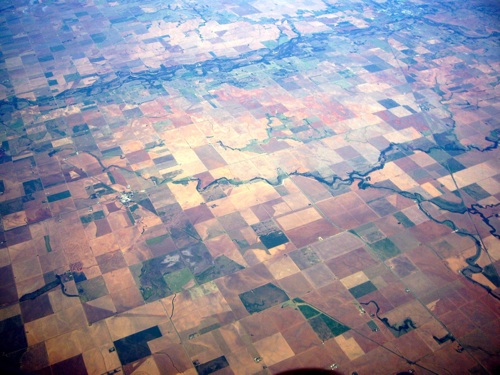
The consequences on the face of the landscape of the township and range survey system of land use in the United States.
Terms to define and post examples of from the readings to the class wiki:
- the frontier
- laissez faire
- agrarianism
- Physiocrat
- manumission
- tariff
- sanctity of contracts
- township and range system
- property tax
- commons
- public domain
- sovereign lands
- commerce clause
- public lands
- private property
- land grants


National ideology is not one thing, but a tension formed from two competitive concepts:
- Federalists and Hamiltonians championed commercial supremacy
- Nationalists, Democrats, Agrarians and Jeffersonian liberalism
The US land system predates the Constitution of 1789
- Articles of Confederation
- big state small state compromise and land claims, "The Great Compromise"
- western land claims
- public domain
- poor roads and dangerous rivers
Dates | Summary | Vocabulary | Background | Reisner | Merchant | Siry | Lesson
Background
Internal Improvements
- canals
- railways
- harbors and rivers
- turnpikes and post roads
Slavery
- Mason-Dixon line
- Seaboard slave states
- western expansion and the Compromise of 1820
- Compromise of 1850 and the seeds of disunion and civil war
Mission and manifest destiny
- Arid Regions
- Gold and silver of the mining frontier
- the Great American desert, great plains and great basin
- salt, fisheries and agriculture
- wheat belt (glaciated soils) and the corn belt (laterite soils)
- forestry
Dates | Summary | Vocabulary | Background | Reisner | Merchant | Siry | Lesson
The Early Republic
Population increase and expansion of agriculture upriver to the frontiers
Eastern seaboard cities were shipbuilding and overseas, or coastal trading centers
An uneasy social truce persisted among slaves, frontier settlers, artisans, merchants, or speculators and the few very large landholders.
What is an American? J. Hector St. John de Crévecoeur
"The rich and the poor are not so far removed from each other as they are in Europe."
"...this new man? He is either European or a descendant of an European, hence that strange mixture of blood, which you will find in no other country."
pp. 131-132.
On the frontier
"There men appear to me no better than carnivorous animals of a superior rank , living on the flesh of wild animals when they can catch them,and when they are not able, they subsist on grain. He who would wish to see America in its proper light, and have a true idea of its feeble beginnings and barbarous rudiments, must visit our extended line of frontiers where the last settlers dwell, and where he may see the first labors of settlement, the mode of clearing the earth, ... which often fails when not sanctified by the efficacy of a few moral rules."
p. 133.
Thomas Jefferson,
agrarian virtues of the small farmer
"those who labor in the earth are the chosen people of God, if ever he had a chosen people"
"keeps alive that sacred fire, which otherwise might escape from the face of the earth."
"While we have land to to labor then, let us never wish to see our citizens occupied at work bench,....Carpenters, masons, and smiths, are wanting in husbandry."
Jefferson was influenced by the physiocrats a group in France who had formulated a Physiocrat ideology in prerevolutionary, 18th century France in which it was argued that land was the basis of all wealth.
p. 134.
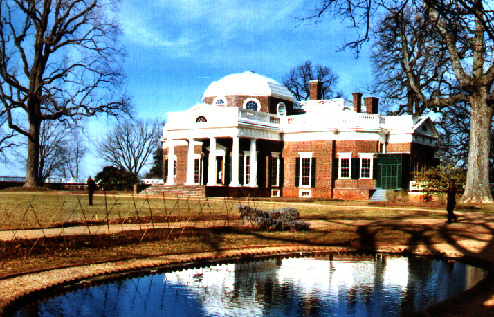
Monticello was Jefferson's designed home on a slave holding estate in Virginia.
People who shaped early national attitudes about ideas and social behavior.
Benjamin Rush, Americas first scientist and physician was appalled by fevers that were seasonally rampant in coastal cities.
Samuel Slater and a cotton spinning (textile) venture
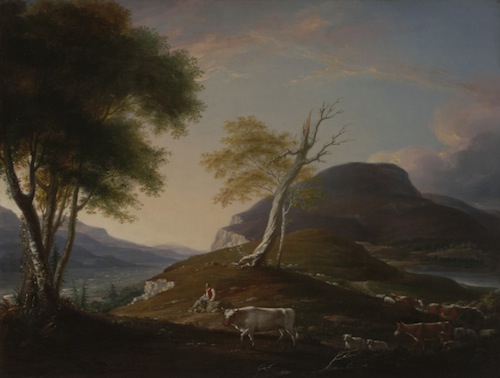
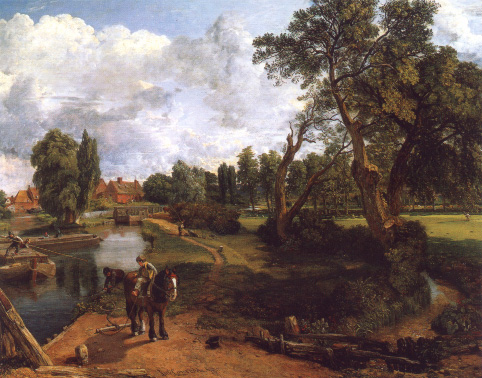
"View on the West Mountain Near Hartford," oil on canvas, c. 1791, by the American artist John Trumbull.
Benjamin Latrobe and river pollution
John James Audubon and squatters in the Mississippi Valley
sectionalism
Coastal exporting economy of the tidewater (Seaboard states) was competitive with
The "advancing" Frontier or the distant "Interior," upland or inland areas where subsistence farm-economy dominated land use.
Model of exploitation
Land-use patterns of the small farm, used what was at hand.
Worldviews (perceptions and ideology)
market farming and commercial revolution
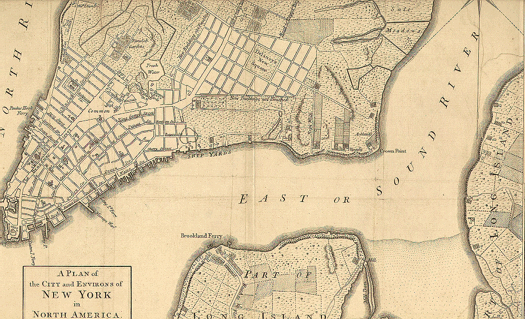
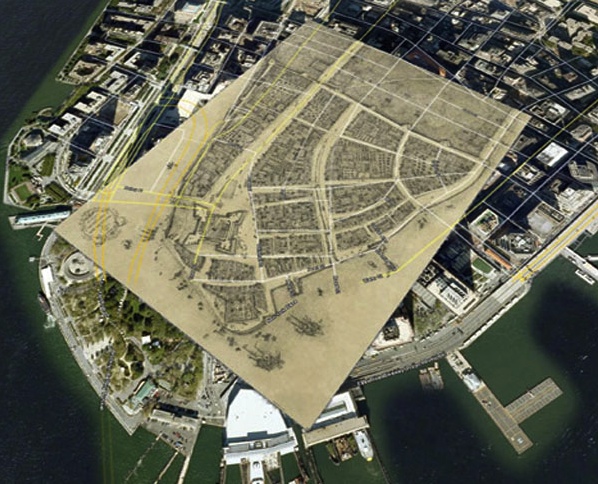
Observers report that New York City by 1830 was so crowded and confined to Manhattan Island south of Greenwich Village, that filth and disease generated a desire for preservation of nature as an escape from crowded conditions.
New York under British occupation in 1776 [left] and an old 18th century map superimposed over lower Manhattan [right] today.
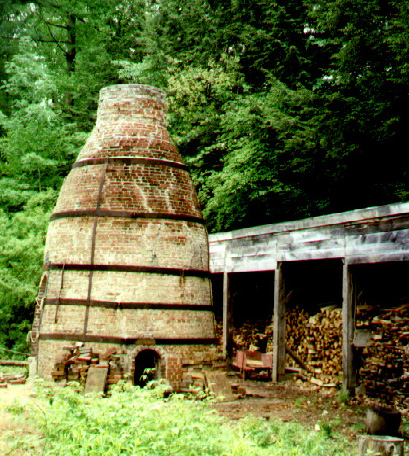
Origins of Industrialism based on wood and water.
This lime kiln in the Cumberland Gap of the central Appalachian mountains is a reminder that mechanization and industry had its origins in the countryside where resources such as limestone and wood were readily accessible for exploitation by foundries.
Dates | Summary | Vocabulary | Background | Reisner | Merchant | Siry | Lesson
Transforming the land for settlement.
Consequences: An initial consequence of the early national attitude to exploit the land for resources and use the water, minerals, forests and animals for commercial gain led to the belief that dams on rivers of eventually any scale were just extensions of the early small scale mill dams and were something like a sign of progress.
Dams: "In this century, something like a quarter of a million have been built in the United States alone."
Reisner, p. 105.
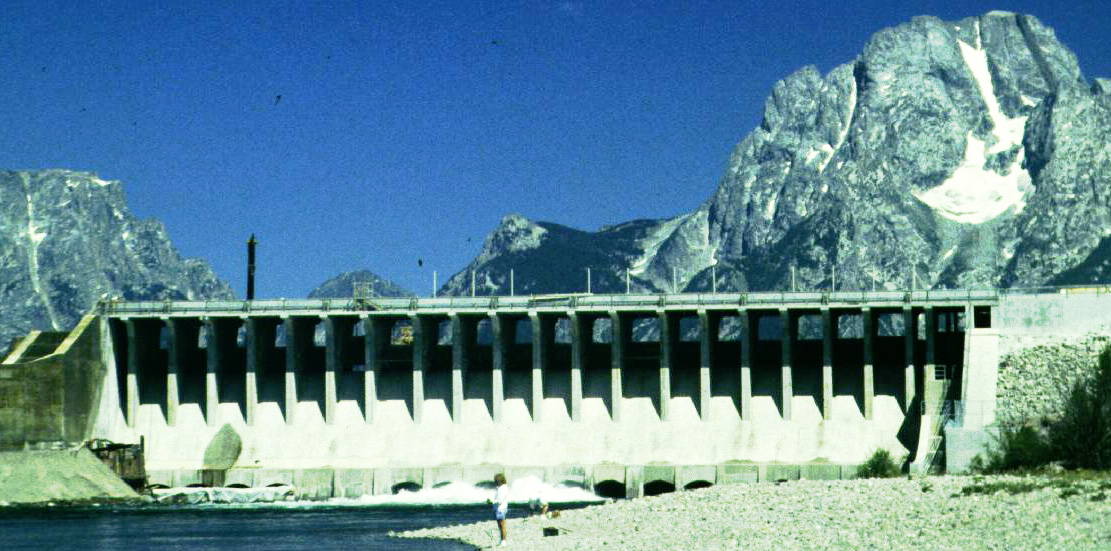
Teton, Snake River dam, Wyoming.
Dams are huge, residing in 1000s of places and soaring some sixty stories high, they are our symbols of naked wealth and compulsive public deception.
they silt up -- fill with sand
they cost more than can be defended rationally
The psychological imperative that drove us to build dam after dam
sunk in the 1880s a period of unsurpassed blizzard, drought and floods.
"Ice encrusted on their staring vacant eyes."
The 1886 blizzard took innumerable human lives an 35-75 percent of the cattle's herds on the plains.
by 1888 the drought was so severe that half the homesteaders on the plains left, bankrupt, because their free land grants had been second mortgaged to the banks.
"The atmosphere it seemed had been permanently sucked dry."
"Rain follow the plow was a preposterous fraud (perpetrated by railroads, banks and land companies,)
homestead act was a "catastrophic failure" in the west
1889 was the driest of the drought years but wet in the east.
May 31, 1889 was the Johnstown, Pennsylvania flood drowning 2,200 residents
insufficient wind mills in "a region with no wood."
The west was the graveyard of the western privately financed irrigation movement.
p. 108
"cruel irony in the collapse of irrigation companies" Kansas was hardest hit,
Agricultural populations were at a standstill by 1898.
Farm aid and "township" allotments called "irrigation districts."
The Wright Act "Another in a long series of doomed efforts to apply eastern solutions to western topography and climate."
"a legacy of waste and disaster"
p. 109
Regionalism: western hypocrisy and blindness to the need for a national policy to protect property rights and common access.
John Wesley Powell and Theodore Roosevelt
1894 Carey Act was misguided only 288,553 acres were transferred to states
"and land, at the time, was the only thing of value most of them (the states) had."
p. 110
Reisner makes a Fundamental criticism of narrowly construing commercial values:
For the first time in their history, Americans had come up against a problem they could not begin to master with traditional American solutions – private capital, individual initiative, and and hard work – and yet the region confronting the problem happened to believe most fervently in such solutions."
To believe such a thing (that private capital could irrigate and reclaim the west for farms) was to imply that their constituents did not measure up to the myth that enshrouded them – that of the indomitable individualist."
p. 110-111
The passage of the Reclamation Act in 1902.
the act was in many ways inevitable.
p. 111
Francis Griffith Newlands may have been the only elected official to fathom the problem of water in the west, in a position of power and influence.
Newlands waited as other proponent's plans failed until 9-14-1901.
"nationalize the the works of irrigation."
President Roosevelt's brilliant ploy to move the Warren bill as the Newlands' Act.
What is needed in politics is "a less than athletic mind" Frank Mondell was it, he altered the Warren bill with the Newlands' language while Warren was at home tending to his sick wife.
p.113
"On June 17, 1902 the Reclamation Act became law."
The new Reclamation Service attracted the best and the brightest minds to a new vision o of the west.
The problems besetting the agency were politics and money.
the hard realities of irrigated agriculture often left saline swamps and mineralized soils in the wake of poorly designed projects.
local constituents and chambers of commerce, once the bill was passed harangued the Service to select their sites for dubious reclamation projects.
"Projects were frequently undertaken with only a sketchy understanding of the areas climate, growing season, soil productivity, and market conditions."
pp. 114-115.
Congress made things worse by ignoring John Wesley Powell's concepts based on "land realism".
Powell's Arid Regions Report proposed 2,560 acres not 640 acres as allotments
Few settlers had any experience with irrigated farming.
p. 115
The first reform was 1910 with a 20 million loan to the bankrupt Reclamation fund.
p. 116
1914 the repayment period was extended form one to two decades
1922 sixty percent of the irrigators had defaulted on their loans to the Bureau
1924 an inspection team recommended loans be extender to 40 years at a very time when agricultural surpluses pushed the country toward the worst economic depression in the 20th century.
p. 116
the value of reclamation land crops fell in 1922 to $83.6 million from a high of $152 million in 1919.
despite reforms "a number of projects continued to operate at a hopeless loss."
p. 117
1923 Bureau of Reclamation, renamed
"viewed public works as ends in themselves."
"transforming the desert into a garden"
p.118
"setting water prices according to the farmer's ability to pay."
"the natural landscape of the American West, the rivers and deserts and wetlands and canyons , was to undergo a man-made transformation the likes of which no desert civilization has ever seen.
p. 119
Jefferson | Crévecoeur | What is an American? | basic criticism | the challenge | conclusion
Dates | Summary | Vocabulary | Background | Reisner | Merchant | Siry | Lesson
Take-Away Concepts
The triumph of the national agrarian vision after the Civil War slammed into the arid reality of the far western regions and sunk under the weight of idealism.
The federal promotion of commerce and industry and the wholesale transfer of land from treasury office to settlers, or speculators ended in bank foreclosures and the necessity of the federal government to initiate a national program to save the frontier, its businesses and residents.
Reisner | Siry | ecological core is | model of wealth & worldviews | ecosystems are? | landscapes change
Links