
Access to site
wilderness

"The tendency to define the issue in ethical rather than economic terms."
"Fear underlay the upswell in what used to be called 'conservation,' but was increasingly known as 'Environmentalism.' It was not the old fear of running out of resources and losing the competitive edge in international politics that had alarmed the generation of Theodore Roosevelt and Gifford Pinchot."
Brower | Zahniser & Douglas | Faulkner | Alaska | Mckibben | Stegner
Cosmetic Conservation
Mountains, forests, and wild areas were protected originally in the public domain starting from the 1880s as watershed protection; that is as sources of water for irrigation, municipalities, and wildlife.
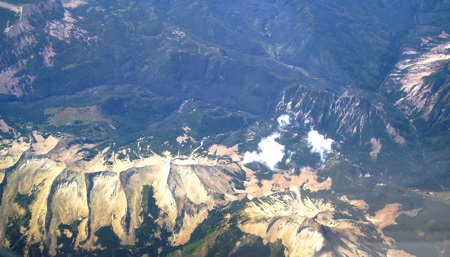
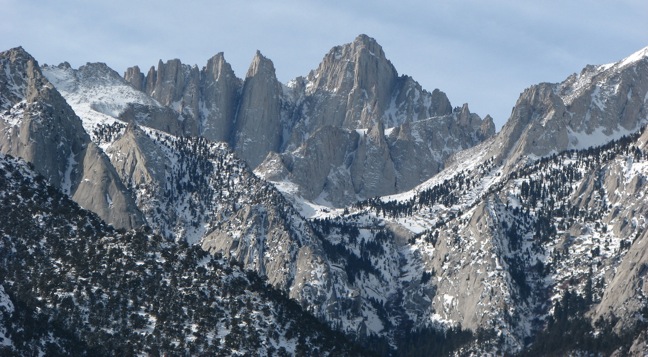
Wild areas with snow levels above the tree lines in the Rocky Mountains.
"The new driving impulse based on ecological awareness, transcended concern for the quality of life to the fear for life itself."
"Americans suddenly realized that man is vulnerable. More precisely they began to see man as part of a larger community of life, dependent for his survival on the survival of the ecosystem and on the health of the of the total environment."
Nash, p. 254.
"We need wilderness, Howard Zahniser reflected, to get away from the technology that gives us the illusion of mastering rather than belonging to the environment. In wilderness, he pointed out "we sense ourselves to be dependent members of an interdependent community of living creatures that together derive their existence from the sun."
"This idea of a continuous and interrelated web of living things and natural processes, and of man's dependency on it, characterized the new environmentalism."
"The wild world, according to David Brower, fills man's need for an environment 'where he can be reminded that civilization is only a thin veneer over the deep evolutionary flow of things that built him."
"The ecological point of view seemed to be instructive with contemporary wilderness defenders, William O. Douglas wrote that his contact with wild places helped him see all living things 'as links in a chain of which [man] too is part'."
Nash, p. 254.
"For William Faulkner the underlying rapacity of the civilizing process in the Deep South undermined confidence in the value of American culture. The lush bottomlands had degenerated in Faulkner's view, into 'the untreed land warped and wrung to mathematical squares of cotton for the frantic old-world people to turn into shells to shoot one another.' This spectacle compelled him to believe that the conquest of the wilderness had been unjustified. "
Nash, p. 250.
Ike McCaslin's hunting behavior.
"The point was that American civilization, in Faulkner's estimation, had shamed the death of the American wilderness."
"Americans had not proved worthy of their opportunity. They had turned predatory feeding on their fellows, and giving Faulkner the grim satisfaction that 'the people who have destroyed [the wilderness] will accomplish its revenge.' This according to Faulkner, was the final tragedy in the interaction of wilderness and civilization in America."
Nash, p. 250.
"...civilization in excess proved a liability."
Nash, p. 251.
Wilderness and the American Mind. Hartford: Yale University Press, 1982. 3rd edition, pages.
How Cities devour many inhabitants upon which it depends.

Merchant | Worster | Cronin | Reisner | Jackson | Siry | Leopold | |Diamond | Williams | Austin | Mumford | Marx

preservation contrasted with conservation
Wilderness | Carson | Stegner | Williams | McKibben | Margulis | Future of Life | Index

Readings