Reflection
 "the setting"

Navigating the site:
.gif)
Geography


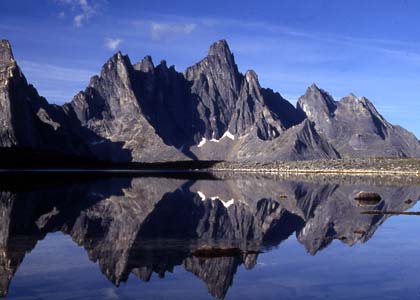 |
Geography is literally a study of the representations of the Earth's features. From ancient studies of the airs, waters, contours (topography) and facets of the surface of places developed a sophisticated analysis of the terrain, climate, soils, landmarks, physical composition, chemistry, geology and hydrology of regions to comprehend human settlement patterns, resources, land-use, vegetation, wildlife, fisheries, and health. |
|
| The Grand Teton's, a mountain range behind Jenny Lake, Wyoming. | ||

"Yet America is a poem in our eyes; its ample geography dazzles the imagination, and it will not wait . . . "
Emerson, Ralph Waldo
“The Poet,” (1844)
How does "geography" influence any nation's development?
Luna B. Leopold | Vermeer | Aldo Leopold index | Emerson | Olmsted | Mumford | landscape art
The phrase "geography is destiny," is more a polemical if not a bare political statement than an adequate academic reflection of how landforms and water systems affect the course of human settlement. There are many forms of determinism -- or the belief that people and events are driven by external forces. Geographical determinism is related to environmentalism and both can be traced at least to the historian Herodotus, in ancient Greece, who traveled to Asia and Africa noting how people differed due to climate, soil, exposure, and water qualities of their native regions. Historical geographer Clarence Glacken has deeply analyzed development of environmentalist thought and the the tendency from then until Darwin's time showing that many great thinkers have attributed the success of failure of ethnic minorities, their nationalities and entire states, or even whole empires to the pressure of the environment on human institutions.
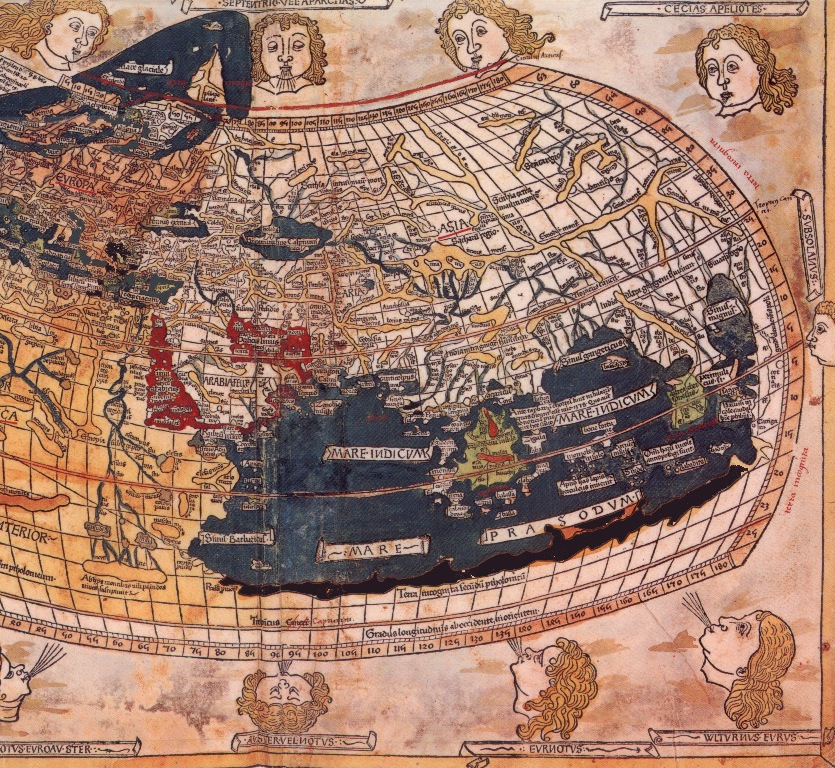
The map shown above is a copy of Claudius Ptolemy's 150 AD map of the then known world depicting the airs, waters and places by degrees.
The very famous statement of geographical determinism, elicited its finest expression in the writings of D. H. Lawrence, who insisted among the northern peoples there was a sort of "ice wisdom." This knowledge from the ice age was the very sort of blood knowledge that tropical people's do not possess because they did not experience the ten or more glaciating advances during the last million years that tested the metal of European, Asiatic and North American peoples.
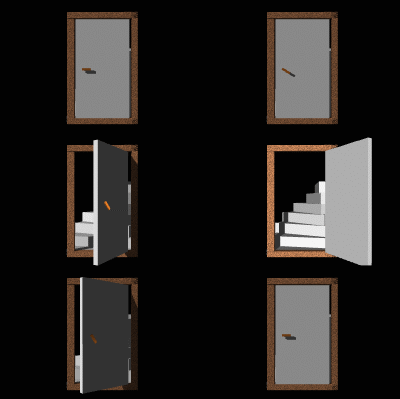 The idea that knowledge –that unlocked or open doorway – is passed in the blood from generation to generation was refuted by Darwin, and later Mendel, and then again by contemporary genetics. Yet the belief that we are shaped by environmental circumstances remained alive in the medical professions. The bias today is that human nature is shaped by our inheritance. That inheritance is largely the product of environmental change and biological adaptations to that change, or at least that is the way a popular construction of environmental determinism explains our fate. We live at the mercy of an angry god who created the landscape as a test of our skills. Shaped by the land we perish under the weight of its natural laws. Malaria or literally "bad air" (mal + aria) was attributed to hot, humid and virtually unhealthy vapors emitted from swamps and low lying areas. Some places can be bad, after all, Kentucke, in the Shawnee language meant "a dark and bloody ground."
Nothing is more persistent in its perniciousness than a pervasive idea that refuses to submit to rational explanation. Environmental determinism is just one form of geographical prison that we confront. People are inferior to other people because of their geographical situation, living conditions and exposure to nature, is the most pernicious manifestation of this belief. In 19th century London, during repeated Cholera epidemics, the ruling classes and the educated elites all blamed the poor for the disease due to their slovenly habits. The spread of the disease in the hot summer months was said to be due to geography of squalid, tenement living conditions.
But was environment the immediate cause of their behavior and the underlying cause of their death from this horrible disease? Before railroads, which needed to adhere to geographical contours such as following water sources and river valleys through mountain passes, the food people consumed was based on geography so the idea that health and disease, food and malnutrition, and success or failure where entwined with geography was common place. Even when Adam Smith extolled the virtues of the markets, the size and location of markets --studied by economic geographers-- became a matter of placement along a river, or other artery of travel. Commerce seemed to funnel through high mountain passes, water bodies, or stall, for a while, at the falls in a river system.
 Geography or the tug of space on its inhabitants seemed to explain why Greece dominated the early Mediterranean, how China dominated Asia, why Spain ruled the Atlantic and the Mediterranean, or why Britain was inhabited the world's shopkeepers." Geography determined one's sphere of authority and territorial hegemony. Or did it? Environmental history has to marry geography to ecology and it must discard the habit of determinism, since geographical, genetic,economic or environmental determinism are all traps to ensnare the mind from thinking more deeply about where we are.
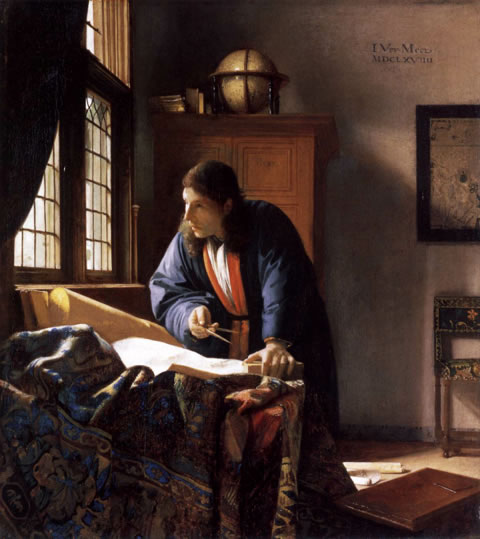
The Canadian / Australian writer, Janette Turner Hospital has suggested the necessity of a frame that is at once a wall within which we live and an aperture from which we may view the outside world. In the Johannis or Jan Vermeer painting of the "Geographer" the artist literally sheds light on this particular practitioner who, with compass in hand and resting in the light on a manuscript of maps, contemplates. He pauses to reflect on what he has just learned, caught in the light – if not enlightened, then pausing to recollect and reconnect what he has known to what he is discovering in the act of consulting the manuscript we call an Atlas. The context of the painting in light through a window. The frame for Vermeer is the part of the room exposed to the twin windows, where the scholar is standing below the globe, looking at graphical representations of the world. Clearly the world that is being mapped or made into a globe is outside, but it is also inside the room for Vermeer to paint, for the geographer to ponder, and for us to see, if not admire.
Who decides what is margin and what is text? Who decides where the borders of the homeland run? Absences and silences are potent. It is the eloquent margins which frame the official history of the land. As for geography, there are divisions and boundary lines that fissure any state more deeply than the moat it digs around the nationhood. In every country there are gaping holes. People fall through them and disappear. Yet on every side there are also doors to a wider place, a covert geography under sleep where all the waters meet.
She provokes us with this covert geography and that is the territory for the ecological historian to traverse, describe and perhaps discover unseen pitfalls ? An ecological approach to history assumes nothing more than contingency and complementarity. That is events are not determined, they instead rely on what have preceded the initial conditions of our investigation. In nearly every case, because of feedback, there are complementary forces that act on climate, settlement, population growth or decline, soil, food, water availability such that too many factors always affect outcomes. That means the unintended consequences must be paid attention to, as opposed to human intentions. Columbus went west, not east, to India, only to open the world to two unexpected landmasses larger than even Australia and Antarctica the four continents that were unknown to even Chinese, Indian and European map makers. This painting reveals just one example of frame, context, and a body of knowledge as complementary factors in the forces that change our view of the world. In the seventeenth century the world was profoundly redefined, and Vermeer captures that moment in his painting as if all of history could be portrayed as a portrait of a person struck by the investigative light of a revelation about the great cosmos in which we are either lost or found.
JVS, August 10, 2007, & July 7, 2014.
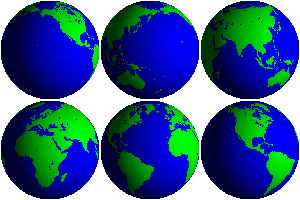 Geography to know:
- Susquehanna river valley and mouth from the Hudson river valley:
- Mississippi Valley watershed and five tributaries:
- Five boroughs of New York City: Queens, Kings, Richmond, Bronx, & Manhattan.
- Distinguish the Cascades from the Sierra Nevada, Sangre de Cristo, Rocky, Uinta Mountains, Wind River Ranges, and the Great Salt Lake.
- The North Slope of Alaska, Prudhoe Bay and Bristol Bay.
- The locations of Yosemite, Yellowstone, Acadia, Glacier, Teton, and Big Bend National Parks.
- Mountain tops: Mount Whitney, Mount Saint Helens, Mounts Marcy, Denali, and Mauna Loa.
- Puerto Rico, The Isthmus of Panama, Hawaii, and Leyte Gulf.
- Erie Canal and Lake Champlain.
- The five Great lakes: Huron, Superior, Ontario, Michigan, & Erie:
- The great plains, the llano estacado, and the Rio Grande.
- Vancouver Island, Banff - Lake Louise, and the Yukon.
- Newfoundland, Nova Scotia, and the Bay of Fundy.
- Iwo Jima, Palau, Hiroshima, and Nagasaki.
- The Adirondack, the Berkshires and Catskill Mountains.
Fifty (50) answers or 2, two points per answer.
Geographical Dictionary
Truisms
"Geography is the science of our world . . . the key to our future."
"I like geography. I like to know where places are."
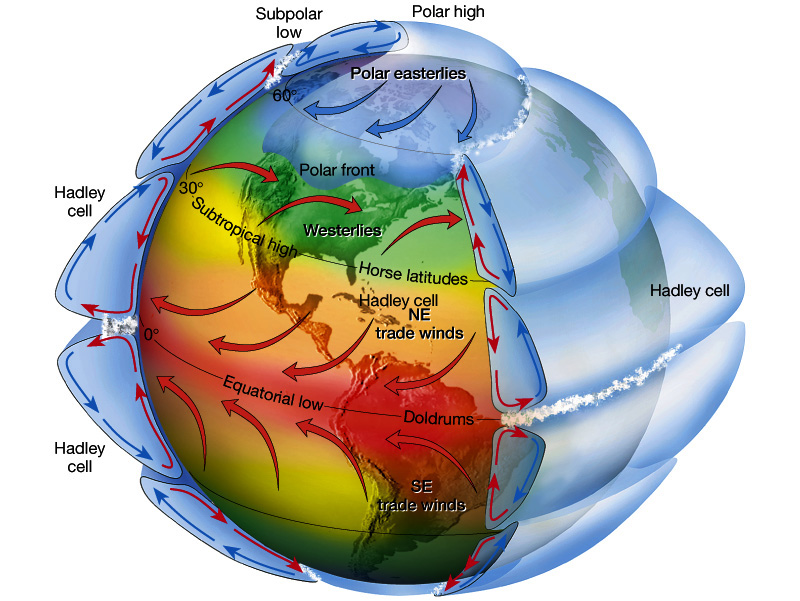
Geography is destiny. Except when it isn't.
"In America, the geography is sublime, but the men are not: the inventions are excellent, but the inventors one is sometimes ashamed of."
Ralph Waldo Emerson,
“Considerations by the Way: The Conduct of Life,” 1860
Category: United States. philosopher: transcendentalist, essayist & lecturer.
Geography and reckoning time by calendars.
History and geography, in Rousseau’s view (1762):
". . . most of the problems of education are problems of motivation, as teachers try. . . ."
quoted in The Rise and Fall of Childhood, by C. John Sommerville
Categories: schoolteachers and teaching; teaching/learning
Europe is “the western excrescence of the continent of Asia.”
Europe Between the Oceans, Sir Barry Cunliffe, emeritus professor of European archaeology at Oxford University.
Le long duree, or
the long-term means geological time or millions of years. Over such a time span no one can promote their self-interest, because it would take a genetic investment in the future.
And selecting for traits to last over the long-term in the genetic sense often selects against short-term gains.
Irrational preoccupation with soil, blood, property and one's identity is inherently human; perhaps a waste of the unused portions of the prefrontal cortex, but a human characteristic all the same.
Knowledge is always enveloped by uncertainty, restricted by experience, access, and curiosity–but surely knowing is intrinsically circumscribed by physical, chemical, geological and biological conditions such that knowledge is the exception to the more general rule of ignorance.
Here is an example a remark that sounds accurate, but due to an ill-advised choice of words is not:
"Nature, I have constantly argued in my work, is the real superpower of this godless universe. It is the ultimate disposer of human fate, randomly recarving geography over 10,000-year epochs."
The good concept here is that geography as nature's 'medium of expression' over "10,000-year epochs" is the dispatcher, driver, and disposer of human intentions. The key failing in this otherwise provocative quotation is the choice of the phrase, "randomly recarving geography" there is nothing random about geology, except in the mind of the author. Plate Tectonics and sedimentation, erosion and deposition are processes we can comprehend as both contingent and cumulative, but they are not random in the strict sense of the term.
Read more at Tom Felton: Brainy Quotes
Luna B. Leopold | Aldo Leopold index | Emerson | Olmsted | Mumford | landscape art