
Germs, Seeds and Animals:
Studies in Ecological History 1
Contents | Meaning | Introduction | Natives | Tainos | Columbus | Europe's Ecology | Debate | Argument | Columbian Exchange | Terms | Sources
"Celebrants of paradox who emphasized the importance of instability and the immense power of the humble, even the invisible" in the Americas
"The Old World peoples had some distinct advantages in the biological competition that followed. Although their crop plants were not superior to those of the Amerindians per se – wheat, rice, and yams were 'better' than maize, potatoes and cassava in some ways and inferior in others – the Old World advantage in domesticated animals was great."
Crosby, p. 10.
"These, for the sake of convenience, we will call the Lands of the Demographic Takeover."
Crosby, p. 29.
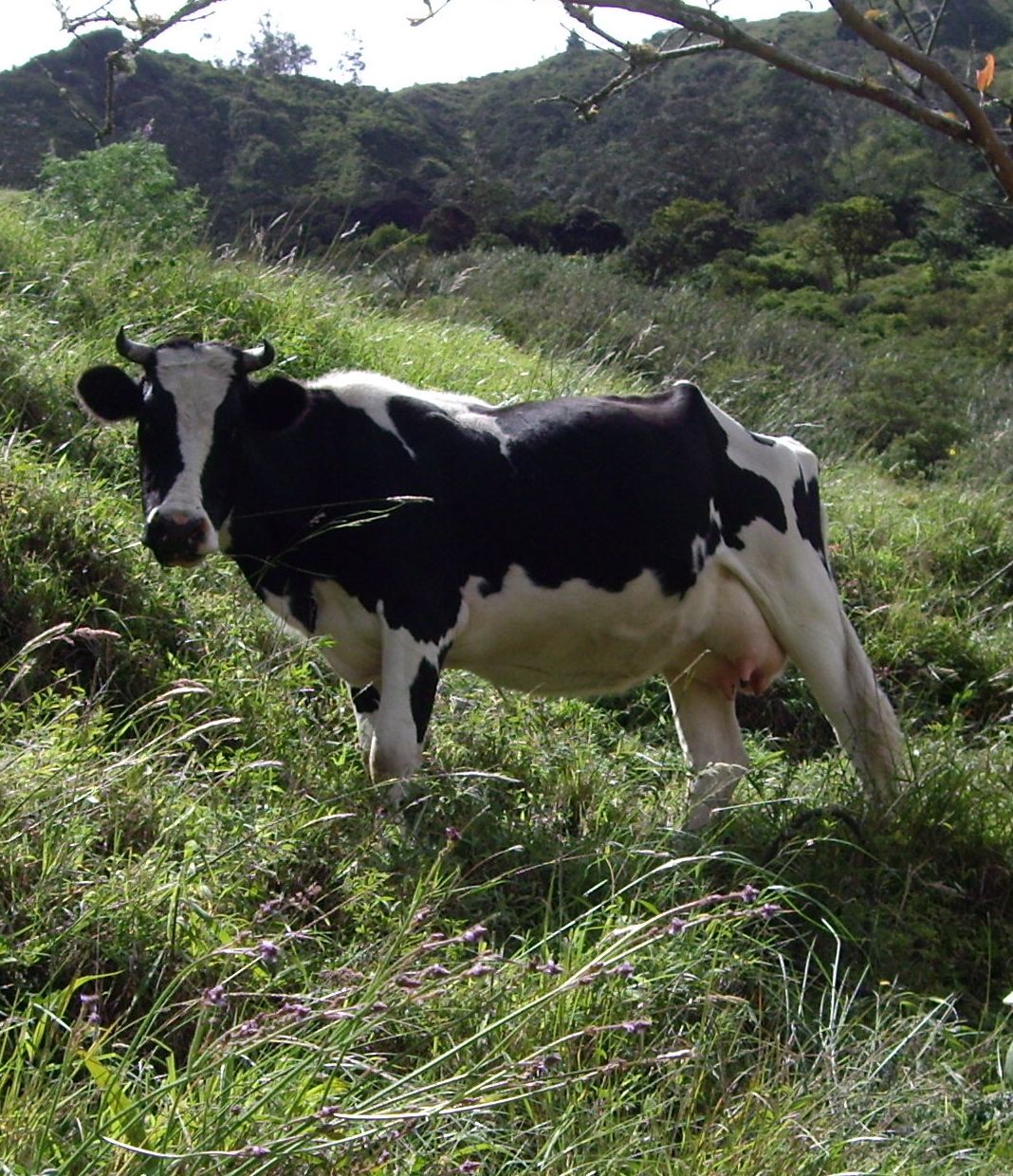
A European derived cow in the Amazon basin, 2008.
"Was there . . . a connection between the post-Columbian Exchange and the upsurge in global population in the last few centuries?"
p. xiii.
"We humans are, above all else, organisms."
p. xiv.
Ecological Metamorphosis
Crosby argues that a "biological metamorphosis of the Americas" occurred with the arrival of the Spanish and Portuguese; what does he mean?

"Archaeology thrust the beginnings of American history back at least fifteen thousand years and populated these millennia and both American continents with myriads of clever and mysterious people."
p. 7.
"The five hundredth anniversary of the Columbian discovery of America has come, and with it an obligation to assess . . . the significance of that voyage and the establishment of permanent links between the Old and New world."
p. 3.
The Bardic versus the Analytic schools
p. 8.
Contents | Meaning | Introduction | Natives | Tainos | Columbus | Europe's Ecology | Debate | Argument | Columbian Exchange | Terms | Sources
 Contents
The biology of imperialism, pp. vii-44.
The Bardic Interpretation
The Analytic Interpretation
The Heirs of ColumbusIntellectual Effects
The Economic Effects
Nutritional Effects
Demographic Effects
Assessing the Columbian ExchangeEcological Imperialism: The overseas Migration of Western Europeans as a Biological Phenomenon, p. 28 - 41
The Demographic Takeover
Explaining the Takeover
Human Beings
Animals and plants
PathogensThe Biological Metamorphosis of the Americas, pp. 45-61.
The British Empire: Cultural adaptations, pp. 62-81.
The Demographic Effect of American Crops in Europe pp. 148-166.
Ethnic character and identity, pp. 82-108.
National Character & fictions, pp. 167-179.
Contents | Meaning | Introduction | Natives | Tainos | Columbus | Europe's Ecology | Debate | Argument | Columbian Exchange | Terms | Sources
Text
"None of the major groupings of humankind is as oddly distributed about the world as the European, especially Western European Whites."
p. 29.
"In Madeira, white settlers, often led by down-at-the-heels Iberian nobility seeking land and wealth to match their titles, discovered how to make a lot of money raising sugar; in the Canaries they learned how swiftly a fierce aboriginal people, the Guanches, could disappear and how easily they could be replaced with imported labor to raise tropical crops for the European market."
p. 7.
Commentary
". . . cannot be described or analyzed to the full extent of their significance within any unit smaller than the world."
p. 8.
"The decisive advantage of the human invaders of America was not their plants or animals – and certainly not their muskets and rifles, . . . – but their diseases."
p. 11.
"Wherever the European has trod . . .death seems to pursue the aboriginal . . . " Charles Darwin 1836.
p. 12.
"Second, we must explain the stunning, even awesome success of European agriculture, that is the European way of manipulating the environment in the Lands of the Demographic Takeover. . . . its easy, almost fluid advance in North America."
Crosby, p. 31.
Crosby
"The Tainos and Spaniards who met in the Greater Antilles were products of physical and, more significantly, cultural evolutions that had been diverging for a very long time. The Tainos reached out to touch the Spaniards to 'ascertain if they were flesh and bones like themselves.' For the Spaniards, the Tainos were the most exotic people they had ever met, with 'their hair not tightly curled like the Africans' but straight and coarse like horse hair' Columbus wrote."
"They did have a few trinkets of gold."
p. 52-53.
"History makes it clear that it was the Europeans who had the edge."
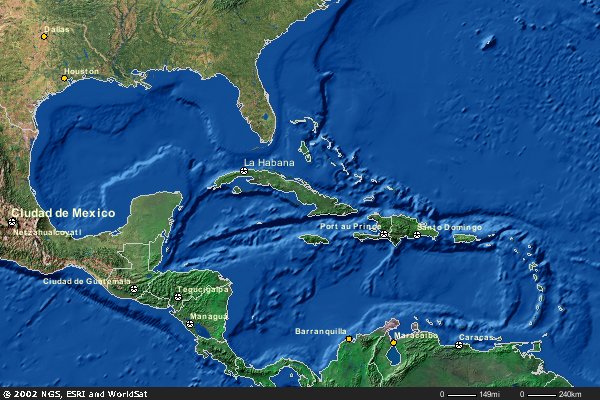
Greater Antilles, were the necessary base from which Spanish could "successfully invade the Americas from Europe."
p. 51.
Columbus returned to Española and the Antilles in 1493.
- 17 ships
- 1200 men
- stones, cuttings, wheat, grapes, melons, chick-peas, onions, sugar cane, fruit trees.
- horses, pigs, cattle, dogs chickens, sheep, goats, vermin
p. 51.
"European crops did not thrive in the tropical Antilles.
...but their livestock did well."
especially "horses, cattle and swine."
"The masters of America's first haciendas did not begin with bulls too weak to mount cows that were too frail to carry calves to full term, but with healthy beasts selected from the avant-garde herds of the Antilles."
...the smallpox virus, also incubated in the Antilles."
It arrived not long before or after Christmas, 1518."
"Bartolomé de as Casas recorded that smallpox left no more than one thousand alive on Española 'of that immensity of people that was on this island and which we have seen'."
52.
"Within thirty years of Columbus's landfall in the West Indies those islands contained all that the conquistadors needed for the successful invasion of the mainland.
"their successes were as much due to their biological allies as to their abilities ....teams that included more than humans."
"invaders: pigs, cattle horses, and pathogens."
53.
swine, "In the Antilles they rooted the Tainos' manioc tubers and sweet potatoes out of the ground, stole their guavas and pineapples, gobbled lizards, baby birds--everything went down their maws."
53-54.
Much of the meat in the first European colonists's diet. . . was American green turtle, or venison, or other game, but after that it was usually pork--free to the hunter."
"The cows were soon dropping calves two and three times per year . . . When the Europeans set them loose in the grasslands of northern Mexico, the cattle propagated into scores upon scores of millions."
54.
"The impact of the animals the Europeans brought with them to the Americas transformed whole ecosystems."
p. 55.
"The world's leading infections were the by-products of the rise of agricultural and pastoral peoples."
Native agriculture sustained extremely dense populations.
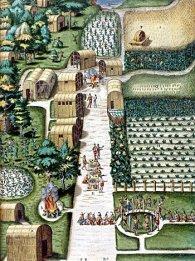
- vegetarians: corn, beans, squash, cassava (manioc), chiles, tomatoes.
- water diverting
- classic symbionts: legumes and nitrogen
- manioc is a very time consuming crop that requires water to leach the material of its tannins.
- manioc consumption was a staple crop in the tropical lowland areas.
- maize or corn needs to be ground by hand to make tortillas or flat bread that was a staple of upland peoples.
- matrilineal extended families the mother is the one through whom inheritance and the line of descent is traced.
- property is held by the sisters of the extended family.
- cousins were considered brothers and sisters.
European agriculture was labor intensive
- humans - extended family life focused on harvest and planting
- animals - oxen and plow, horses, donkeys and burrows eased the heavy burden from human labor
- periodic famines - at least, once per generation left genetic effects on both boy and girl children (epigenetic impacts)
- patrilineal families, the father is the one through whom inheritance and the line of descent is traced.
Transplanting Europe's Ecology into the Americas.
"The human invaders and their descendants have consulted their egos, rather than ecologists, for explanations of their triumphs. But the human victims , the Aborigines of the lands of the Demographic Takeover, knew better, knew they were only one of many categories being displaced and replaced; they knew they were victims of something more irresistible and awesome than the spread of capitalism or Christianity."
"...so our people, also will be gradually supplanted and exterminated by the Europeans."
Maori person, quoted in Crosby, p. 41.
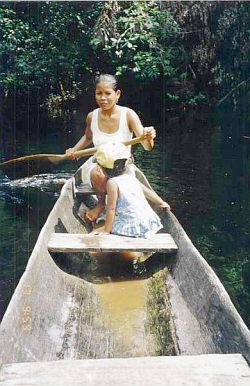
Arawak woman in a dug-out canoe, Guyana.
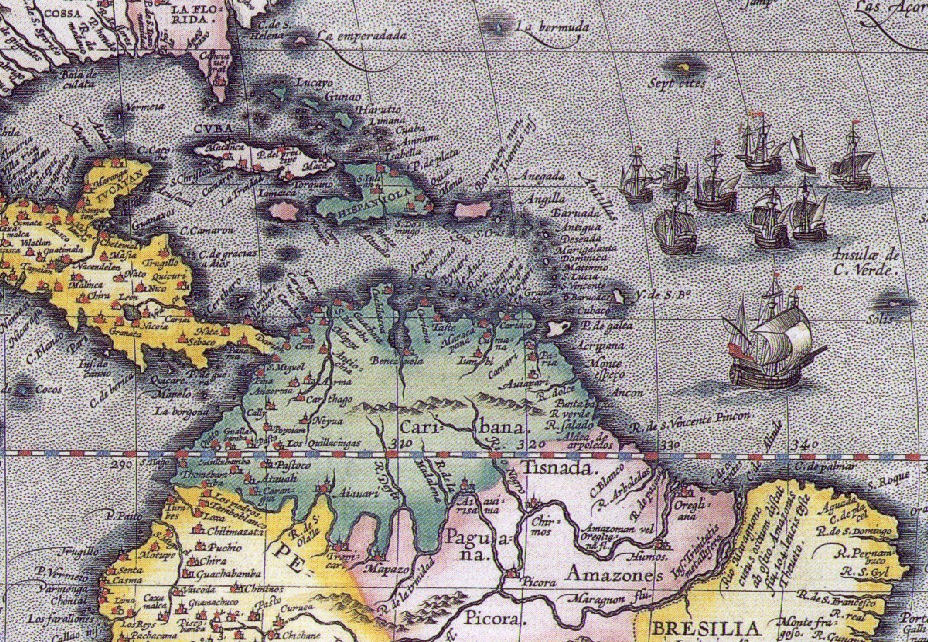
Antilles, word of possibly Latin origin associated with the western islands well off the coast of Africa, spoken of by ancient mariners, and attributed to Genovese and Portuguese map makers.
Plutarch
The legend of the Antillean islands seems to have arisen at the latest in pre-Christian Roman times when Plutarch chronicled (in 74 AD, chapter 8 refers) the life of the Roman military commander and Consul of Spain Quintus Sertorius (died 75 BC). After returning by sea to Spain after a campaign in "Mauretania" (modern northern Morocco), Sertorius "met some sailors who had recently come back from the Atlantic Islands." It was from these men that Sertorius learned facts so beguiling that he made it his life's ambition to find the islands and retire there. According to Plutarch:
“ The islands are said to be two in number separated by a very narrow strait and lie 10,000 furlongs from Africa. They are called the Isles of the Blessed. They enjoy moderate rains and long intervals of winds which for the most part are soft, and precipitate dew, so that the islands not only have a rich soil excellent for ploughing and planting but also produce a natural fruit that is plentiful and wholesome enough to feed, without toil or trouble, a leisured folk.
Moreover an air that is salubrious, owing to the climate and the moderate changes in the seasons, prevails on the islands. The North and East winds which blow out from our part of the world plunge into fathomless space and, owing to the distance, dissipate themselves and lose their power before they reach the islands, while the South and West winds that envelop the islands sometimes bring in their train soft and intermittent showers, but for the most part cool them with moist breezes and gently nourish the soil. Therefore a firm belief has made its way, even to the barbarians, that here are the Elysian Fields."
Crosby vs Diamond vs genetic evidence a three-way debate on
Why the Dominance of Europe:
- Germs (plague, smallpox, chickenpox, measles, venereal diseases)
- Seeds
- Animals (pigs, goats, chickens, horses, rats, dogs, cats, donkeys)
- Guns
- Steel
- Faith (crusades, proselytizing, missionaries, redemption)
- fortune
- famine
Jared Diamond Alfred Crosby physicianecological historian"latitudinal hypothesis"bio cultural perspectivedisease frontierimmunity is destinycultural dominance is not geneticdominance is a false history
Jared Diamond, Guns, Germs and Steel (1998), versus Alfred Crosby, Germs, Seeds and Animals, (1993)
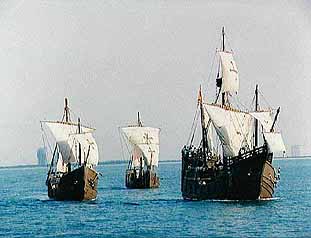
"Columbus and his contemporaries had no inkling that 200 million years ago the continents of the earth were parts of one immense world continent in which physical continuity minimized the development of biological diversity."
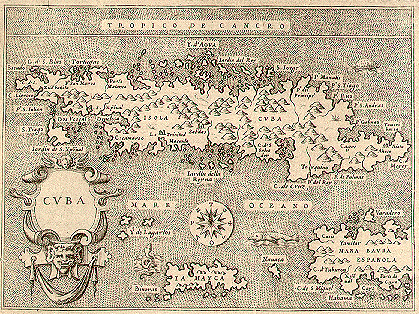
"in so many ways New Spain --Nova Hispania-- was new , a combination, crossing and concoction of entities that had never before existed on the same continent."
Crosby, p. 49.
"Columbus wrote of the West Indies that the trees were "as different from ours as the day from night, and so the fruits, the herbage." He was so surprised by the differences of the plants, and animals too, that he even claimed the rocks were different."
Crosby, p. 50.
- endemism is the biotic response to physical separation, or geographical isolation
- speciation is a geographical event in the life of creatures
- adaptive radiation occurs when species have no predators
- predation is a biotic fact that alters cultural pretensions

Therefore:
- isolation and immunity to pathogens.
- idolatry, demoralization, and faith.
- density of populations.
- desirable products to trade.
- fortunate circumstances.
- horses, chickens, pigs, rats and dogs.
- divide and conquer strategies.
- Staging grounds in the Antilles.
European hegemony or dominance depended on
biological reality, timing, and cultural peculiarity:
"The great Genovese navigated, administered, crusaded, enslaved, but above all he mixed, mingled, jumbled, and homogenized the biota of our planet."
p. 61.

"History has the cruel reality of a nightmare and the grandeur of humans consists in their making beautiful lasting works out of the real substance of that nightmare. . . it consists in transforming the nightmare into vision, in freeing ourselves from the shapeless horror of reality --if only for an instant-- by means of creation."
Octavio Paz, 1950

"you have seen nothing yet."
Miguel de Cervantes
Olin Library,
"The important thing is to not stop questioning, curiosity has its own reason for existing."
problem solving index.
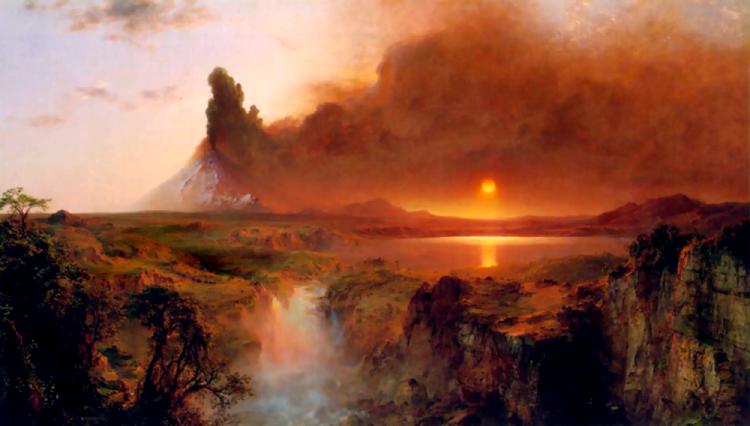
Cotapaxi, Volcano, by Frederick Church, (c. 1860s).
Metamorphosis,
-
literally to ability to change shape or take on another shape or form,
-
figuratively the capacity to transform beyond recognition.
 Alfred Crosby, Germs, Seeds, and Animals. New York: Sharpe, Inc. 1992,
Contents | Meaning | Introduction | Natives | Tainos | Columbus | Europe's Ecology | Debate | Argument | Columbian Exchange | Terms | Sources
This page was renewed
•1/27/08•