Michio Kaku and Jennifer Thompson
The Cosmic Quest for the Theory of the Universe
(New York: Random House, 1995, revised edition)

contents | Four Forces | Part I | Two opposites | Quantum | Part II | dimensions | Part III | conclusion

". . . the quantum behaviour of the physical world. At very short distances, such as the size of an atom and smaller, the world behaves very differently to the “classical” world we are used to. . . ." 1
The cosmos' great contradiction!
What is all the fuss about String Theory? 
"a comprehensive, mathematical framework that would unite all the known forces of the universe."
"A new theory . . . . with new mathematics of breathtaking beauty and elegance."
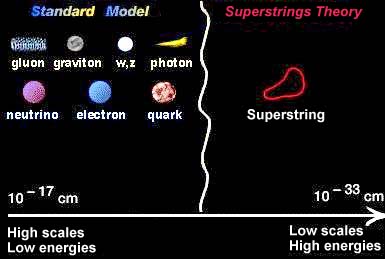
"we are finally closing in on a unified field theory."
"a new understanding of what time and space really are."
Edward Witten, Princeton, pp. 3-4.
 Hypothesis: Neither atoms nor quarks are nature's fundamental structural elements.
"That vast storehouse of information of our physical universe,"
". . . it forces us to revise our understanding of the nature of matter."
p. 4.
 "they are much too small to be observed (They are about 100 billion billion times smaller than a proton)"
"our measuring devices are too crude to see these tiny strings."
"All particles are just different vibratory resonances of vibrating strings."
p. 5.
"The answer to the ancient question 'What is matter?' is simply that matter consists of particles of different modes of vibration of the string. . . ."
pp. 5-6.
" matter consists of particles that are different modes of vibration of the string . . . .
"The 'music' created by the string is matter itself."
p. 6.
For a contrast see Frank Wilzeck lecture.
Energy arises from within matter.
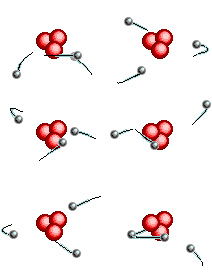 "Pound for pound, a nuclear bomb releases over a million times the energy contained in dynamite."
p. 7.

contents | Four Forces | Part I | Quantum | Part II |Part III | conclusion

"A star is basically a huge nuclear furnace in which the strong force within the nucleus is unleashed."
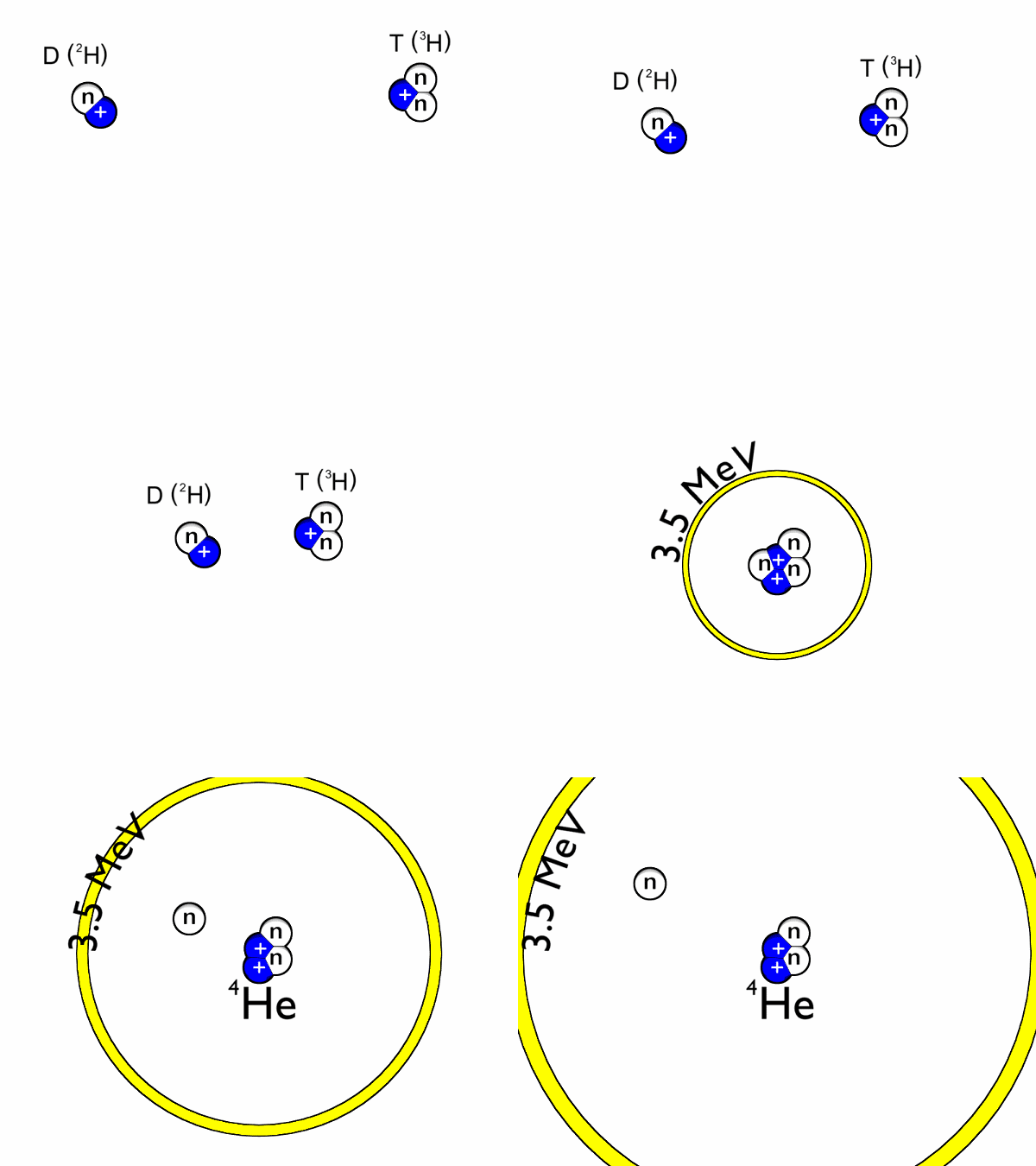
"formed in a star whenever three helium nuclei collide at one spot within less than a million millionth of a second. Every carbon atom in every living creature has been formed by such a wildly improbable collision."
Jacob Bronowski, The Ascent of Man, 1972
Four fundamental universal Forces
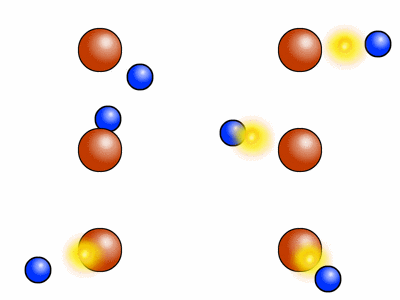 Gravity [1670s] attraction & acceleration (Einstein 1915)
The hydrogen atom is a proton surrounded by an electron.
These three or four universal explanations for why anything (and everything) moves are basic to comprehending the "plot" of Kaku and Thompson's book. See for example page 76.
Hear about these four fundamental forces of nature from Michio Kaku. 2
"A force is anything that can move an object." 
p. 6.
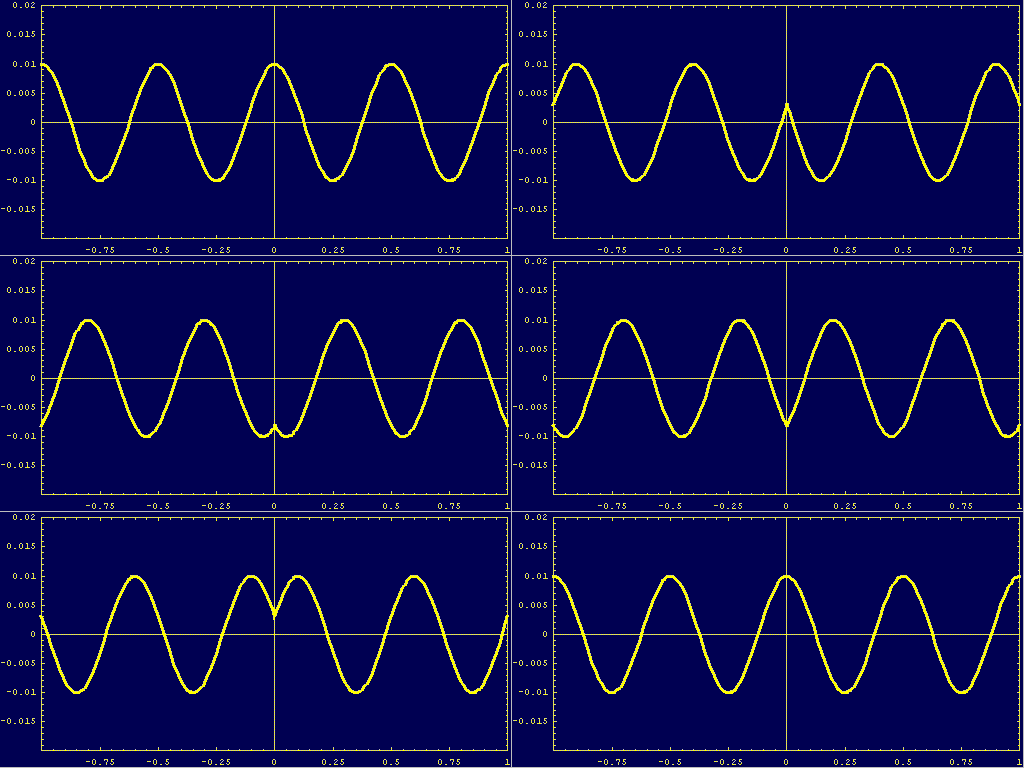 "resonate with different frequencies"
p. 5.
"In the twentieth century, two great theories of have towered above all others: quantum mechanics, with its resounding success at explaining the three subatomic forces, and Einstein's theory of gravity, called general relativity. In some sense, these two theories are opposites."
p. 9.
"So physicists were faced with two distinct theories, each employing a different set of of mathematics, each making astonishingly accurate predictions within its own realm, each profoundly separate and distinct."
Force incompatibility
"It's as if nature created someone with two hands, with the right hand looking entirely different and functioning totally independently from the left hand."
"It was a puzzle; they could not believe that nature could function in such a bizarre fashion."
p.10.
What does this mean? An answer form Cal Tech.
 |
I. A Theory of the Universe |
| II. Supersymmetry and Superstrings | |
| III. Beyond the Fourth Dimension | |
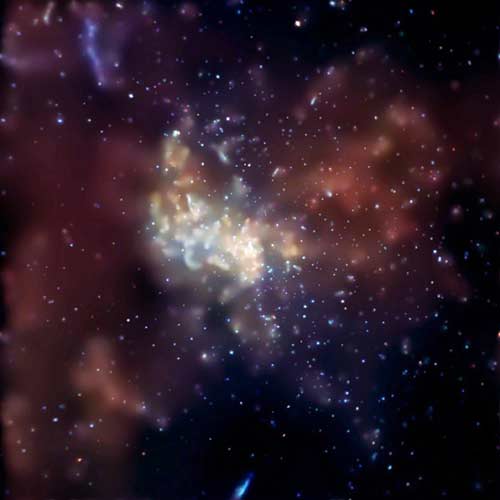
| When we look into space we are looking back in time; looking into deep space we are seeing farther back into time. | |
"We all agree that your theory is crazy. The question that divides us is whether it is crazy enough."
Niels Bohr to Wolfgang Pauli, 1958. p. 11.

"According to Einstein's theory, the universe began 10-20 billion years ago in a gigantic explosion called the Big Bang . . . . concentrated into a super dense ball, which exploded violently, creating our current expanding universe."
p.11.
"According to superstrings, the universe originally existed in ten dimensions. . ."
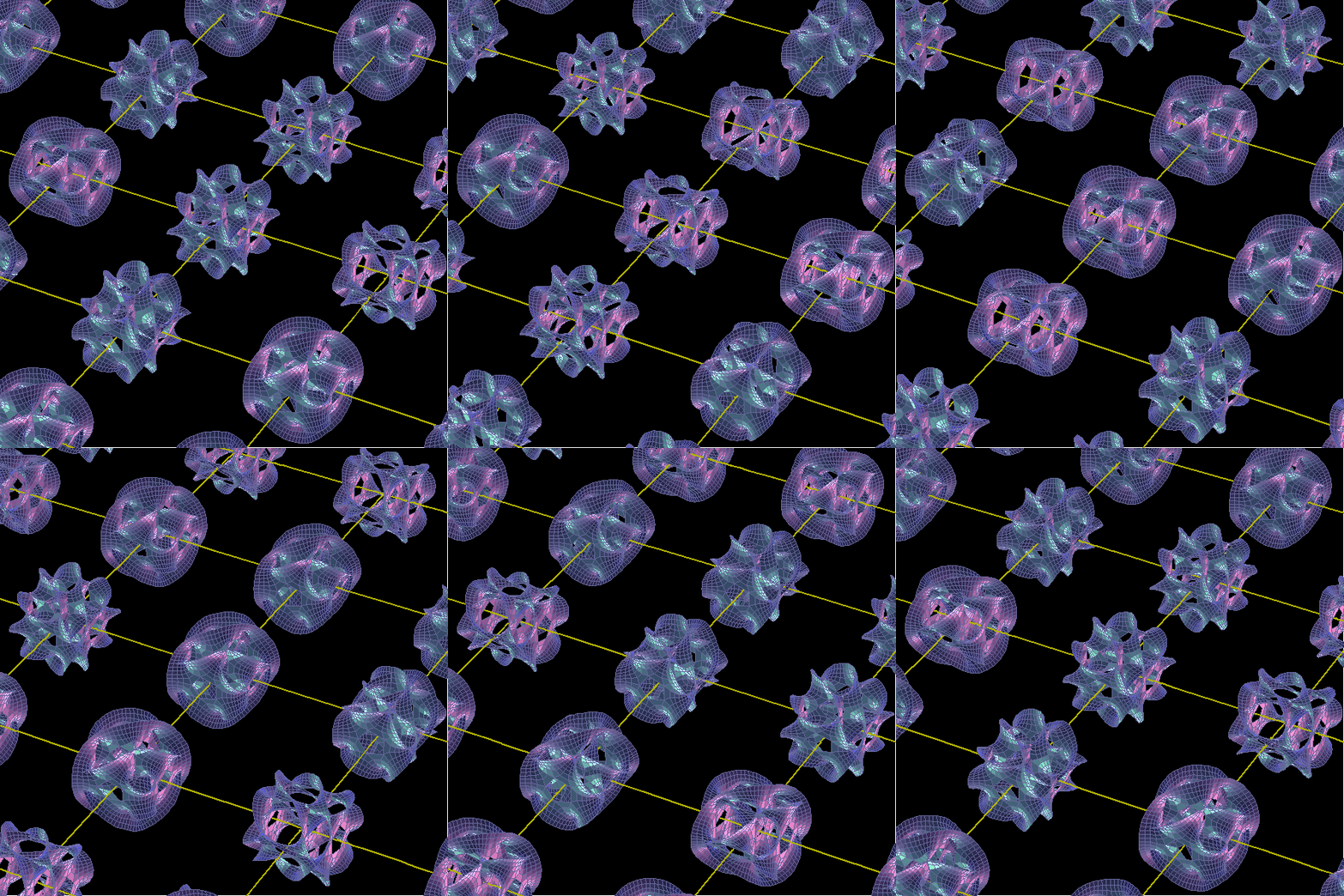
"The cracking of the ten-dimensional universe into two pieces."
p. 12.
"The only way to detect dark matter (invisible material) is by its weight: it has no other known interaction with other forms of matter . . . . there may be more dark matter than ordinary matter." [Well to be precise, 27% of our universe is dark matter, NASA, 2014.]
p. 13.
"Instruments do not exist with sufficient energy and size to test the superstring theories predictions and this has led skeptics to argue that, as a theory of everything, there exists nothing to prove superstring theory. Supporters of string theory retort that no experimental evidence thus far has refuted the theories predictions.
14-15.
"In fact, the energy scale in which this unification takes place can only be found at the beginning of time."
15-16.
"In this sense, solving the puzzle of the unified field theory may well solve the riddle of the origin of the universe."
p. 16.
contents | Four Forces | Part I | Part II |Part III | conclusion
2. The Quest for Unification. 
"Historically, science has developed rather disjointedly."
p. 17.
Maxwell's Discovery
"Similarly, Maxwell discovered that the interplay between vibrating magnetic and electric fields created the wave . . . . only the delicate interplay between electric and magnetic fields could produce this wave."
p. 21.
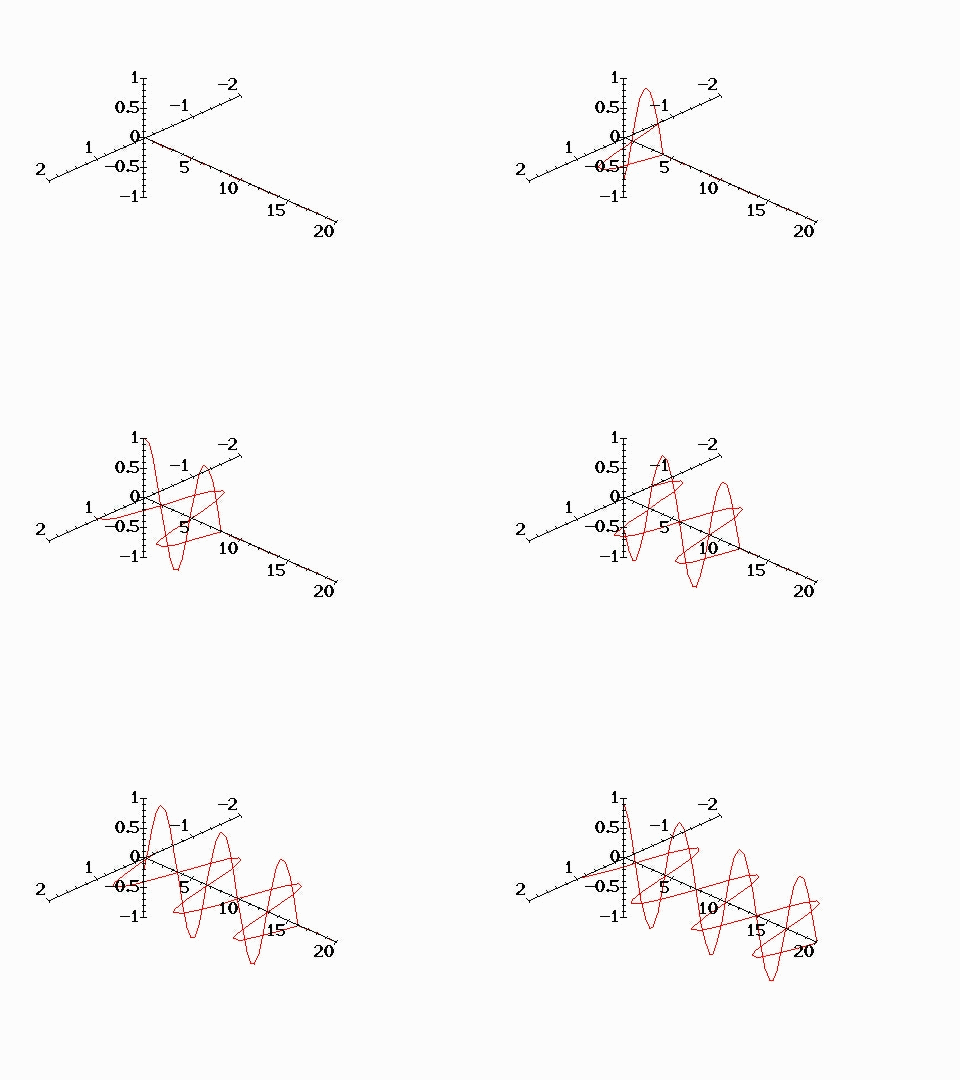 ". . . our understanding of unification – that of electricity and magnetism . . . . "
p. 20.
| Sir Isaac Newton's world differs from Werner Heisenberg's & Erwin Schrödinger's | |
 |
 |
| Cosmic gravitational attraction | subatomic particles and the uncertainty of motion & position |
| "Moreover, the mathematics and principles required for quantum mechanics seem dissimilar to Einstein's general theory of relativity, which describes space warps, black holes and the Big Bang. | ||
Einstein quoted, p. 29. |
||
| "With the developments of the unified field theory, however, it now becomes possible to assemble these disjointed pieces and view the whole as more than just the sum of its parts." | ||
| Newton's world | Our worldview differs |
|
 |
Isaac Newton, and his discovery of the universal law of gravitation, easily the most significant development in... human history." | 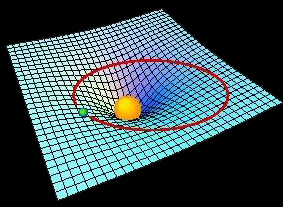 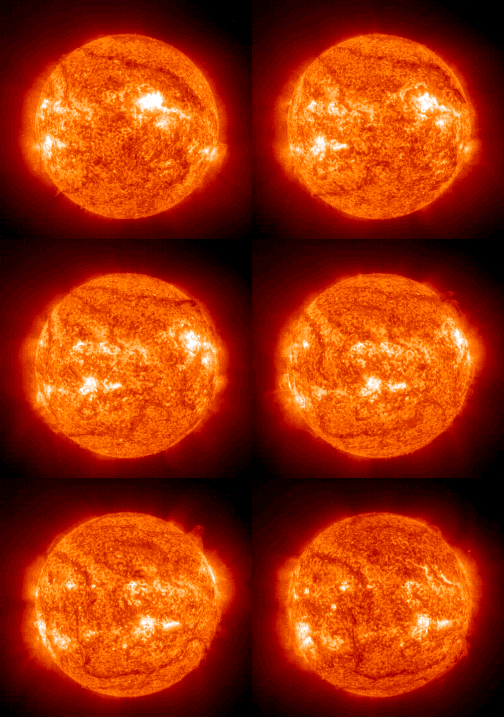 |
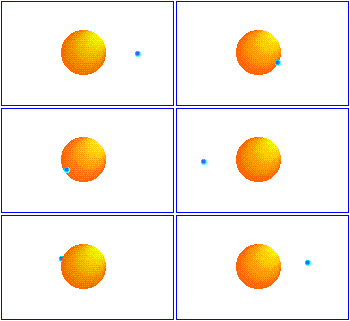
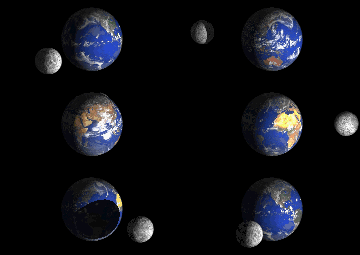
The moon moves around the earth as any planet moves about the sun.
|
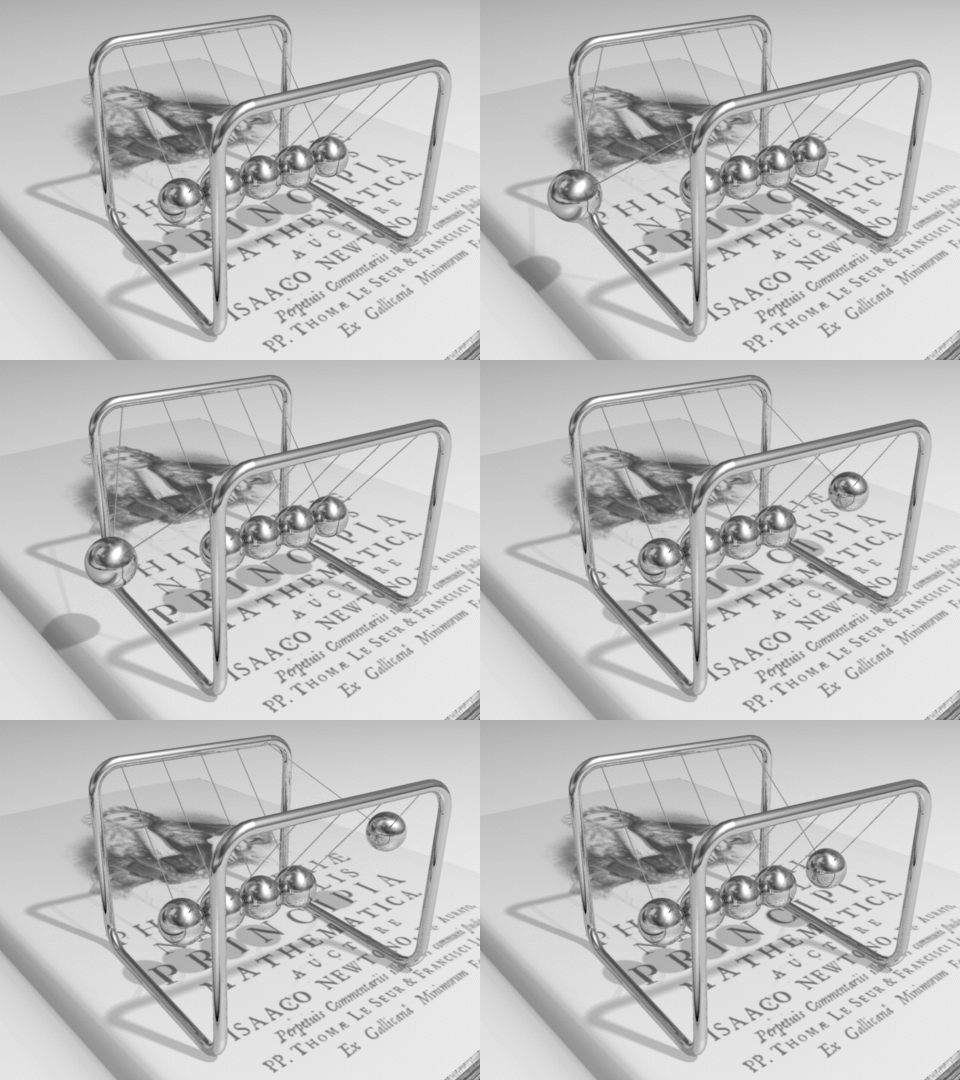 |
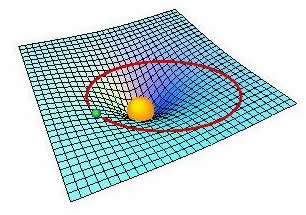
Massive stars like the sun warp space-time.
|
p. 17
Feynman's lecture on planetary motion discussed gravity.
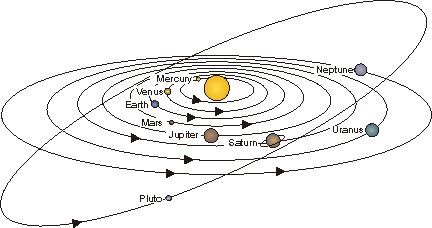
The planets move about the sun and their satellites move about their respective planets due to gravity.
 "Perhaps, Newton thought, the moon is continuously falling, guided by the same laws that make a rock fall to the earth, but the moon never crashes into the earth because the earth's receding curvature cancels the falling of the moon. In his masterpiece, Principia, Newton wrote down the laws that govern the motion of satellites orbiting the earth and planets orbiting the sun."
"the first in the history of science, uniting the laws of heaven and earth."
pp. 18-19.
"However, on May 29, 1919, Einstein's general theory of relativity was tested dramatically . . .during a solar eclipse.
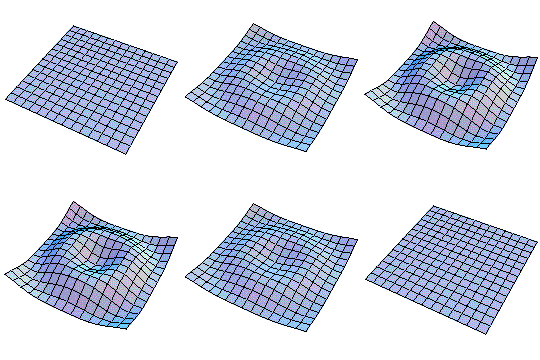
This meant that the sun's vast matter-energy could somehow warp the space-time."
". . . a dramatic verification of these (Einstein's) ideas."
p. 28.
contents | Four Forces | Part I | Two opposites | Quantum | Part II |Part III | conclusion

3. The Quantum Puzzle

"in many ways, these two theories appear to be opposites. General relativity concerns the cosmic motions of galaxies and the universe, while quantum mechanics probes the subatomic world.
Relativity is primarily a theory of force fields that continuously fill up space.
Quantum mechanics, by contrast, is primarily a theory of atomic matter, which travels much slower than the speed of light.
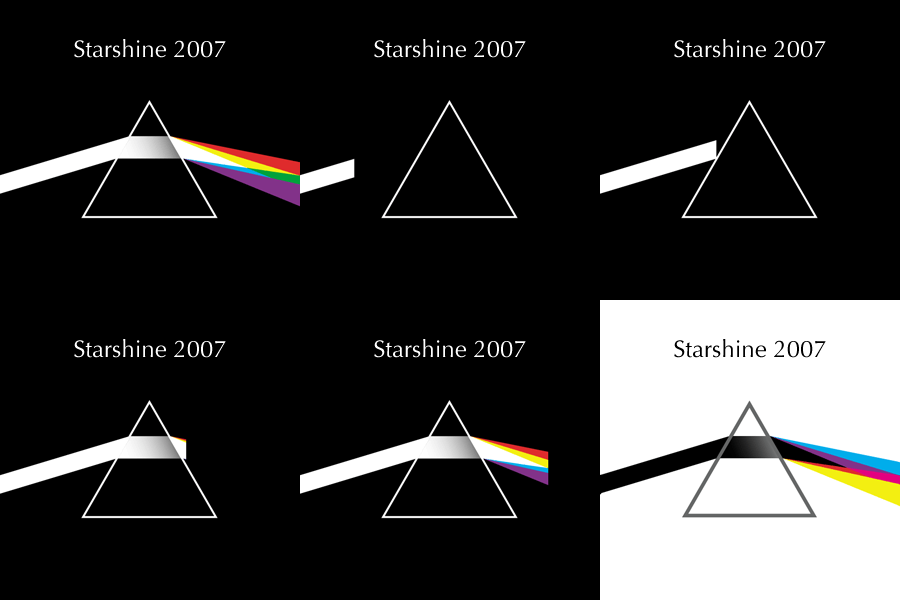
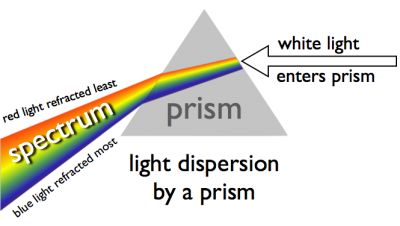
"In the world of quantum mechanics, a force field only appears to fill up all space smoothly and continuously. If we could examine it closely, we would find that it actually is quantized into discrete units. Light for example, consists of tiny packets of energy called quanta, or photons."
p. 37.
the quanta, or light-quantum exists opposite to relativity
"Neither theory in itself provides a satisfactory description of nature. . . . Nor is quantum mechanics satisfactory without relativity; quantum mechanics can be used to calculate only the behavior of atoms, not the large scale behavior of galaxies and the expanding universe."
"Merging these two theories. . . has consumed the herculean efforts of scores of theoretical physicists for the past half century. Only in the last few years have physicists finally formulated, with the help of superstring theory, a possible synthesis. . . . "
p. 37.
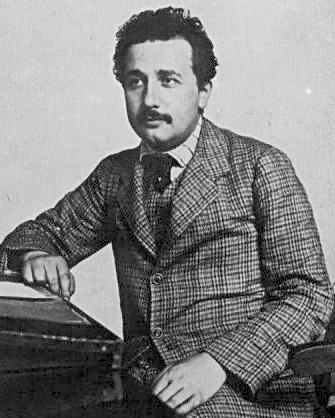
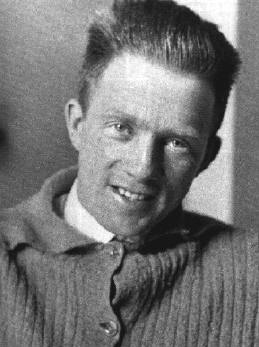
Albert Einstein (March 14, 1879 - April 18,1955) & Werner Heisenberg, (December 5. 1901 - February 1, 1976)
"Not only were the personal destinies of these two men linked, but their scientific creations were also intimately related."
| macrocosm | microcosm | |
 |
 |
|
| Albert Einstein, the photoelectric effect | Werner Heisenberg, uncertainty principle |
"In posing these questions, Heisenberg and his colleagues created quantum mechanics."
p. 36.
Heisenberg -- "Could nature possibly be as absurd as it seemed in these atomic experiments?"
"The solution of the difficulty is that the two mental pictures which experiment leads us to form- the one of the particles, the other of the waves- are both incomplete and have only the validity of analogies which are accurate in limiting cases."
-Werner Heisenberg
"Einstein believed that quantum theory was incomplete . . . . The following requirement for complete theory seems to be a necessary one: every element of the physical reality must have a counterpart in the physical theory. "
p. 47.
"The mechanism by which theory manages to marry both special and general relativity with quantum mechanics ...is a fascinating feature found only in strings."
p. 52

4. The Riddle of Infinities.
"Since the 1930s , physicists have been consumed by the frustrating task of 'cracking the safe' of quantum field theory and finding the key to the successful marriage between quantum mechanics and relativity."
"…the experimental data from atom smashers form a systematic pattern."
"…this pattern can be expressed as an underlying mathematical symmetry that links forces that appear to be totally dissimilar."
"The discovery that these symmetries can cancel these divergences is perhaps the greatest lesson of the past half century of physics."
p. 53.
contents | Four Forces | Part I | Quantum | Part II |Part III | conclusion
5. The Top Quark. 
"The heaviest elementary particle ever discovered."
p. 74.
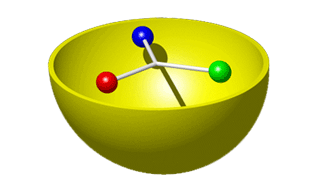
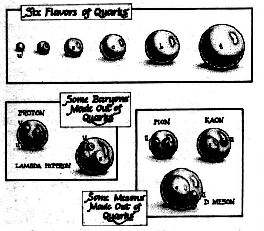
July, 1994 the "top quark" was discovered and with it a seventeen year search for this partner of the "bottom quark" ended that began with having discovered the discovered the "bottom quark" in 1977.
Quarks are the experimentally verified and theoretically predicted particles; the real materiality at the heart of subatomic physics.
Without these quarks "elementary particle physics would collapse. . . ."
p. 73.
The standard model "Thus, it is perhaps the most successful theory ever proposed in the history of science . . . . it is exceptionally ugly and asymmetrical."
"At present there has been no experimental deviation from the Standard Model."
"It seems strange that nature, at a fundamental level, prefers to have a high degree of useless redundancy in the construction of the universe."
Attempts to bring ". . . the electromagnetic force, the weak force, and the strong force into one theory."
"Tape can be used to connect the three pieces forcibly."
p. 75.

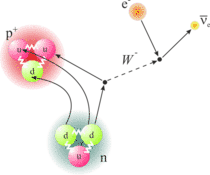
"This theory predicts that the quark can turn into an electron by emitting another particle. This means of course that the proton (made up of three quarks) will eventually decay into electrons and that the proton has a finite lifetime."
pp. 77-78.
Video on Strong and Weak forces.

II. Supersymmetry and Superstrings
The mathematical formulation and, as yet undiscovered, experimental findings that may reveal a very tight relationship between bosons and fermions, or the terms in physics for subatomic particles with spin and those with half spin.
Boson such as a photon
While not clear to the lay person these features of qualities of material objects have a beautiful similarity based on mathematical equations of related findings, such as the fact that electricity has a symmetry with magnetism revealed by Maxwell's field equations. These Supersymmetry equations are explained by the need to develop a mathematics to predict outcomes of string theory such that experimental evidence can can confirm whether or not nature demands symmetry and if symmetry is discoverable at the core of natural materials, then why do we apparently inhabit a world of "broken" symmetry.
For a more understandable account of supersymmetry do read: "Here's why supersymmetry is such a big deal for physics". Australian Business Insider, by Kelly Dickerson. March 20, 2015.

6. The Birth of Superstring Theory, (1968)
"Nowhere else do we find a theory that was proposed as the solution to the wrong problem, abandoned for over a decade and resurrected as a theory of the universe."
Chew's theory required on a mathematical theory of colliding particles, called "S-matrix theory" and so rigorously and restrictively applied to the data, that only a single outcome was possible.
pp. 81-82
"According to this theory, the infinite variety of 'elementary particles'... found in nature are simply different resonances of the same string, with no particle any more fundamental than any other."
The superstring theory, then, incorporates the best features of both the s-matrix theory and the quantum field theory because it is based on a strikingly different physical picture."
p. 82
Leonard Euler's Beta function, ß∫, was a beautiful conceptual thing because "they found that it automatically satisfied almost all of Chew's S-matrix postulates."
"an overnight sensation in the world of physics."
p. 83
"The Mobius strip represent the geometry of the single-loop."
p. 91.
Superstring theory lost favor around 1974.
p. 94
"There are a few other rare occasions in the history of science when an apparent defect was found to be a tremendous asset. For example, in 1928, Alexander Fleming found that his cultured dishes of staphylococcus bacteria colonies could be destroyed if they were accidentally contaminated by certain bread molds."
p. 98
contents | Four Forces | Part I | Part II |Part III | conclusion
7. Symmetry: The Missing Link
What is beauty?
"To a physicist , however, beauty means symmetry."
p. 99.
"We say the crystal is invariant under rotation at a certain angle, because the crystal rotates back into itself."
p. 99.
"Is symmetry simply a matter of aesthetics (our perception), peculiar only to humans, or does nature prefer symmetry in the universe?"
p. 99-100.
"A century later, this 'useless' theory of Lie groups would provide the foundation for all of the physical universe!"
p. 102.
Lie groups are a form of algebraic computation that Dr. Robert Gilmore in his book suggests "Lie groups were initially introduced as a tool to solve or simplify ordinary and partial differential equations. The model for this application was Galois' use of finite groups to solve algebraic equations" and that "Lie groups are beautiful, important, and useful because they have one foot in each of the two great divisions of mathematics --- algebra and geometry. Their algebraic properties derive from the group axioms. Their geometric properties derive from the identification of group operations with points in a topological space."
Lie Groups, Physics, and Geometry, Cambridge University Press 2008.
Lie groups actually correspond to states of matter we do not sense or apprehend but know experimentally to exist.
| √ | Lie symmetry groups | corresponding matter |
|---|---|---|
| O(N) or O(3) | the atoms [any spheres] | |
| SU(N) | ||
| U(1) | symmetry underlying Maxwell's equations: photon | |
| SU(2) | proton and neutron | |
| SU(3) | strong interactions (binding protons / quarks) | |
| SU(5) | electron, neutrino, 3 quarks | |
| E(N) | "no ordinary objects" | |
| E(8) | superstring |
These states of matter (shaded ochre) are actually particles and waves that physicists have discovered existing beneath the molecular structure of the elements.

"If we could understand why the numbers 8, 10, and 26 continually crop up in the superstring theory, perhaps we could understand the the universe is in four dimensions."
p. 104.
 |
 |
 |
 |
 |
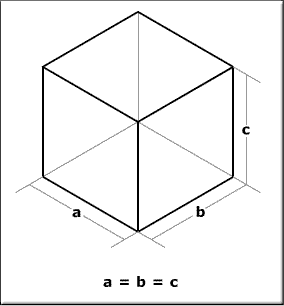
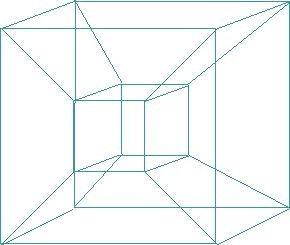
A three dimensional cube drawn in two dimensions. |
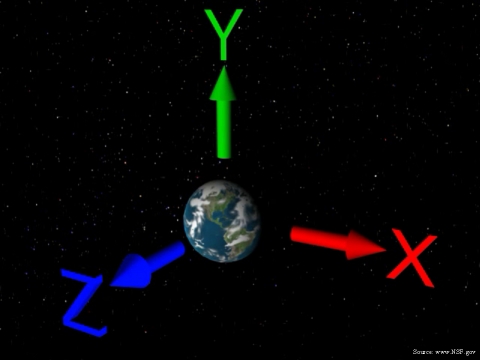
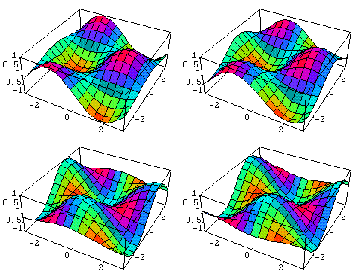
What are the three dimensions: X,Y, & Z. |
Visualizing change in three dimensions. |
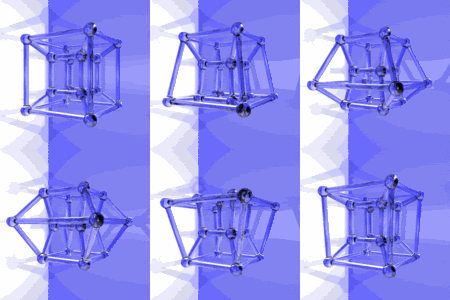
What would four dimensions look like? |
8. Supersymmetry.
Supersymmetry amounts to a series of related theories in order to unify gravitational theory as proposed by general relativity with quantum mechanical mathematics.
"But trying to answer the question posed by nature seemed more focused and more fun." John Schwartz, Cal. Tech.
"All objects have spin or angular momentum – everything from galaxies to subatomic particles."
contents | Four Forces | Part I | Part II |Part III | conclusion
III. Beyond the Fourth Dimension
 What do four dimensions look like?
"Every society has its mythology about the origins of time."
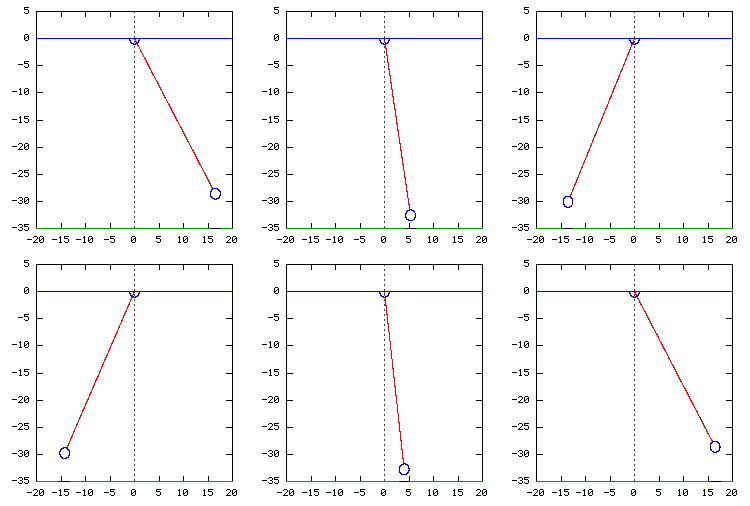
Over time the universe expands.
the expanding universe postulated by Einstein in 1917, who invented the cosmological constant to counteract the expansion that was a predication of his equations.
Einstein later called this creation of a cosmological constant, "his greatest mistake" because as the equations predicted, the universe is actually expanding and there is no need for "inventing" the constant.


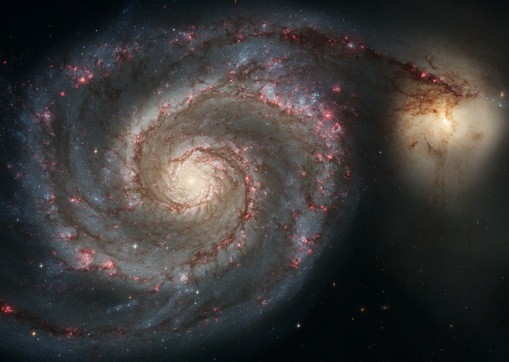
 1929, Edwin Hubble found evidence in the red shift or Doppler shift of light coming from distant stars in galaxies far beyond the Milky Way suggesting the expansion of the universe.
"Hubble found that the farther a galaxy is from the earth, the faster it was traveling away from the earth."
p. 130
"Why is the night sky dark?" This problem is solved by the "red shift."
p. 131.
Mathematically predicted by the general theory of relativity, 1917 & confirmed by Edwin Hubble, 1929.
At the beginning of time when the heat of the universe was immense, its size was miniscule (the size of a neutron) and density infinite, their was perfect symmetry, all four forces of the universe where united into one.
"united in one coherent force."
"Three minutes after the creation stable nuclei began to form.
Three hundred thousand years after the big bang, the first atoms were born.
...space was actually opaque, like a dense fog."
p.133.
"the breakdown of the ten dimensional fabric of spacetime."
p.142.
contents | Four Forces | Part I | Quantum | Part II |Part III | conclusion
10. The Mystery of Dark Matter.
" One of the greatest achievements of twentieth century science was the determination of the chemical elements of the universe. With only a little over one hundred elements scientists could explain the trillions upon trillions of possible forms of matter, from DNA to animals to exploding stars."
pp. 143-44.
"The universe was made of atoms and their subatomic constituents. That was the final word in physics."
p. 144.
except that now it is thought that 90% of the universe is made of particles (invisible) of "dark matter."
p. 144.
If Newton's law of gravity is accurate to intergalactic distances, there must exist, unseen "dark Matter." Fritz Zwicky
p. 145.
contents | Four Forces | Part I | Quantum | Part II |Part III | conclusion
11. Cosmic Strings.
"incredibly tiny vibrating objects, much too small...."
According to this theory, the vibrations left in the wake of these . . . cosmic strings are the gigantic galactic clusters we see in the heavens, including our own."
p. 154.
Announced the discovery of a giant wall of galaxies stretching about 500 million light years across."
April 1992 -- "Careful analysis showed that the cosmic microwave background radiation was not so uniform and that tiny irregularities showed up that were too small to be detected by previous experiments. Photos of these irregularities were given to reporters, with the tongue-in-cheek statement that they were gazing at the face of God.
According to the revised theory, these small anomalies in the microwave background radiation existed 300,000 years after the Big Bang and grew in size over the next billion years, until they caused galaxies to clump in space .... until they gradually became the clumps of galaxies we see today."
p. 157.
Our minds, which conceptualize objects in three dimensions, cannot fully grasp higher-dimensional objects. Even physicists and mathematicians, who regularly handle higher dimensional objects in their research, treat these objects with abstract mathematics rather than trying to visualize them."
p. 167.
A four dimensional cube.  A cube would unravel into six equal squares to a two dimensional observer.
p. 167
contents | Four Forces | Part I | Quantum | Part II |Part III | conclusion
12. Journey to Another Dimension.
Back in 1919, Theodor Kaluza wrote Einstein about special relativity and mathematics.
"Kaluza did not have the slightest experimental proof that the world should be five-dimensional, but his theory was so elegant that it seemed it might have some truth."
"The idea of five dimensions was so outlandish to Einstein that he held on to the paper, delaying its publication for two years."
p. 162.
13. Back to the Future.
"The first person to open the door to the possibility of alternate worlds was Paul Dirac, one of the founders of quantum mechanics, who discovered the theory of antimatter quite by accident."
pp. 178-179.
Implied by E-MC2, the existence of antimatter was with the detection of the positron or positively charged electron was subsequently found analyzing cosmic ray tracks by Carl Anderson at Cal Tech.
p. 180.
Feynman diagrams -- anti matter reverse time.
pp. 180-181.
"One day, when Feynman was a student at Princeton, his adviser Wheeler excitedly claimed that he now knew why all electrons in the universe look alike. (Every student of chemistry learns that all electrons are the same ....) Wheeler proposed to explain this by assuming that all electrons look the same because they are, indeed the same electron."
pp. 181-182.
14. Beyond Einstein.
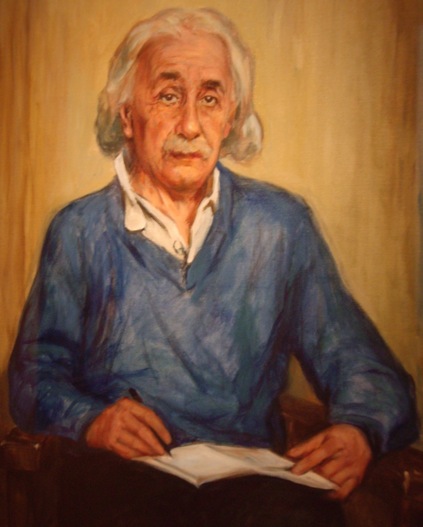
Conclusion
"This would complete the cosmic quest begun by Einstein in the 1930s to unify gravitation with the other known forces."
p. 191.
"We are finding that nature uses more sophisticated but simpler mechanisms than we originally thought to build the universe."
p. 193.
"nature seems much more coherent than before."
p. 193.
"Yet give our relatively primitive technological development, we still have been able, largely by using the enormous power [ of theoretical thought ] of symmetry, to make statements about the origin of time itself. On an evolutionary time scale, it has been only perhaps two million years since we left the forests (which is nothing but the blink of an eye) but already we are making careful, rational statements about events that happened billions of years ago, at the beginning of time."
"capable of discovering the unified field theory."
"As [Sheldon] Glashow says, a unified field theory simply explains to us the rules of the game, but does not teach us how to become Grandmasters."
"p. 198
"Fortunately technological progress proceeds geometrically (exponentially). However, our brains cannot comprehend geometric growth... that is why science will always be stranger than science fiction."
p. 200.
contents | Four Forces | Part I | Quantum | Part II | dimensions | Part III | conclusion
1 "Millennium Prize: the Yang-Mills Existence and Mass Gap problem." The Conversation, December 8 2011, 2.38pm EST.
"Here's why supersymmetry is such a big deal for physics." The Business Insider Australia, KELLY DICKERSON, 20 March 2015 at 3:00 PM.
2 "A look at the four forces from the Physics Department at Georgia State University."
"Unification of The Four Great Forces of Nature," Michio Kaku. "We lied to you, . . ." because "space pushes you down"

Writing | writing from texts | how to approach writing | writing papers | writing & world views
Descartes | Galileo | Hooke | Newton | Einstein | Gell-Mann | Hawking | Hawking - Universe | Hansen | Kaku - Hyperspace
Science index | more science pages | even more science indexed!
The powers of ten related to scale