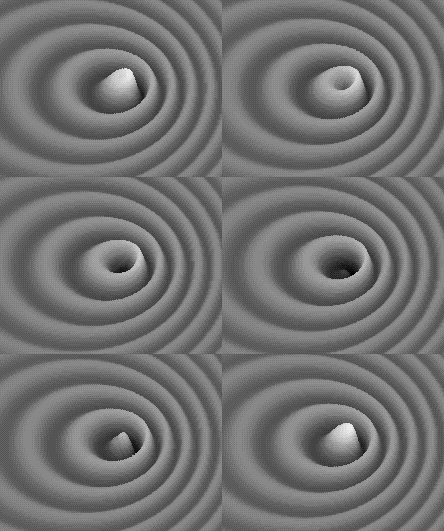
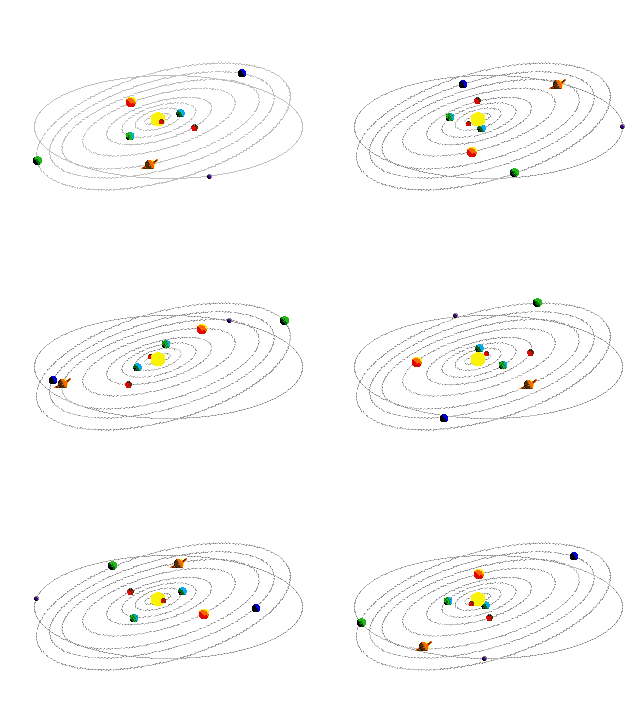
Visual depiction of the Doppler effect as the foreshortening & elongation of waves.
Veracity of our doubts in the understanding of the cosmos?
Visual depiction of the Doppler effect as the foreshortening & elongation of waves.
worldview | means of knowing | body of knowledge | what is done with knowledge | conclusions
|
|
 |
“Every technological advance has come at a price – but the full price is seldom known until long after the achievement… The technology of industrialization has moved us into an increasingly complex world…. Humankind has reached a point where it must work consistently to exercise its new power over technology and social organization.”
(Brooke Hindle, p. 279)
Machine, machinery: “a system of usually rigid bodies, formed & connected to alter, transmit, and direct applied forces in a predetermined manner to accomplish a specific objective such as the demonstration of useful work.”
A mechanism belongs to those devices having a source of motive power to do work.
“limits to development resulting from reliance on land based resources were slowly removed.”
(Arnold Pacey, 109)
“We do not ride upon the railroad, it rides upon us.”
Thoreau in (Leo Marx, 249)
Thomas Carlyle warned that “the mind will become subject to the laws of matter; that physical science will be built up on the ruins of our spiritual nature; that in our rage for machinery, we will ourselves become machines.”(Leo Marx, 183)
worldview | means of knowing | body of knowledge | what is done with knowledge | conclusions
we either believe it or not; either machinery or the organic qualities best describe the living world.
Body of KnowledgeMachinery of nature: in that the material world is functional, operates sequentially, requires fuel and produces waste.
Evolving organic complexity of nature means the material world is becoming something novel all the time.
Revolutions in what we know today have five distinctly significant qualities:
1) statistically discernible patterns (we can separate from background noise.)
2) quantity, quality, timing and dispersal of essential materials comprise the functioning world
3) stochastically probable events are contingent on the conditions that preceded the current life on earth
4) the universe appears to be both growing and already more enormous than we can imagine
5) light is electromagnetic radiation and accounts for a speed limit governing the velocity of objects in the universe because light travels at 186,000 miles per second (Earth is only 25,000 miles around).
worldview | means of knowing | body of knowledge | what is done with knowledge | conclusions
Rational and empirical knowledge of the solar system reveals the Earth moves around the sun.That some diseases are caused by unseen microbes that live within larger organisms and we get from animals.
Just knowing the cause of a disease does not create effective therapy leading to the eradication of the affliction.
The most productive natural areas are among the least understood and least beautiful features of the planet.
Steam engines & refrigeration (1700s)Electricity and magnetism (1870s)

Weak and Strong nuclear powers (1935-1945)
Radiation, x-rays and diagnostic precision (1898-1920)
Mechanical transport (1905-16)
Electronics (1940s-1960s)
Code encryption (1939-now)
Digital information storage (1940s-1970s)
Telecom ( 1870-1930s )
Arms (1500-2000)
worldview | means of knowing | body of knowledge | what is done with knowledge | conclusions
Machinery reinforces our reliance on labor saving devices and automatic responses; thus making instruments important sources of knowledge about the world.
Means of knowing what we can about the world have changed enormously in a short time of several generations. Yet, the world is way ahead of humans' responsiveness in the sense of this planet's active developmental, adaptive capacity.
Science as useful, enriching and preventive means to know and manage the world, or at least managing our own needs for the world.
Mathematics has far more vigorous set of proofs to use to assure the solutions to problems.
Geology, biology, chemistry and physics have all undergone "revolutions" since 1500.
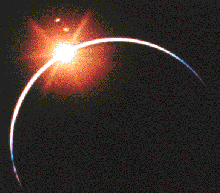
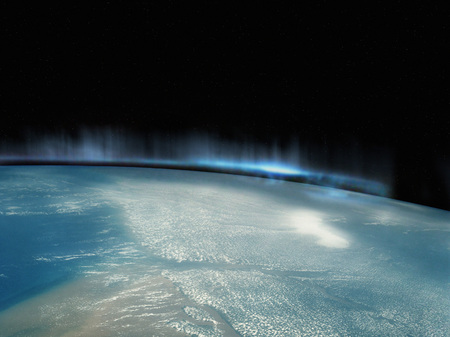
Solar eclipse by moon and the Aurora Borealis on Earth as viewed from space.
worldview | means of knowing | body of knowledge | what is done with knowledge | conclusions