"The hand-loom gives you a society of the feudal lord; the steam mill society with the industrial capitalist."
Postman quote attributed to Karl Marx, Technopoly, p. 21.
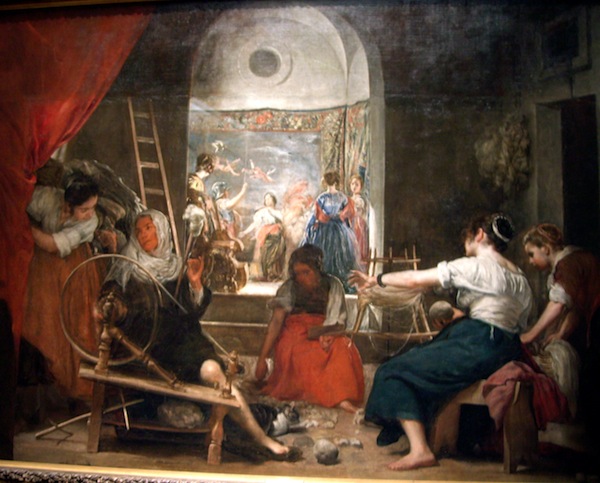
"The hand-loom gives you a society of the feudal lord; the steam mill society with the industrial capitalist."
Postman quote attributed to Karl Marx, Technopoly, p. 21.
Women spinning thread for use in a hand-loom.
§ – for the meaning of this statement do see below; by clicking this link.
His argument | defining technocracy | expressions of faith | Sir Francis Bacon's role | Convergence | Recall | Sources
The Railway Age, C. S. Pierce called the 19th century (1800-1899)
"...and such ways are the key to understanding diverse forms of social and mental life."
Postman, Technopoly, p. 21.
The age of electronic communication had three stages of development,


His argument | defining technocracy | Sir Francis Bacon's role | What does it mean? | Machine's rule | Recall | periods

Tools in the 18th and 19th century "attacked the dignity" and integrity of culture.
From the 10th to the 13th century was the Medieval Mechanical Revolution when machinery:
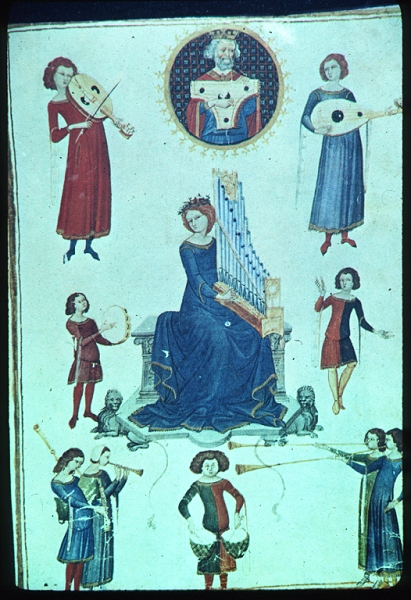
Medieval world view (thought and behavioral worlds) was dominated by the belief that:
"All knowledge and goodness came from God."
Postman, p. 25.
Defining detail: (Rubric)
"In technocracy tools play a central role in the thought world of culture."
"The name 'tool using culture' derives from the relationship in a given ( stipulated or case ) culture between tools and the belief system or ideology."
"The tools are not intruders. They are integrated into the culture in ways that do not pose a significant contradiction. . . "
"a very high degree of integration between its tools and its world-view."
Postman, p. 25.
His argument | defining technocracy | Sir Francis Bacon's role | What does it mean? | Machine's rule | Recall | periods
Technocracy
arises from the convergence of keystone technologies:
"the transformation of the mechanical clock in the 14th century..."
creating a new relationship between tools and culture.
"The meaning of existence itself was open to question."
Kepler who proved the precise elliptical movement of the planets around the sun in 1600s;
Kepler asserted, "yet the source of motion, carries the image of God... the Creator...."
His argument | defining technocracy | Sir Francis Bacon's role | What does it mean? | Machine's rule | Recall | periods
Bacon was the "announcer" of a new (1600-1620s) "means or way of thinking" that tried to do away with the authority of Aristotle a leading influence in the Middle Ages.
The new approach had spread by replacing a logic based on associations, sympathies, and analogies was a new method of knowing called empiricism, forerunner of rational empiricism.
Empiricism
- to observe
- to make a test
- to experiment
- to see what the outcome is
- to apply the findings to the natural and human worlds
These five steps of the new empirical approach are a novel method of discovery that replaced Aristotelian logic based on sympathies;
• the head is like the father; who as he is to the family so the king is to the nations.
• the hand is to the arm as the peasants (pawns) are to the nobility;
"October 23, 4004 BCE" – "to determine the exact moment of the Creation"
p. 36.
"Knowledge is power."
p. 38.
He linked science to the improvement of the human condition and "advance the happiness of mankind."
His method was striving to "endow useful and new inventions and riches."
p. 35.
His argument | defining technocracy | Sir Francis Bacon's role | What does it mean? | Machine's rule | Recall | periods
Sir Francis Bacon was the premier, or foremost "architect of a new edifice of thought" or body of knowledge. His conception of the world was made up of the following:
- observation or objectivity, these were equated; the act of observing by more than one person was aid to be objective.
- experimentation or trial and error
- think deeply and systematically about nature
- progress and power
Bacon believed that printing, gunpowder, magnet because "these have changed the whole face and state of things throughout the world. Especially in
- literature
- warfare
- navigation
pp. 36-37.
Bacon represented an early manifestation of:
"The mentality of the modern world, that is technocracy."
p. 38.
Thomas Carlyle, English writer and editor argued (as a critic) that
the "true Deity became mechanism." (Nineteenth Century)"we have become 'mechanical' in head and hand"
Carlyle also said: "Man is a tool using animal."
Technocracy was born of Bacon's synthesis
- practical application– what use are the means we invent?
- observation– scientific methods
- ideas– progress, utilitarianism, physiocrats
He noted that the influences of
were altering the values that had held the human world together.
The tethers or multiple ties that represent our tradition were untied by the power of tools and techniques.
That is because we allow tools to reshape ideas, materials and the people who use new devices and implements.
"Bacon is the first man of technocracy, but it was some time before he was joined by the multitude."
Between the 1600s with Bacon and 1800s with Carlyle, the dominance of hand tools were replaced by industrial mechanization as a driver of technical change work, and capital formation, changing people's hearts and minds.
"But any conception of God's design certainly lost much of its power and meaning, and with that loss went the satisfactions of a culture in which moral and intellectual values were integrated."
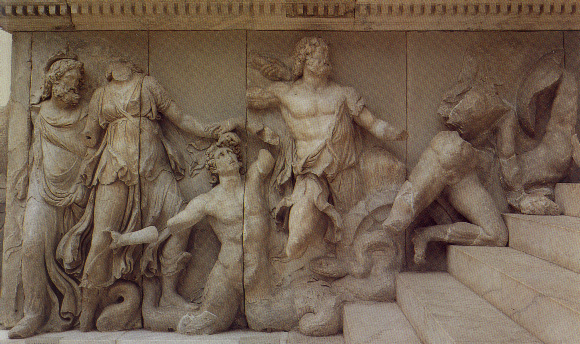
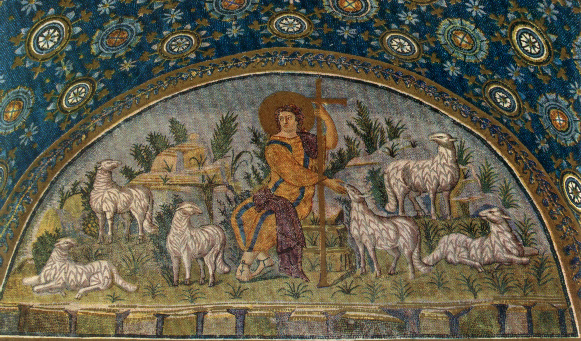
Compare the older Greek conception above & the bottom Christian mosaic of later Greek influence showing divergent depictions of God; though both reveal human images of the deity they portrayed.
His argument | defining technocracy | Sir Francis Bacon's role | What does it mean? | Machine's rule | Recall | periods
What do we want to recall?
example | convergent power | definition | outcomes
The start of a profound shift after 1453:
Galileo, Kepler and Bacon contributed unwittingly to a redefinition of the world and that is called, after Rene Descartes, the Cartesian way of thinking.
Because the change accompanies a widespread introduction of wind, water and fire driven machinery that Cartesian thinking is "mechanistic" in that the world is rationally conceived to be a mechanically functional, and predictive assembly of parts that synchronize to form a whole.
The clock is the best example of the many machines that came to be in the period between 1500 and 1800, but the roots of mechanization and the replacement of feudal lords in a medieval land-based society by factory owners and machinists who controlled wealth in the form of money, resources, and know-how included other tools and tool complexes.
By best example we mean that clocks are:
- easily recognized
- widely referred to
- influential (changes people's behavior)
- an image that replaced a pastoral ideal of God as a good Shepard with a clock maker deity.
The power of these tool complexes to shape behavior and thus influence how people perceive the world is called technocracy, literally meaning the authority of technology over human order, or "the rule of the tool" supplanted religious orders.
Some of these collateral inventions that became widespread enough to alter society, redefine behavior, and change cultural conditions –such as mores or ethical relations– were:
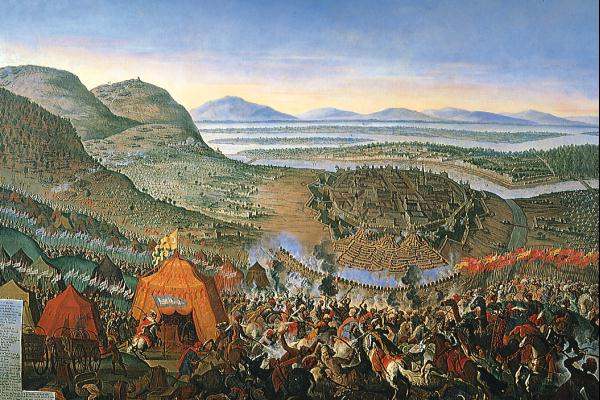
In 1543, on their way to Vienna the Turkish Imperial forces (Ottomans) laid siege to Hungarian cities. Sebastian Vrancks was so impressed by the cannons used in this two week ordeal that he portrays the scene of defeat from the view of the bombardiers. War created armies that always divided up tasks and labor, but cannons created a new division within warring armies that remain with us to this very day.
The painting reveals a change in technology that, having created a change in society, then altered the course of world history.
The transition from hand-craft to mechanical production created a split in society and a new more powerful elite whose wealth was based on control of tools and resources. As a result of that control they were able to buy expert, machinists and unskilled labor to use in the operation of the machinery they owned.
His argument | defining technocracy | Sir Francis Bacon's role | What does it mean? | Machine's rule | Recall | periods
example | convergent power | definition | outcomes
Pursell | Pacey–Meaning | Pacey | Tenner | Postman–Tech | Postman–Television | Eberhart | Snow | Kaku Visions
You may hear the word rubric used a great deal, like prioritize, it is a misused word where "rule" would do as well.
The dictionary tells us that rubric means
a heading on a document.
• a direction in a liturgical book as to how a church service should be conducted.
• a statement of purpose or function : art of a purpose, not for its own sake, was his rubric.
• a category : party policies on matters falling under the rubric of law and order.
DERIVATIVES
rubrical | an adjective from rubric |
ORIGIN late Middle English rubrish (originally referring to a heading, section of text, etc., written in red for distinctiveness), from Old French rubriche, from Latin rubrica (terra) ‘red (earth or ocher as writing material),’ from the base of rubeus ‘red’ ; the later spelling is influenced by the Latin form.
An etymology site on the www.DERIVATIVES as evidence.
Postman uses the italicized phrase in Chapter 2:
Did Karl Marx say that precisely?
"hand-loom gives you a society of the feudal lord; the steam mill society with the industrial capitalist."
But
As Marx puts it:
"social relations are closely bound up with productive forces . . . The hand-mill gives you society with the feudal lord; the steam mill, society with the industrial capitalist."“The Poverty of Philosophy”, Collected Works 6, (Moscow/London, 1976), p. 166.
See: The Materialist Theory of History,
Jacques Ellul, The Technological Society was published in English in 1964. You Tube interview in French. 34 Slides
See Postman book's Chapter 2 – on line at Google-Books.
Postman's thesis | Simon Head | Carroll Pursell | Arnold Pacey | Communications Revolution | Michio Kaku | Reality tests | Time line | Siry