|
|
| Renaissance | |
| The great transformation involved investigating the world and a consequent critical rebirth of ancient learning. | |
|
|
The expression "renaissance des lettres" is of recent origin according to Paul Johnson, "The term 'Renaissance' was first prominently used by the French historian Jules Michelet in 1858, and it was set in bronze two years later by Jacob Burckhardt when he published his great book The Civilization of the Renaissance in Italy."
During the period after 1250 until 1450 there was a slow accumulation, based on Arabic sources of ancient Greek and Roman writings, a re-imagining of expression including mathematics, materials, tools, art, sculpture, music, and writing in the Byzantine and Roman worlds of Europe.
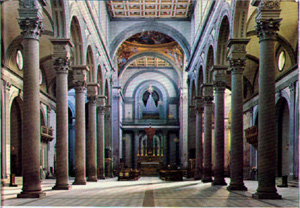
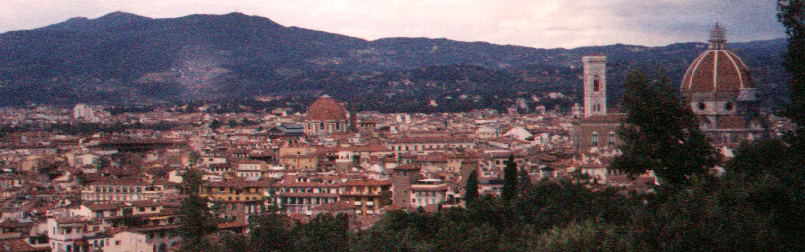
"analysis and conceptualization often depended on measurement and scale drawing. Filippo Brunelleschi, just before 1420," used scale drawings so he could conceptually model larger structures. Brunelleschi was responsible for the construction of the great dome on Florence's Cathedral church.
CAVEAT: "during the Renaissance, knowledge was understood as a matter of resemblance between signs." 1
Some have traced the origins of dual means of thinking; practice and theory to this period of European history. The mastery of two different ways of knowing referred to also as applied as opposed to abstract thought are distinguishing features of today's sciences that may not have been so distant during the period from 1000 to 1660 in the current era. For example, expressive arts and mastery of technical details fused with analysis of ancient sources and synthesis of new materials. Such skillful expressions were manifest in the numerous works of Leonardo da Vinci and Filippo Brunelleschi.
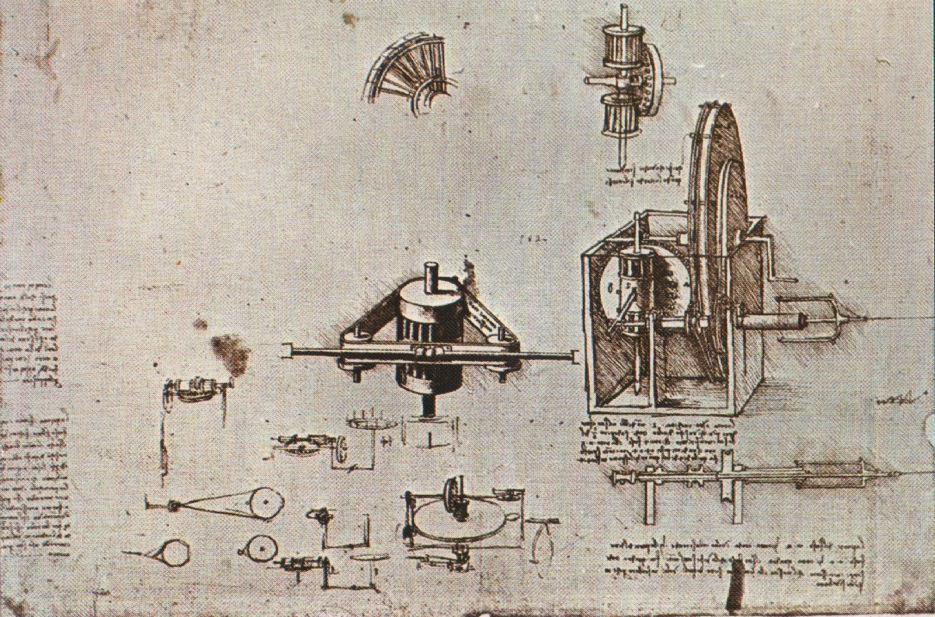
Da Vinci's notebooks were his technical and artistic means to re-envision the world.
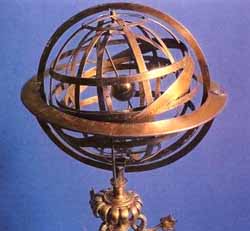
1410, Town clock in Prague constructed to represent the movement of the heavens
1452, Leonardo da Vinci was born
he grew up to become a naturalist, artist, and engineer.
1469, da Vinci came to Florence
1482, Leonardo da Vinci moved to Milan
He was not really that practical: ten tons of iron in da Vinci's large cross-bow design.
1514, Church accused him of necromancy for dissecting human bodies which was illegal then.
1534, He then moved to France at the behest of the French Court
A time period from 1300 to 1600 of transformation from:
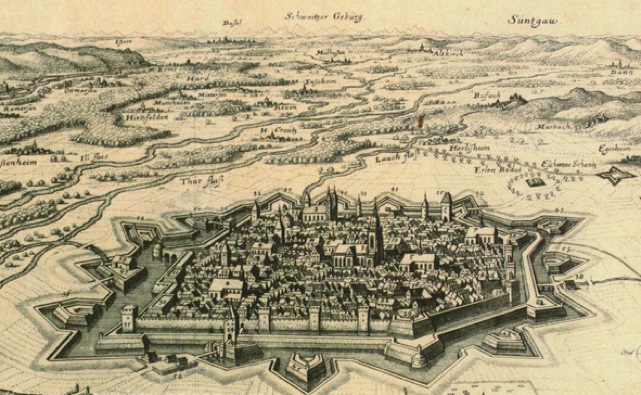
Renaissance walled (fortified town) based in part on geometrical principles derived from ballistics.
1558 Fall of Calais from England to France
1561 Fallopius published his Observations on Anatomy
1562 Akbar the Mogul Emperor of India
1563 Cathedral built in Mexico City by native peoples for Spain
1566 The Netherlands revolts against Spain & the Inquisition
1572 Catherine de' Medici as Queen of France assists in a Protestant massacre
1587 Beheading of Mary, Queen of Scots
1593 Portuguese & Dutch colonize Africa
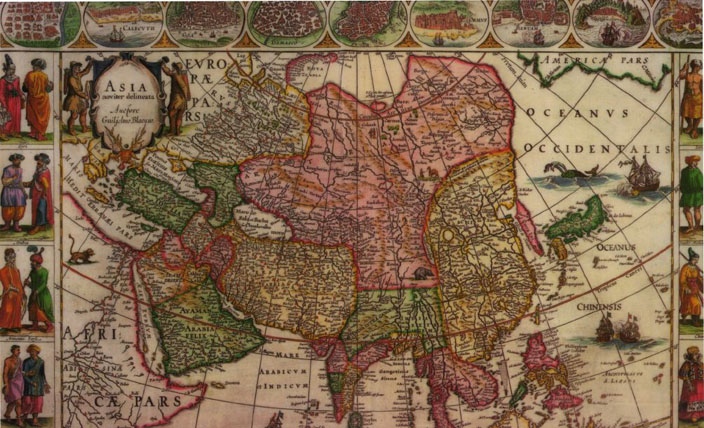 Asia in 1600
1602 Dutch East India Company was established controlling Indonesia and the spice islands
1607 Jamestown, Virginia founded
1628 New Amsterdam (York) founded by the Dutch
1648 Treaty of Peace of Westphalia ends the 30 years war
1680s John Locke assists in the founding of the Carolina colony
1688 The "Glorious Revolution" William & Mary's reign in Great Britain
Francis Bacon's idea about the central importance of experimental research in order to improve human conditions.
"Francis Bacon, captured the spirit of the new approach in important respects. And Bacon not only wrote about how science should be studied in terms of collecting, classifying and analyzing facts, He also put forward ideas about how scientific work should be organized, and how it could benefit from collective effort, with an implicit division of labour."
Pacey, Technology in World Civilization, pp. 97-98.
Spain and France fought over Italy (1500), Spain fought in the Mediterranean against the Ottomans and broke their power in the Battle of Lepanto and the control of the Levant (Syria & Lebanon) and the eastern Mediterranean Sea.
A Christian naval fleet was assembled under the overall command of Admiral Don John of Austria. Although young (in his twenties), Don John was a capable naval commander. The Spaniards were led by Santa Cruz, the Genoese by Andrea Doria, and the Venetians commanded by Agostin Barbarigo and Sebastian Veniero. The fleet under Don John's command was some 300 ships strong, with over 100 ships and 30,000 men being supplied by Philip II of Spain alone.
The Ottoman Turks had raised a fleet of 181 ships, carrying some 30,000 soldiers, and Malta was the prize they sought. Their goal was to plunder and sweep all the ships of Christian Europe from the Mediterranean. Then, in control of the sea lanes and trade routes, with their naval and economic power supreme, all of Europe would be set to fall before them.
At dawn, on October 7, 1571, the two fleets met. Only 40 Ottoman ships survived the five hour ordeal of battle. The victory was celebrated throughout Europe, despite the growing fissures and deep rift caused by the Protestant Reformation (1517) and a Roman Catholic counter-reformation (1568).
Stanford University Encyclopedia of Philosophy; Michel Foucault.
Pacey, Technology in World Civilization, pp. 97-98.
Martin Kemp, Visualization.
Jacob Bronowski, Science and Human Values.

time line | historical periods | chronological thinking