Title: Wildlife and wilder lands under fire
Background | Information | Essay | Argument | Conclusion | Lesson
Background
the effort to enlarge productive land will wipe out a large part of the worlds flora and fauna.
Edward O. Wilson, (2000), The Future of Life
Human use and appropriation of productive land is defined as the ecological footprint
In short, the Earth has lost its ability to regenerate -- unless global consumption is reduced, or global production is increased, or bothp. 27
If humanity were to replace the free services of the natural economy with substitutes of its own manufacture, the Global GNP would have to be raised by at least $33 trillion.
During the 1990s the global catch leveled of at about 909 million tons.
North Atlantic, Caribbean and Black Sea fisheries have collapsedWatersheds:
...forested watersheds capture rainwater and purify it before returning it by gradual runoffs to the lakes and the sea, all for free,
Edward O. Wilson, (2000), pp, 106-107
Atmospheric pollution, biological fragmentation, climate change, and destruction of water quality are diminishing the value of ecological services on public lands where wildlife and fisheries are threatened.
Disturbance, degradation and damage to natural areas due to polluted air, nutrient laden runoff, underground water contamination and acid precipitation are compounding the survival potential of traditionally protected, birds, mammals and fisheries. Each of the impacts is cumulative. Though one or more disturbances may appear insignificant, when viewed in light of poorly designed developments, increasing mobile sources of air pollution and diversion of surface water runoff, the combined influence of each degrading intrusion on wild lands can and often does damage fishery and wildlife populations.
Actions taken in isolation to protect a species here or a land area there are laudable and in the spirit of a national and international conservation ethos. Taken separately the protection of vast areas may appear effective, but wildlife and fishery populations are not indiscriminate dwellers on our lands and in our waters. Instead animals, vegetation fungi and the bacterial relations that support our wildlife and fisheries require specific geographical locations with peculiar water, energy, air and landscape features. Without these requisite conditions the capacity of a place to sustain life is undermined.
"Life operates on only 10% of the sun's energy reaching the earth's surface, that portions fixed by the photosynthesis of green plants."
(p. 36, E. O. Wilson, The Diversity of Life, 1994)
We already appropriate 40% o father planets organic matter produced by green plants.(p. 33, Edward O. Wilson, The Future of Life, (2000).
Definitions:
Dates:
1628, Plymouth Colony regulates the cutting and sale of timber on common lands.
1871, US Fish Commission was created to study and improve fishery stocks.
1879, April 10 set aside as Arbor Day by effort of John Sterling Morton.
1885, New York state declares the Adirondack forest preserve to protect water supplies.
1897, Forest Management Act defines the purpose of forestry reserves.
1900, Lacey Act protecting migratory birds and their ranges passed.
1903, National Wildlife Refuge system inaugurated by Presidential action to protect declining wildlife
"Throughout the nation today a series of state ad federal estuarine refuges exist as quiet testimony to the ideals, efforts and commitment of local conservation groups, planners, engineers, and scientists. These advocates possess a resolute maturity in asserting that some places must be set aside for future generations because, as Rachel Carson once remarked, 'man's way is not always the best.'" (Siry, 1984, p. 17.)
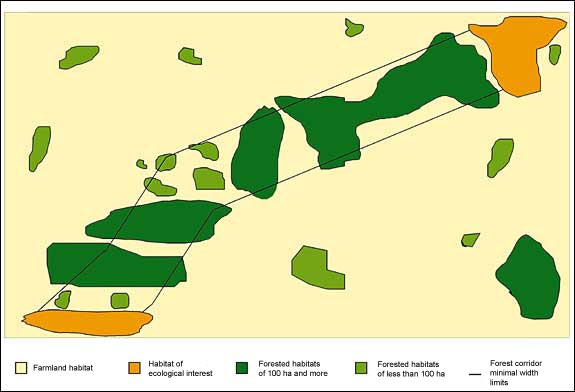
It is time to expand the ecological ethic to include future generations of fish and wildlife with adequate agricultural and forested buffers to the ranges, breeding and feeding terrain so that the recovery and not mere protection of landscapes can occur within the next thirty years. Although the side effects in benefits to the economy are direct and measurable, the moral imperative of recovering sufficient land and water resources to renew fishery and wildlife populations is of imminent importance.
Data:
Every minute, 50 acres of natural or farm land is developed in the USA.
In just sixty years every resident of the United States has only half the amount of room per person, as did their grandparents. The paradox lies here in the fact that half of us live in twice the square footage now as we did when we were children. Richer today than in the past many Americans find it hard to see let alone comprehend, the costs associated with rapid growth. In places like California, Texas and Florida where population change is faster than even in poor African countries. Migration and birth have altered familiar places beyond all recognition.
Lost in the paradox of wealth, growth, decay and poverty modern people are unprepared to face the fact that it takes nine to twelve acres of resources per person to sustain our standard of living in the United States. Hidden from our view by economic prosperity and social values to indulge ourselves in pastimes are clues to a quickening calamity of unsustainable consumption and unimaginable numbers.
We have little time for reflection and even less room for error because population momentum is an accelerating process that takes place over time and that means we are approaching the crest of the roller coaster. Either we limit our demands to avert the downward plunge or we control population growth before natural causes leave us too unprepared for the ride of our lives.
Argument
We have the capability and the wealth to invest now in the protection of the ecological services inherent in land and water. The Land and Water Conservation Fund of the federal treasury was designed for such a purpose by Congress in 1964 and has been growing in size. Unless changes are made to the law and funds appropriated to develop management practices, employ appropriate tools and recover sufficient space for water recharge, energy conservation, air quality improvement and landscape renewal, the restoration of fisheries and wildlife will not occur in time to avert a serious loss of birds, mammals, commercial and sport fisheries. Such a loss will mean costly investments by municipalities to provide adequate recreation and utility sites. The loss of ecological services will burden state and local taxing authorities and generate a revenue loss from diminished opportunities to view nature, fish, hunt or passively experience the wild outdoors.
Conclusion
The gift of a shimmering physical disequilibriumThe soil , water and atmosphere of its surface have evolved over hundreds of millions of years to their present condition by the activity of the biosphere, a stupendously complex layer of living creatures whose activities are locked together in precise but tenuous global cycles of energy and transformed organic matter,
When we destroy ecosystems and extinguish species, we degrade the greatest heritage this planet has to offer and thereby threaten our own existence.
Wilson, p. 39This urgency to protect natural areas and landscape features for more than merely their scenic qualities arises from fact that only forty years ago the Earth had half the people it does today. This growth carries an existing momentum that will cause the world's population to double again on or before 2060. Such unprecedented growth enriches the few at the cost of the many and even in the wealthy United States creates crowding, undermines health, and degrades surroundings.
Industrial societies, like ours, have already exceeded the capacity of land, air and water to sustain rising demands for security and shelter. Stripped of the capacity to assimilate our mounting wastes the countryside is exhausted by people's accelerating consumption, growing numbers and unrestrained appetites. In this situation the loss of wildlife and fisheries are only a symptom of a deeper disturbance. Psychologically we are ill-equipped to see that the land and water from which we draw our economic sustenance and mental health is dying, because we have learned, incorrectly, that the land and water are inanimate objects subject to our disposal or use.
Lesson
Everything has changed, except the way we think"
A. Einstein
Title | Background | Information | Essay | Argument | Conclusion | Lesson
Title: Wildlife and wilder lands are under fire and poorly
funded
by Joseph Siry
Background | Information | Essay | Argument | Conclusion | Lesson
Background
the effort to enlarge productive land will wipe out a
large part of the worlds flora and fauna.
Edward O. Wilson, The Future of Life , (2000).
Human use and appropriation of productive land is defined as
the ecological footprint, such as ten acres to support a persons
water, fuel, food and secure living demands.
In short, the Earth has lost its ability to regenerate
-- unless global consumption is reduced, or global production
is increased, or both
p. 27
If humanity were to replace the free services
of the natural economy with substitutes of its own manufacture,
the Global GNP would have to be raised by at least $33 trillion.
Soil: Illinois soil holds darker secrets as well. To the
89 percent of Illinois that is farmland, an estimated 54 million
pounds of synthetic pesticides are applied each year. In 1993,
99 percent (corn fields) were chemically treated
In 1993, 91 percent of Illinois rivers and streams showed
pesticide contamination.
1/4 of all the private wells in central Illinois contained
agricultural chemicals.
Sandra Steingraber Living Downstream: An Ecologist Looks at
Cancer and the Environment, (1997) pp. 1-3
Fisheries: During the 1990s the global catch leveled of
at about 909 million tons.
North Atlantic, Caribbean and Black Sea fisheries have collapsed
Watersheds: Forested watersheds capture rainwater and
purify it before returning it by gradual runoffs to the lakes
and the sea, all for free,
The value of the Catskill Mountains watershed to the city
of New York, for drinking water alone, is over $10 billion,
since to replace the natural recharge area of the land, requires
that monetary amount to clean up septic tank wastes, farm runoff
and deforestation.
Edward O. Wilson, (2000), pp., 106-108.
Information
Atmospheric pollution, biological fragmentation, climate change,
and destruction of water quality are diminishing the value of
ecological services on public lands where wildlife and fisheries
are threatened.
Disturbance, degradation and damage to natural areas due to
polluted air, nutrient laden runoff, underground water contamination
and acid precipitation are compounding the survival potential
of traditionally protected, birds, mammals and fisheries. Each
of the impacts is cumulative. Though one or more disturbances
may appear insignificant, when viewed in light of poorly designed
developments, increasing mobile sources of air pollution and
diversion of surface water runoff, the combined influence of
each degrading intrusion on wild lands can and often does damage
fishery and wildlife populations.
Actions taken in isolation to protect a species here or a land
area there are laudable and in the spirit of a national and
international conservation ethos. Taken separately the protection
of vast areas may appear effective, but wildlife and fishery
populations are not indiscriminate dwellers on our lands and
in our waters. Instead animals, vegetation fungi and the bacterial
relations that support our wildlife and fisheries require specific
geographical locations with peculiar water, energy, air and
landscape features. Without these requisite conditions the capacity
of a place to sustain life is undermined.
"Life operates on only 10% of the sun's energy reaching
the earth's surface, that portions fixed by the photosynthesis
of green plants."
(p. 36, E. O. Wilson, The Diversity of Life, 1994)
We already appropriate 40% o the planets organic
matter produced by green plants.
(p. 33, Edward O. Wilson, The Future of Life, 2000).
Definitions: watershed: biological diversity:
genetic viability: living space:
assimilative versus carrying capacity: niche:
ecological integrity: ecosystem services:
Dates: Do these historic events amount to a Legacy we are not
able to match?
1628, Plymouth Colony regulates the cutting and sale of timber
on common lands.
1871, US Fish Commission was created to study and improve fishery
stocks.
1879, April 10 set aside as Arbor Day by effort of John Sterling
Morton.
1885, New York state declares the Adirondack forest preserve
to protect water supplies.
1897, Forest Management Act defines the purpose of forestry
reserves.
1900, Lacey Act protecting migratory birds and their ranges
passed.
1903, National Wildlife Refuge system inaugurated by Presidential
action to protect declining wildlife
Details:
"Throughout the nation today a series of state ad federal
estuarine refuges exist as quiet testimony to the ideals, efforts
and commitment of local conservation groups, planners, engineers,
and scientists. These advocates possess a resolute maturity
in asserting that some places must be set aside for future generations
because, as Rachel Carson once remarked, " 'man's way is
not always the best.'"
(Siry, 1984, p. 17.)
It is time to expand our incipient ecological ethic to include
future generations of fish and wildlife with adequate agricultural
and forested buffers to the ranges, breeding and feeding terrain
so that the recovery and not mere protection of landscapes can
occur within the next thirty years. Although the side effects
in benefits to the economy are direct and measurable, the moral
imperative of recovering sufficient land and water resources
to renew fishery and wildlife populations is of imminent importance.
Our task today is to instill the ethic of Noah to avert what
Wilson and many ecologists call the bottleneck through which
all natural life is passing due to human encroachment into the
functional capacity of the earth to sustain life.
Data:
Every minute, 50 acres of natural or farm land is developed
in the USA.
Black Rhinoceros: Activist network information @ http://www.blackrhinoceros.org/actions/pollution.html
Essay:
In just sixty years every resident of the United States has
only half the amount of room per person, as did their grandparents.
The paradox lies here in the fact that half of us live in twice
the square footage now as we did when we were children. Richer
today than in the past many Americans find it hard to see, let
alone comprehend, the costs associated with rapid growth. In
places like California, Texas and Florida, where population
change is faster than in developing African nations, migration
and housing demand are altering familiar places beyond recognition.
Lost in the paradox of wealth, growth, poverty and decay modern
people are unprepared to face the fact that it takes nine to
twelve acres of resources per person to sustain our standard
of living in the United States. Hidden from our view, by economic
prosperity and social values that encourage folks to indulge
themselves in energy consumptive pastimes, are clues to a quickening
calamity of undiminished consumption and unimaginable demands
for space. As Rachel Carson once observed wild creatures,
like people must have a place to live. But as
civilization creates cities, builds highways and drains marshes
it takes away...land...suitable for wildlife.
(Carson, quoted in Siry (1984), p. 138)
We have little time for reflection and even less room for error
because population momentum is an accelerating process that
requires response time and like a speeding car must have ample
stopping distance to bring the passengers safely to a stop.
Because population momentum takes place over time, that means
we are approaching the crest of an appetite driven roller coaster.
Either we increase our efficiency to dampen our demands and
avert the downward plunge or we control population growth before
natural causes --reactions accumulating from ever widening human
assaults-- leave us too unprepared for the ride of our lives
and the loss of our animals.
Argument:
We have the capability and the wealth to invest now in the protection
of the ecological services inherent in landscapes and watersheds.
The Land and Water Conservation Fund of the federal treasury
was designed for such a purpose by Congress in 1964 and has
been growing in size. Unless changes are made to the law and
funds appropriated we risk an even more expensive problem in
the coming decades. We must create adaptive means to develop
management practices, employ appropriate tools and recover sufficient
space for water recharge, energy conservation, air quality improvement
and landscape renewal, or the restoration of fisheries and wildlife
will not occur in time to avert a serious loss of birds, mammals,
commercial and sport fisheries. Such a loss will mean costly
investments by municipalities to provide adequate recreation
and utility areas. Loss of ecological services burdens state
and local taxing authorities and generates a revenue loss from
diminished opportunities to view nature, fish, hunt or passively
experience the wild outdoors.
Conclusion:
The gift of a shimmering physical disequilibrium
that is our Earth is vanishing due to our inaction, inadvertence
and ignorance.
The soil , water and atmosphere of its surface have evolved
over hundreds of millions of years to their present condition
by the activity of the biosphere, a stupendously complex layer
of living creatures whose activities are locked together in
precise but tenuous global cycles of energy and transformed
organic matter,
When we destroy ecosystems and extinguish species, we
degrade the greatest heritage this planet has to offer and thereby
threaten our own existence.
Wilson, p. 39
This urgency to protect natural areas and landscape features,
for more than merely their scenic qualities, arises from fact
that only forty years ago the Earth had half the people it does
today. Explosive growth carries an existing and ongoing momentum
--or accelerating rate of change-- that will cause the world's
population to double again on or before 2060. Such unprecedented
growth enriches the few at the cost of the many and even in
the wealthy United States creates crowding, undermines health,
and degrades surroundings.
Industrial societies have already exceeded the capacity of land,
air and water to sustain rising demands for energy, resources,
security and shelter. Stripped of the capacity to assimilate
our mounting wastes, the countryside is exhausted by people's
accelerating consumption, growing numbers and unrestrained appetites.
In this situation the loss of wildlife and fisheries are only
a symptom of a deeper disturbance. Psychologically we are ill-equipped
to see that the land and water from which we draw our economic
sustenance and mental health is dying, because we have learned,
incorrectly, that lands and waters are inanimate objects subject
only to our disposal or use.
Lesson:
"Everything has changed, except the way we think"
A. Einstein
Our actions have been short circuited by the way we think, the
activity we reward, and the problems depth.