 determining value
Navigating the site:
Value
 Examining value;
Some reflections on the origins and expression of social, economic, and ecological values.
Relations among the many material features that contribute to value.

values | word's origin | social worth | economic | Purchasing & parity | formula | natural | materialism | wealth | worth | zero-sum
Value, meaning the significance, importance, or preciousness of a  thing, place, or person is based on widely observed and comparable qualities. Such as advantages, uses, efficiencies, worth or perceived merits of existing things or processes.
The term comes from our ability to recognize worth and call some endeavor or activity worthwhile. Further the term suggests our critical capacity to determine the comparable scarcity or abundance of things. The word also implies that different people may discover similar uses or some exceeding interest in persons, life, places, concepts or materials.
In addition to the relative quantity of something and the quality of its features, the distribution of materials and timing of the demands for precious things will affect their value.
Materialism | wealth | worth | zero - sum
Etymological ORIGIN: is Middle English -- from Old French, feminine past participle of valoir ‘be worth,’ from Latin valere.
Comparable features or quantifiable significance of processes or things.
More than mere quantity, of commercial importance is parity.
A culture's ethos, morality, or ethics heavily influence what people value and what society rewards its members for valuing. Hence, or from these expressions of sanctioned social behavior we can imagine what people think is worth more than something that is worthless.
ethos, the character or disposition of a culture as exhibited in condoned behavior, customs, or mores.
morality, or mores: the unspoken, unwritten, and codified rules that discern right from wrong, the customs and conventions of a community largely influenced by culture, beliefs, and power of enforcement.
ethics, the body of knowledge and study of those principles that people, societies and cultures employ to distinguish correct behavior from incorrect conduct and thus the ideas informing and the contexts that shape the choices between right and wrong actions. See justice.
What is the worth of one nation's goods, labor and natural resources versus another nations?
Quantity is the amount, or number available: from scarce to plenty.
| amount | scarce ( restricted ) | plenty ( available ) |
|---|---|---|
| value | greater |
less |
| worth | rare & costly |
common & cheap |
| price | high |
low |
| economic | expensive |
surplus, discounted |
| ecological | limiting factor |
relative abundance |
The questions associated with comparable commercial value involve a concept in economics called purchasing power parity.
Purchasing power parity, involves a question about whether the value of one country's capacity to obtain goods and services is comparable to their neighbor's?
A critique by Dr. Deirdre McCloskey:
The underlying question is how well integrated are these markets, any market and all markets.
Economists are not in agreement as to the existence of purchasing power parity.
"the narrowest test of purchasing power parity, and the one that dominates the official rhetoric, is to plot the price in the United States (of steel or other goods in general, in levels or in differences), against the corresponding price abroad, allowing for the exchange rate. If the slope of the line is 1.00 the hypothesis of purchasing power parity is said to be confirmed, if not, not."
pp.109-110.
"Something has gone very wrong with the quantitative rhetoric of economics."
p. 110.
A resort to statistical methods is necessary, but not a sufficient means of determining the the verity of market behavior.
Why do we resort to a faith, even when unfounded, in numbers?

* My formula is based on the "Labor theory of value"
resources and work combined make products, dry goods, capital goods, & services.

Natural Resources * Human resources => create Wealth
Environment times Population = yields => Production
interpretation
Natural resources combined with animal or human labor makes wealth or capital.
Purchasing & parity | formula | materialism | wealth | worth | zero - sum
Capital refers to surplus in the sense that tangible and intangible things can accumulate or do not readily deteriorate. This means that material possessions, non-perishable products, financial instruments, technology and techniques, information about significant processes, or investments of time and money are all included by the generalized term capital. Capital in this sense is accumulated wealth .
"Wealth is derived from combining work with available materials."
John Locke and Karl Marx, among others, explored this concept in what is defined by them as the labor theory of value.
Parity means roughly similar. Etymology–late 16th cent.: from late Latin paritas, from par ‘equal.’equality, equivalence, uniformity, consistency, correspondence, congruity, levelness, unity, coequality.
Historically there is a general and a specific meaning of parity:
• Generally meaning the value of one currency in terms of another at an established exchange rate.
• Specifically referring to a system of providing farmers with consistent purchasing power by regulating prices of farm products, usually with government price supports.

translation means: any value arises from a combination of human skills and natural conditions.
Nature and human effort are necessary to combine when defining something's worth.
When you put the two material categories together (land or Nature and human effort) the mixture creates something that is worth more than it was in isolation. That is to say without added work to make the raw materials into more useful commodities, unrefined materials are not worth as much as finished goods.
See commodity.
Natural and human resources are combined in order to form a more reliable and accountable measure of wealth. Such refinement of natural materials is what has value to others in society. Finished or refined products have a greater worth than various natural, raw materials because they have more varied uses, do not deteriorate over time or serve significant functions.
Nature -- Even though it is a source of products-- nature, or natural resources are by definition unfinished, unrefined, or crude, because raw materials are without purposeful design for social uses.
Purchasing & parity | formula | materialism | wealth | worth | zero - sum
Nature can be considered as the three ecological dimensions of human existence each contributing to the inherent, useful, and social value of natural peoples, wildlife, places, or objects.
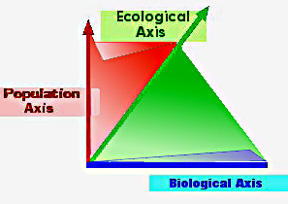
Biological axis: X axis means living organisms and their inherent physiological needs
Population axis: Y axis means the quantity or amount of living organisms, their spatial distribution and the age structure of the group of reproducing creatures.
Ecological axis: Z axis means the relations of living organisms to their immediate surroundings; both other living things and the physical distribution of resources.
Accounting for ecological assets.

Materialism | wealth | worth | zero - sum
These three ecological dimensions of existence are derived from the geometrical dimensions of settings, such as rooms, buildings, property lots, or other structures. But in the above case, length, width and depth are replaced by biological elements, population features, or ecological conditions in which living things thrive, persist or go extinct.
Purchasing & parity | formula | materialism | wealth | worth | zero - sum
Social values are those expressions of value or value laden behaviors such as attitudes, behaviors or mores (and folkways) that a group exhibits, believes in as important, or upholds by means of institutionalized (meaning formalized ways) sanctions, rewards, reinforcements, or shame. All societies and social animals display certain habits, behavioral responses, and group activities that arise from the situation of being among others. Those concepts and ideas that are shared among members of a group relating to worth or significance of others, their possessions, skills and / or products.
The worth of, significance of, or value of something, some person, some place or some intangible as determined by others.
From social and society, meaning:
- social existing for others, more than a few isolated individuals, a group.
- society the aggregation of people into a common, identifiable and coherent grouping with distinguishing characteristics arising from its members but widely shared by members of the population.
That means any social value is and not just an expression one's own personal system of judgment. To the extent that others agree on what items, skills, product, or services are desirable, we say social values are shared.
The expression of a group with respect to actions that are rewarded or discouraged.
Those things of worth that are common to a larger number of people as necessities or as niceties.

| value | shared | personal |
|---|---|---|
| utility | necessity | nicety |
| defined as | must have to survive. | desirable but not absolutely needed. |
| examples | air, food, water, space, shelter. | health and nutrition. |
| artifacts, tools, machines, devices. | skills, implements, techniques. | |
| wealth | security |
Values as related to value
Dr. Clare W. Graves (December 21, 1914 – January 3, 1986) was a College professor of psychology, who originated a theory of adult human development and deliberately used the term "values" in a model of human conduct corresponding to stages in how the individual interacted with their peers and wider society. He popularized in the 1960s a perspective that . "Value Systems and their Relation to Managerial Controls and Organizational Viability," paper presented before the College of Management Philosophy, The Institute of Management Sciences, 1965. Graves was a professor of psychology at Union College who was a specialist in the theory of human personality as it related to medical and organizational problems.
Students of Grave's contributions have insisted that, "The Spiral Dynamics model of Graves, also referred to as the Emergent Cyclical Levels of Existence Theory (ECLET), provides a profound and elegant system in terms of which human development can be understood (Wilber, 2001). . . . For purposes of clarity, Wilber recommended the use of the word “value system” as proposed by Graves."
See: Maretha Prinsloo,"Consciousness Models in Action: Comparisons," http://integralleadershipreview.com/tag/clare-graves/
There are criticisms of Graves and his reliance on the studies of his contemporary Abraham Maslow for both the term "values" based on the study of white privileged men, and presentation of a hierarchical approach to understanding how all humans determine the correctness or incorrectness of their actions. At a deeper level Graves "system of values" or value system" is seen as a product of industrialism and thus flawed for both a materialist bias and an instrumentalist approach to defining people, products and behavior.
materialist bias that all understanding is limited to that which can be observed
instrumentalist approach that pragmatically (bias) suggests all forms of thought and behavior are tools for the narrow purpose of achieving some desired (not necessarily desirable) end as opposed to the greater good, or liberation from oppression, or metaphysical transformation.
Value
A regard for something; as in an item, person, process, or place.
A deserved utility or quality that any action or thing possesses.
The relative importance --of stuff, behavior, or sequences in an outcome-- depending on some criteria for judgment.
A matter of degree to which people assign some significance.
| 1 | 2 | 3 |
|---|---|---|
| aesthetic | utilitarian | ecological |
| pertaining to the senses | of some use, or functional |
naturally inherent |
| beauty | brawn |
being |
| artistic or scenic | needed or desired for an outcome |
biological & relational |
An alternative comparison of values:
| Spiritual | Material | |
| health | karma |
hygiene |
| aesthetic | grace |
pleasant |
| utilitarian | good works |
productive |
| ecological | ritual |
services |
Purchasing & parity | formula | materialism | wealth | worth | zero - sum
 Materialism is the body of knowledge characterized by arguments that sustain beliefs in the importance and
definitive power of tangible, physical items, things and tools.
Materialism is the body of knowledge characterized by arguments that sustain beliefs in the importance and
definitive power of tangible, physical items, things and tools.
This is a belief that tangible, physical items, things and tools have the capacity to shape what a society values; that is, what any people or an entire culture believes, finds worthwhile, and even empirically thinks about the world. Materialism in referring to materials and matter as objects, stresses that only those real things that can be measured or accounted for exist with any importance to society.

For example, the idea that an ecosystem is the sum of all the physical, chemical and geological preconditions for life to exist reduces all experience to the material, as opposed to the transcendent or spiritual dimensions of existence.
Relating costs to value, next.
"Conservation or restoration have contributed to economic development."
Edward O. Wilson wrote over two decades ago that "The estimated cost of to make an impact on tropical deforestation over the next five years would be U.S. $8 billion–a large sum but surely the most cost-effective investment available to the world at the present time."
p. 16, Biodiversity, (1988).
§
Accounting for ecological assets.
E. O. Wilson | What is biological diversity? | Genes | Nature index

A Zero-sum game?
The concept arises from the notion that wealth can be transferred from one material item to another but that the overall stock of wealth is conserved. This means that for one thing to gain in worth, something else must diminish in value equal in amount to the increase in worth of the more valued object.
Purchasing & parity | materialism | wealth
| worth | zero
- sum

More on identifying natural values:
The values of features associated with particular places.
The values associate with coastal marshes.
Value and landscapes and land.
Eugene Odum on natural assets.
E. O. Wilson | What is biological diversity? | Genes | Nature index
Terms | Glossary | Word webs | Basic vocabulary | Advanced Vocabulary | Antonyms | Synonyms | Obscure words
Last Updated on 10-5-2007 & 6-09-2011.