 Interpreting Wetlands
Ecological Design Activity Interpreting Wetlands

Dr. Siry
The United Nation's Millennium Ecosystem Assessment Report for 2005 brings grim conditions to light of which most people are not aware.
Wood Storks as indicators of wetland health

What is a wetland's importance?
Ecology is a synthetic science, so once you analyze the details of any particular branch of ecology, you need to see how those branches tie together well; meaning to fit together functionally and fit together spatially (form) to seamlessly furnish services and goods called natural capital.
"Estimates of global wetland area range from 5.3 to 12.8 million km2. About half the global wetland area has been lost, but an international treaty (the 1971 Ramsar Convention) has helped 144 nations protect the most significant remaining wetlands. Because most nations lack wetland inventories, changes in the quantity and quality of the world's wetlands cannot be tracked adequately. Despite the likelihood that remaining wetlands occupy less than 9% of the earth's land area, they contribute more to annually renewable ecosystem services than their small area implies. Biodiversity support, water quality improvement, flood abatement, and carbon sequestration are key functions that are impaired when wetlands are lost or degraded. Restoration techniques are improving, although the recovery of lost biodiversity is challenged by invasive species, which thrive under disturbance and displace natives. Not all damages to wetlands are reversible, but it is not always clear how much can be retained through restoration. Hence, we recommend adaptive approaches in which alternative techniques are tested at large scales in actual restoration sites."
Using principles of ecological design to understand the value and significance of wetland restoration and protetction
Three stages | Concerns in planning | water shortages
A). Define ecological design using wetlands & evaluate this page -- Wikipedia Wetlands:
A.1 Summarize the importance of wetlands according to the page.
A.2 Of the eight substantive parts of this article, what strikes you as the parts of most to least importance?
A.3 How would you organize, or better reorganize a paragraph describing the importance of wetland's restoration with these eight parts in mind?
B). Now a book, read the Ecological Design's Preface, and define the phrase ecological design as “any form of design" that _______________________ ?
C). How is it, ecological design, both a
hopeful vision + pragmatic tool for protecting wetlands?
D). origins of:
What does he say the three of four origins are for their ideas about design?Sources for are:
Architecture and nonlinear dynamics meet in “searching for a pattern.” (Wendell Berry)
- Christopher Alexander, A Pattern Language. What is a pattern?
- Gregory Bateson, Steps to an Ecology of Mind, & Mind and Nature.
- Horace Freeland Judson, The Search for Solutions.
- Ian McHarg, Design with Nature
- John Todd's Living Machines for water conservation.
E). Example of a dialogue (define what the term dialog means and give an example):
F). Describe the purpose of the book in terms of clean healthy water:
Drawing only from the book’s first five pages, what is the purpose of this writing?G). The art of an overview:
An overview is a summary that tells us the reader where we are going.How would you describe Van der Ryn's overview and what three or more examples does he use; from what fields of study are these examples taken?
Draw a diagram of any particular site that describes your idea of a place by showing the location of important facilities and defining natural features so that one could know how to get there, how to leave there and what to notice while you are there.
pages
|
||
Dumb
design |
vs. |
Ecological
design |
| |
||
| |
||
| |
||
Homework
define: Sustain with respect to the water, public trust and living things in a wetland.
How are the authors critical of the idea?
“the possibility of balance and permanence in a world where we experience
precisely the opposite.”
p. 3
How important are wetlands given the reality of Abrupt Climate Change due to human induced global warming?
“In search of comfort, convenience and material wealth, we have begun to
sacrifice not only our own health, but also the health of all species. We are
starting to exhaust the capacity of the very systems that sustain us, and now
we must deal with the consequences.”
p. 3
Diagram the connections
among:
Steps to an Ecology of Mind, Gregory Bateson, (P. 14) thought & experience should together guide us to building a more congenial, accessible, and naturally functional world.
Sean Wellesley Miller
Towards a Symbiotic Architecture
p. 8
“Infrastructure for the provision of food, fuel, water, and building materials.”
Crucial, unseen, yet critical 1/12th and 1/3d
"One BTU in twelve is used to heat and cool the US building stock,"“1/12 is equal” to __________percent of the energy used in the country.
“On average it takes as much energy to heat and cool the US building stock for three years as it took to build it in the first place.”
p. 8
Define the three stages provided by ecological design advocates:
"Ecological design offers three critical stages for addressing this loss:
conservation, regeneration and stewardship."
| Principle | conservation |
regeneration |
stewardship |
|---|---|---|---|
| Ecological accounting informs | |||
Emerges from a place |
|||
Keeps things on site |
|||
Working with nature |
|||
Making nature obvious |
|||
| Includes everyone's needs | |||
| advocates | Gifford Pinchot & W. J. McGee | George P. Marsh | Siry on Leopold & Carson |
The three goals: conservation, regeneration and stewardship should not be confused with the five ecological design rules that Van der Ryn and Cowan propose.
They must be synthesized or put together but they are different concepts.
For example:
What is an appropriate level of density for a town? (could be answered 18 different ways)
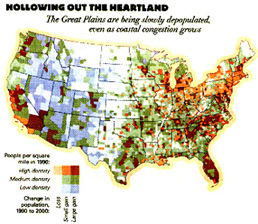
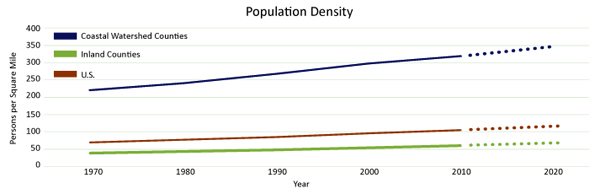
Higher population densities are often found along the shores of the Great Lakes, Gulf and both oceans.
How can land-use patterns be made more conducive to the needs of wildlife? [ Must be answered in terms of A) Ecological accounting informs, such that B) Emerges from a place
to C) Keep things on site, so that vegetation, wildlife, and fisheries benefit from D) Working with nature.]
p. 14
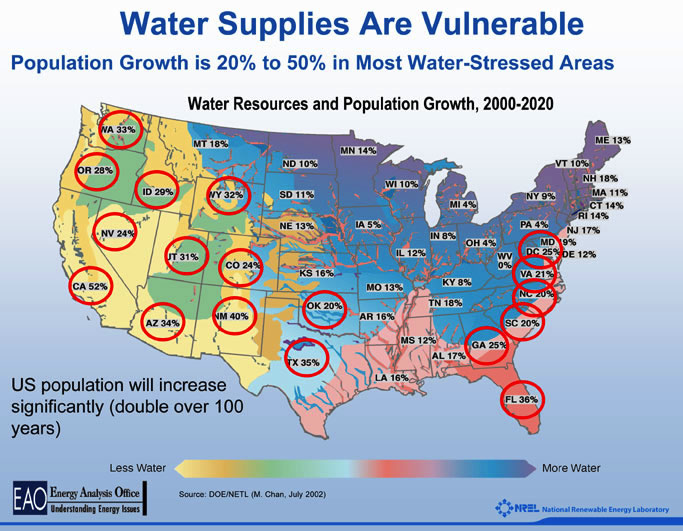
Water use is rising faster than population growth in these large states.
While the U.S. population is expected to increase significantly, accessible freshwater supplies are not. Moreover, population movement and energy demand do not always track well with water availability. During the 1990s, the largest regional population growth (25%) in the United States occurred in one of the most water-deficient regions, the Mountain West. Water availability is also becoming a serious issue in the Southeast, where population has increased by nearly 14% since 1990.
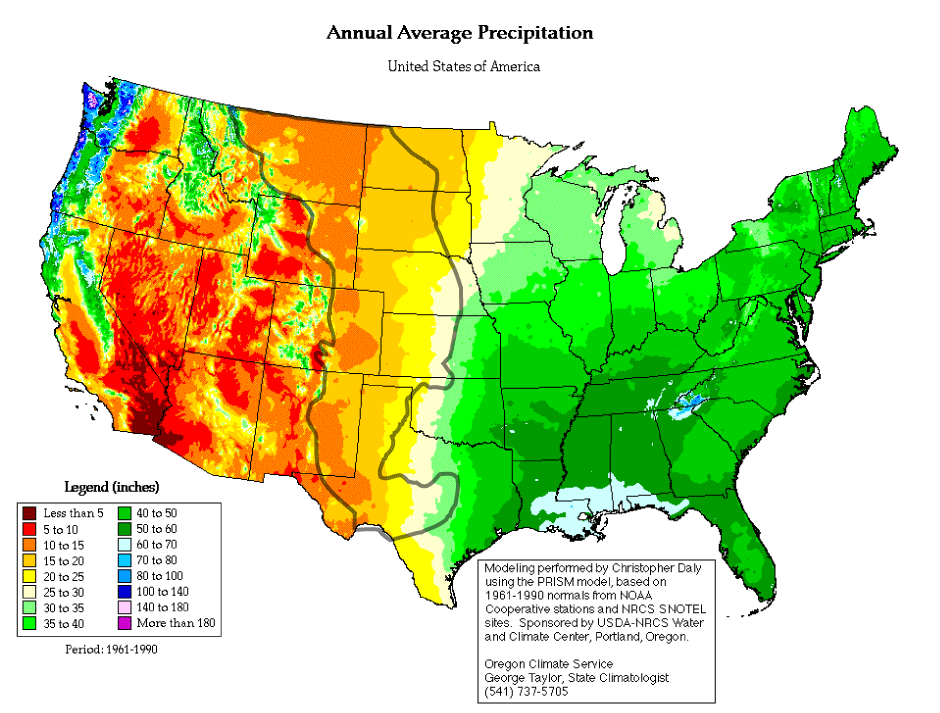
By comparison, the water-rich northeast has experienced only a 2% growth in population.
WETLAND RESOURCES: Status, Trends, Ecosystem Services, and Restorability
Annual Review of Environment and Resources
Vol. 30: 39-74 (Volume publication date November 2005)
• First published online as a Review in Advance on July 6, 2005
• DOI: 10.1146/annurev.energy.30.050504.144248
Water | Water protection | Water ethics