|
 |
| |
|
The Labor Theory of Value |
 |
Authorities trace this idea of the labor theory of value to
influences starting from the work of the Greek philosopher Aristotle (384-322 BC). This labor theory of value became a central or core facet, if not a necessary feature,
in social analyses. |
| |
|
Native American woman weaving |
During the Renaissance and later the Enlightenment the changing character of work and the importance of labor was taken up by such writers as John Locke (August
29, 1632 – October 28, 1704), Jeremy Bentham, (February 15, {O.S. 4 February}, 1748 – June 6, 1832), and later John Stuart Mill (May
20,1806 – May 8, 1873 ). These last two men were called utilitarians. They had studied economists such as the Scottish writer Adam Smith (1723-1790) and the English theorist David Ricardo (1772-1823).
Among other arguments that he proposed, Bentham advocated for women's equality together with:
|
These writers argued against Thomas Malthus
who contended that subsistence and scarcity determined the worth of things. The arguments encourage Karl Marx to investigate the entire realm of the relations among technology, labor and wealth in his multivolume study of Das Kapital.
Economic growth argument
In 1867, "Karl Marx proposed that a motivating force of capitalism is in the exploitation of labor."
Das Kapital
• Revealing argument
 In Chapter Seven of Das Kapital Karl Marx argued that:
"The capitalist buys labour-power in order to use it; and labour-power in use is labour itself. The purchaser of labour-power consumes it by setting the seller of it to work."
Labour is, in the first place, a process in which both man and Nature participate, and in which man of his own accord starts, regulates, and controls the material re-actions between himself and Nature. He opposes himself to Nature as one of her own forces, setting in motion arms and legs, head and hands, the natural forces of his body, in order to appropriate Nature’s productions in a form adapted to his own wants. By thus acting on the external world and changing it, he at the same time changes his own nature. "
Karl Marx, Das Kapital (Hamburg, 1867) §1 Chapter 7.
importance
The utilitarian economists argued instead how the value of a commodity; its worth or economic significance was determined by the quantity of labor needed to produce it.
Work, such as repairing a roof with fresh thatch as shown here, possesses an importance in proportion to the inherent time and skill needed to perform the job. This idea of labor's value contributed to a thing's utility.
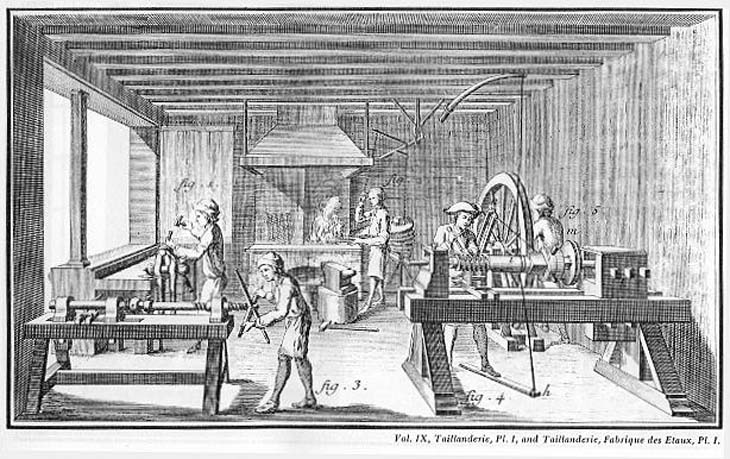
A depiction of 18th century skilled labor conditions in Diderot's Encyclopedia showing a workshop of artisans, or "skilled workers" taillanderie – tool makers.
Work, these analysts insisted – or that effort of any & all laborers, or the level of skill and measurable amount of labor of others – obtained in exchange was the source of the value of products or resources. Worth then, was a measure of the work expended over time to perfect a product. This meant that craft and skill were part of the expense in determining the relative worth, or value and thus the cost of services performed or products.
The German political theorist, historian, and writer Karl Marx (1818-1883) further argued that while labor might dictate a good's value, the existence of capitalists extracting profits meant that labor did not get to keep the surplus value derived from the very work they performed.
The labor theory of value was superseded by the marginal productivity theory of distribution at the end of the 19th century, which emphasized that many factors determined the value of a good.
 Proposed in the late 19th century by the Marginalist group of economists, such as William S. Jevons, used differential calculus to study the impact of small changes in economic quantities, marginal utility refers to the additional satisfaction a consumer derives from the consumption of one extra unit of a product.
Thus, an individual's demand for a product is determined not by the total utility of it but by its marginal utility. Therefore, the greater the supply of a product, the smaller its marginal utility. These economists rejected the labor theory of value which previously had been so central --or essential-- to classical economics.
 Source:
R D Black, A W Coats, and C D W Goodwin, The Marginal Revolution in Economics (Durham, NC, 1973)