 Caribbean Environmental History
Syllabus
| Sun 11/23/14 | Texts | Calendar | Map | Weekly Questions |
 |
Caribbean history is among the most pivotal and misconstrued of subjects in world history. For those of you seeking an authentic academic challenge in knowing about the past this may be a very rewarding inquiry into the origins of your cultural heritage; including the legacies of religion, slavery, ethnic identity, and nature protection in the Americas. Together in this course we will explore several tiers of subjects concerning economic geography, diverse peoples, and an urgent need for understanding the consequences of settlement, the subsequent African and Asian Diasporas, and an uneasy tension between poverty and power in Mexico, Central America, & throughout the Caribbean. |
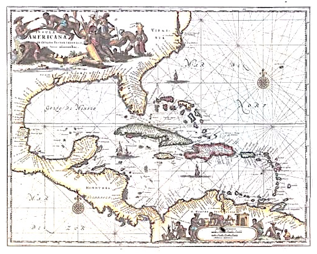
| The Americas: 1662, Dutch map. |
Expectations: In this discussion class participants more practically, will have opportunities to hone their skills in reading analytically, in verbally conveying their views based on the texts about biological conditions, ecological invasions, cultural imperialism, and ethnic identity in a supportive setting. You will be coached to better express your ideas in writing as you learn to analyze writing throughout the term. Especially in our class, I would hope you would experience the delight or enjoyment of being often moved by the profound power of ideas or articulate prose to lift your spirits, amend your behavior, nourish your more curious sensibilities, and even move you to act prudently as a means to improve both yourself and our world. Should your papers not include the texts, I reserve the option to give you an hour exam on the texts.
Grades: all assignments are graded with careful attention to each of these criteria: {CLIFS}
1. C clarity, coherence, spelling, grammar & logical consistency
2. L length & development of your arguments, ideas, or presentations
3. I information from the class texts, library research, or interviews
4. F frequency of examples from the lectures, journal, notes & readings
5. S subjects developed as argued in a thesis; introduction, summaries, & conclusion.
Write the names and phone numbers of two other Active participants in the class:
1. _____________________________ 2. _____________________________
Texts | Calendar | Map | Weekly Questions
August | September | October | November | December

Texts to read and use in essays:
Alfred Crosby, Germs, Seeds, and Animals. Octavio Paz, The Labyrinth of Solitude.
Alfred Crosby, The Columbian Exchange. Jamaica Kincaid, A Small Place.
Sidney Mintz, Sweetness and Power. W.E.B. DuBois, The Negro.
Archie Carr, The Windward Road. J. Siry, “Mangroves of the Tropic Seashores"
Study Guide
We will also analyze a sample of the arguments presented by some of these most thought-provoking authors, including Derek Walcott, Alfred Crosby, Jamaica Kincaid, W.E.B. DuBois, Octavio Paz, Isabel Allende, Eduardo Galeano, Juno Diaz, Carl O. Sauer, Archie Carr, & even Christophoro Colombo, himself.

Calendar
August | September | October | November | December
August
M 25 Studies in Ecological History: Crosby, Walcott, Mintz, Paz, & others.
W 27 Prestest - Scope, significance of learning. Olin 220, creativity lab.
F 29 The authors & meaning of the Caribbean as a "crucible."
September
M 1, Labor Day Holiday, no class (listen to Derek Walcott, The Antilles) origin of the word
W 3, Derek Walcott, The Antilles discuss his themes, meaning, and use of language.
F 5, Crosby Germs, Seeds and Animals, The biology of imperialism, pp. vii-44.
M 8, Crosby Germs, Seeds and Animals, Cultural adaptations, pp. 45-81. 148-166.
W 10, Crosby Germs, Seeds and Animals, Ethnic character and identity, pp. 82-108
F 12, Crosby Germs, Seeds and Animals, National Character & fictions, pp. 167-179.
M 15, Crosby, The Columbian Exchange, mapping catastrophe, pp. ix-3-63.
W 17, Crosby, The Transformation, pp. 64-121.
F 19, Crosby, The disease, pp. 122-164.
M 22, Crosby, Hispaniola; The passing of the Arawak & Taino, pp. 165-207.
W 24, Crosby, Meaning of the Columbian Exchange, pp. 208-222.
F 26, Writing exercise on the Crosby's books for the Columbian exchange draft essay
M 29, Essay draft due: Consequences of the Columbian Exchange, class editing exercise.
October
W 1, Art museum, meet at the Cornell Fine Arts Museum, view the collection.
F 3, Octavio Paz La Malinche: Is gender an excuse for betrayal? pp. 65-88.
Redrafted Crosby essay with Paz’s perspective due! For people who missed Monday's editing exercise.
M 6, Du Bois, See text on-line The Negro (1915)
The West Indian Slave Trade, pp. 9-19, 76-142. Octavio Paz La Malinche: gender & betrayal? pp. 9-29, 65-88.
Final Crosby essay with exercise/ perspective due!
W 8, Du Bois, Slavery in the West Indies, pp. 143-182.
F 10, Discuss First Lecture on Moral Dilemma's of Slavery -- The Moral Problem of Slavery in Western Civilization
M Fall Break –Saturday, October 11-14 The Fall Break means No classes.
W 15, Mintz, Food, . . . pp. xv-18 European colonial rivalry and scars of imperialism,
F 17, Mintz, Production, pp. 19-73.
M 20, Mintz, Consumption, pp 74-150.
W 22, Mintz, Power, pp. 151-186.
F 24, Mintz, Eating & Being, pp.187- 214.
M 27, Octavio Paz, LABYRINTH OF SOLITUDE, pp. 9-29, See: Analyze Chapter One: exercise in class. pp. 9-29,
W 29, Octavio Paz, Mexican Masks pp, 29-46.
F 31, Dia de los Muertos – attend the celebration at Cornell Patio, Monday afternoon!
Essay due on Slavery’s consequences–Du Bois, Walcott, Kincaid, Mintz, & others.
November
M 3, Octavio Paz, Day of the Dead - pp. 47-64. & attend the celebration at Cornell Patio, Monday afternoon, 4:00-5:00 PM!
W 5, Paz on Colonialism & Catholicism, pp. 89-116.
F 7, Octavio Paz as a mirror on Mexico & the Indies - Paz, Revolt 1820 to Revolution 1910, pp.117-150.
M 10, Discuss Second Lecture on the Moral Dilemma’s of Slavery -- The Moral Problem of Slavery II
W 12, Paz, The Dialectic of Solitude, pp. 195-220.
F 14, Mintz, Eating & Being, pp. 187-214 & contrast with Paz, pp. 238-283.
M 17, American Foreign Policy & The Open Veins of Latin America by Eduardo Galeano.
W 19, Paz, pp. 284-325, "Mexico & the Unites States", pp. 355-398.
F 21, Galleano, pp. ix-58. “War of the Worlds” Eduardo Galeano speaking
M 24, Galeano, pp. 60-258. See these Notes from Galleano's text -- read a NYT Review of his work: Compare authors
W Thanksgiving Break
December
M 1, Eduardo Galeano: Verbal Reports & interpretations - The
Devastation of the Caribbean
W 3, Verbal Reports – Compare authors
F 5, Verbal Reports – Compare authors
12: Final Exam Friday, 8 AM - 10 AM: verbal presentations & final revised paper due.
August | September | October | November | December
Expectations for Student Learning outcomes for ecological history:
A Rollins student's submission of work for academic credit indicates that the work is the student's own. All outside assistance should be acknowledged, and the student's academic acquisition of information truthfully reported at all times.
- Identifying and describing key evidence presented by the primary sources used in the class.
- Communication Skills. Active participants will learn to organize and express their thoughts clearly and logically in writing and verbally by frequent informal and ungraded exercises.
- Critical Thinking. Active participants will practice written analysis to apply historical methods to critically evaluate the record of past events and how the text's authors have interpreted significant have interpreted significant ecological invasions, social disruptions, and economic turning points.
- Research Skills. Active participants will acquire and use basic historical research skills, including the effective use of the Internet, libraries, archives, and museums with appropriate texts or databases to display their literacy.
- Writing and Intellectual Integration. Active participants may demonstrate their mastery of the knowledge and skills involved in historical analysis by conceptualizing and executing a significant piece of interpretive writing based on more than three author's explicit arguments and related ideas on a clearly defined topic.
- Active participants will have repeated opportunities to demonstrate an accurate knowledge of historical events where biological factors influenced how people responded to conditions and the significance of specified periods where ecological disasters altered economic and social development.
- Active participants demonstrate in writing and verbally skills of critical analysis:
- Formulating persuasive arguments based on evidence from texts.
- Evaluating evidence and critiquing author's claims in the assigned readings.
- Understand fundamental physical and biological principles that govern natural processes. (Geography, isolation, disease, ecological invasions, food sources, population growth.)
- Compare and contrast fundamental concepts from the social sciences and the humanities underlying environmental thought and governance. (Nutrition, migration, religion, ethnicity, nation, disease frontiers, gender and prejudice, colony, empire, cultural imperialism.)
- Integrate and apply perspectives from across the natural sciences, social sciences, and the humanities in the context of complex environmental problems. (Native depopulation, plantation & mono-crop agriculture, slavery, manumission, Mestizaje process, and the paradox of: independence movements, economic development, or West Indian cultural expression.)
- Communicate integrated perspectives on complex environmental problems in the form of written and oral argument to both professional and lay audiences. (The impact of sugar production and consumption on the land, labor and capital accumulation of Britain, Europe and the European’s American colonies.)
- Independently Design and construct formal essays that describe and summarize examples of ecological conditions that created predicaments or problems that made the Caribbean and Central American region of pivotal importance in history.
Course Requirements:
Texts | Calendar | Map | Weekly Questions
Items Percentage of Grade
Blackboard, frequent use. 5%
Pretest 5%
Reading and recitation 5%
Active Class Participation 15%
Writing 1st essay 20%
Writing 2d essay 20%
Final essay 20%
Final presentation 10%
100%
Percentage range for Grade Scale
93-96 A
90-91-92 A-
87-88-89 B+
83-84-85-86 B
80-81-82 B-
77-78-79 C+
73-74-75-76 C
70-71-72 C-
67-68-69 D+
63-64-64-66 D
60-61-62 D-
59 & lower F
Each assignment that is submitted on Blackboard has an accompanying statement of outcomes, such that you can see before and after you write the terms by which your papers and other assignments are awarded points and a grade. I track the amount you write as well as the quality of the arguments you make, regardless of the grade you earn. See Blackboard™
December 12: Final Exam Friday, 8 AM - 10 AM: verbal presentations & paper due. You stay for the entire 2 hours.
Final exam is an oral presentation of your written findings.
A. Submit a rewritten essay based on previous two papers and all the authors (20%)
B. You present a rehearsed and engaging verbal summary of your paper and focusing on what you learned specifically from the authors lasting from 4 -5 minutes in length of presentation. Music may accompany your talk but not video clips. You stay for the entire 2 hours. (10% of grade is oral present).
All work that you submit, including blogs, e-mails, and texts, must be your own words, or have an acknowledgment as to whose words, ideas, or beliefs are being used and from where.
ENV 206.1: Caribbean Environmental history, is a course that carries 4 hours of credit and counts as an Environmental Studies elective or as a Latin American and Caribbean Studies elective course.
Texts | Calendar | Map | Weekly Questions
A statement about accommodating students with significant concerns.
Rollins College is committed to equal access and does not discriminate unlawfully against persons with disabilities in its policies, procedures, programs or employment processes. The College recognizes its obligations under the Rehabilitation Act of 1973 and the Americans with Disabilities Act of 1990 to provide an environment that does not discriminate against persons with disabilities.
If you are a person with a disability on this campus and anticipate needing any type of academic/medical accommodations in order to participate in your classes, please make timely arrangements by disclosing this disability in writing to the Disability Services Office at (Box 2772) – Mills Building, 1000 Holt Ave., Winter Park, FL, 32789. Appointments can be scheduled by calling 407-646-2354 or by emailing: mailto:gridgeway@rollins.edu
My policies:
I am here to excite and encourage you to excel in learning new concepts and practicing your writing and speaking abilities in an effort to create meaningful discourse. My purpose is to feed your inquiring intellect with significant ideas in a coherent and challenging manner. I anticipate you will ask questions and actively work together to overcome the challenges the course material may pose for you in achieving an excellent level of performance based on an improved, articulated understanding of the readings. I recommend you to discuss perplexing ideas, passages, and assignments with me–at length–during my office hours.
Active learning
Keep in mind that participation in this course involves not only alertness and verbally contributing your ideas, but also listening respectfully without interrupting other speakers who are presenting their views on the assigned readings. Paying attention to others and to me is a sign of respect that I will reward. The use of electronic media, texting, or web browsing for other than class purposes is treated as an absence since texting, internet surfing, e-mailing, or being digitally inattentive to our discussion during class meetings robs us of your intellect’s contributions to our discourse. Students on unauthorized Internet site will be asked to leave the class for that day and lose participation points for the week. Active participation may include meeting me to confer during office hours.
Office # is 407-646-2648.
Beale Building #105: Hours– Mon. 11: AM – 12:30 PM; Tues. 11:30 AM – 2:30 PM Wed. 11:AM – 2: PM
Late papers
Submit all assigned work on or before the start of the class on the day the assigned work is due. Late papers cannot earn the same credit as those received on time in fairness to the punctual students. This is really because we discuss in the class the day the essays are due some of what you had written. Always back-up your work as you write, start at least a week before, and keep a printed copy of the essay you give me.
Paper format
The look of any college paper is always a professional document with an accurate date and page numbers indicating when the work was completely written. I ask you to place a cover page with your name, phone number, essay title, and an abstract of two to four sentences covering the substance of your essay for purposes of privacy because I make extensive comments on your work, that you must read in order to revise the essays. Spelling and grammar errors are unacceptable. All papers are to be typed, double spaced, in Arial or times new roman font, have one inch margins with 23 lines to the page as a minimum.
Academic honesty and writing with integrity
Cheating, borrowing ideas, or copying without proper citation diminishes the integrity of any writing. The habitual resort to these less than responsible practices amounts to plagiarism–a most serious academic offense of novices and experts alike. By the use of words or ideas that are not your own and are either insufficiently accredited or not acknowledged at all you undermine the essay’s reliability. The consequences are that you can fail the assignment, or even fail the class, since these offenses are a violation of the College’s honor code. As such, I am obligated to report such violations to the Dean.
All work must be your own, other's ideas or words must
be attributed by a specific reference, or else you have committed a fraud, and
you are guilty of plagiarism, for which you can fail this class.

College Policies
A statement about accommodating students with significant concerns.
Rollins College is committed to equal access and does not discriminate unlawfully against persons with disabilities in its policies, procedures, programs or employment processes. The College recognizes its obligations under the Rehabilitation Act of 1973 and the Americans with Disabilities Act of 1990 to provide an environment that does not discriminate against persons with disabilities.
If you are a person with a disability on this campus and anticipate needing any type of academic/medical accommodations in order to participate in your classes, please make timely arrangements by disclosing this disability in writing to the Disability Services Office at (Box 2772) – Mills Building, 1000 Holt Ave., Winter Park, FL, 32789. Appointments can be scheduled by calling 407-646-2354 or by emailing: mailto:gridgeway@rollins.edu
Membership in the student body of Rollins College carries with it an obligation, and requires a commitment, to act with honor in all things. The student commitment to uphold the values of honor - honesty, trust, respect, fairness, and responsibility - particularly manifests itself in two public aspects of student life. First, as part of the admission process to the College, students agree to commit themselves to the Honor Code. Then, as part of the matriculation process during Orientation, students sign a more detailed pledge to uphold the Honor Code and to conduct themselves honorably in all their activities, both academic and social, as a Rollins student. A student signature on the following pledge is a binding commitment by the student that lasts for his or her entire tenure at Rollins College: The development of the virtues of Honor and Integrity are integral to a Rollins College education and to membership in the Rollins College community. Therefore, I, a student of Rollins College, pledge to show my commitment to these virtues by abstaining from any lying, cheating, or plagiarism in my academic endeavors and by behaving responsibly, respectfully and honorably in my social life and in my relationships with others. This pledge is reinforced every time a student submits work for academic credit as his/her own. Students shall add to the paper, quiz, test, lab report, etc., the handwritten signed statement
"On my honor, I have not given, nor received, nor witnessed any unauthorized assistance on this work."

Texts | Calendar | Map | Weekly Questions
Reserve:
Keen & Haynes, A History of Latin America & the
Caribbean: should be read throughout the first three months for geographical
and historical details, especially Chapters 1-8, 11-12, 17-18, 20-21.
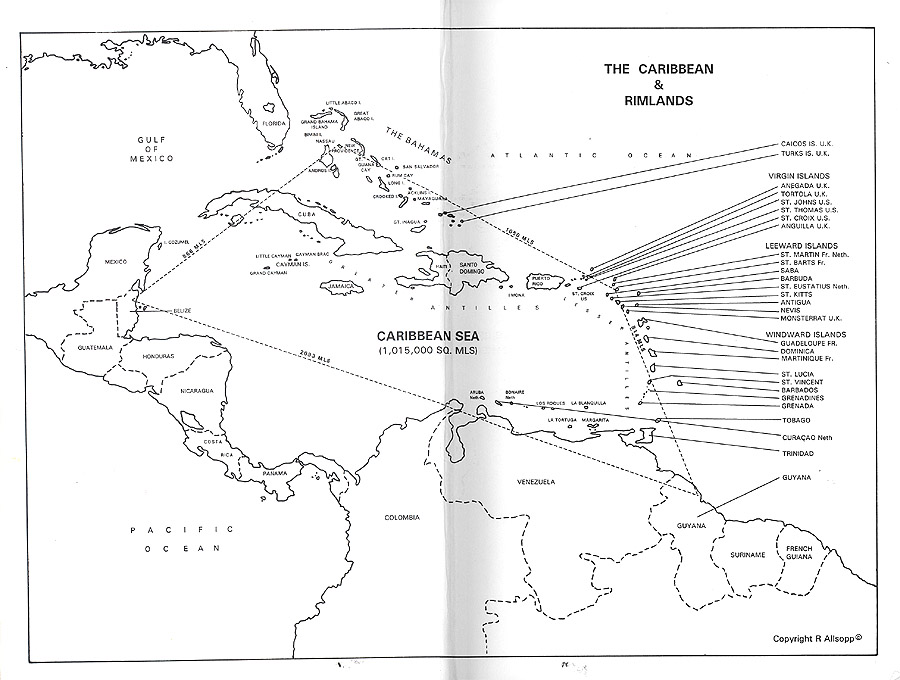
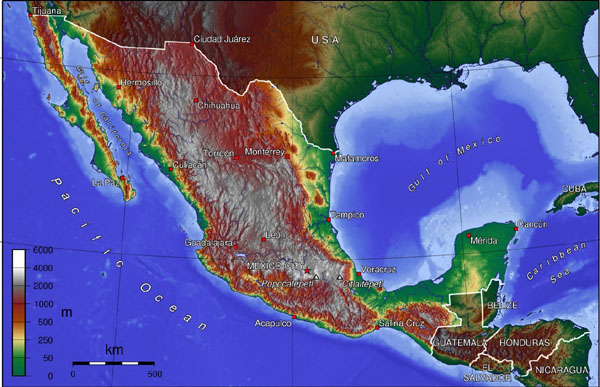
Compare this map to a map of the Caribbean and Mexico, or New Spain and New Granada in 1570.
Questions for you to find evidence for more informative answers.
1. Pretest & Walcott's fragments: The Antilles) origin of the word: What is a theme that pervades Walcott's speech?
2. What four things does Alfred Crosby say distinguishes ecology from history that so reveals Columbus importance?
It is my desire for you to excel in this class. To improve your
verbal presentations I am asking you to tape an interview in the career
services office, so schedule an appointment there very early in the term. You excel in that interview and the
class by reading carefully and asking serious questions about the texts, the
evidence they present and the conclusions drawn about how social systems
persist despite imperial conquest and cultural domination. I am here to assist
your intellectual and emotional development with respect to understanding
ourselves as public members of a society, ethnic heritage, and cultural
tradition we inherit. I reward you for working hard and developing your own
answers to the rather deep and challenging questions posed weekly in the class.
For every hour of class, three hours of study is expected.
A significant product of my wanting you to perform at an
excellent level is that you may discover the value of persistence: personally
and culturally. There are peoples in the America’s today; such as Tarahumara,
Hopi, or Arawak societies, whose resilience in the face of five centuries of
European colonization is a testimony to human endurance, creativity and genius.
Life a bit like a play, into which we—as walk-on
actors—enter in the midst of the action, without being aware of what came before we entered the script. This
class tries to reveal to each of you a bit of the ongoing plot with respect to
our neighboring actors in the Antilles.

Books | Grades | My Intentions | Central Themes | Assignments | Readings | Calendar | Final | Continuity
Paz |Conclusion | Statement on Excellence | Survival tips | What you have to do | Study Guide | Honor Code