 Discoverers
Navigating



1564 - 1642
Mathematics is God's Language
"The earth's motion seemed epistemologically absurd because it contradicted direct sense experience. It seemed astronomically false because it had consequences that could not be observed, such as the similarity between terrestrial and heavenly bodies, Venus' phases, and annual stellar parallax." until 1609.
Finocchiaro, pp. 4-5.
problems | overview | zeitgeist | what is modern? | worldview | Influence | Background | Trial | Brecht | lesson
Dates | Sidereus Nuncius | El Dialogo | Education
Why resolving the motion of the planets mattered.
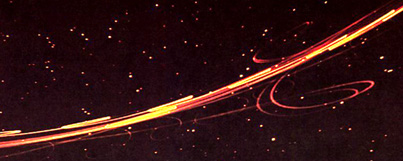
The problems in the heavens: calendars | comets | planetary motions | precession | what the world may look like.
 The way Mars appears in the night sky over months:
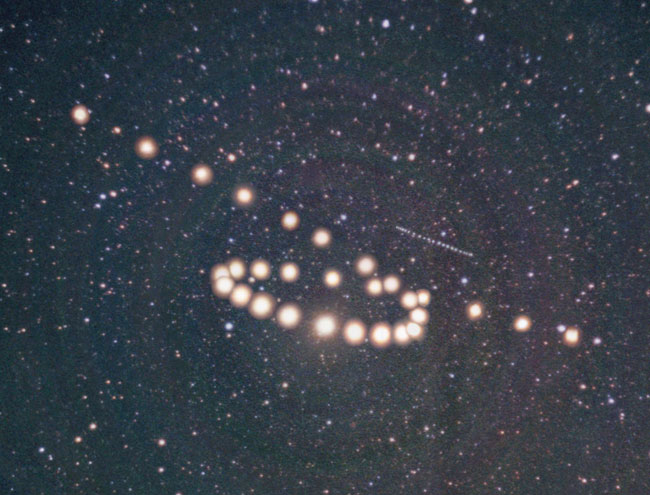
Among others, Edmond Halley observed how Mars was concealed by the by the Moon on 11 June 1676.
Another planet's apparent retrograde motion.
The apparent movement of Mercury in the night sky –similarly– over several months.
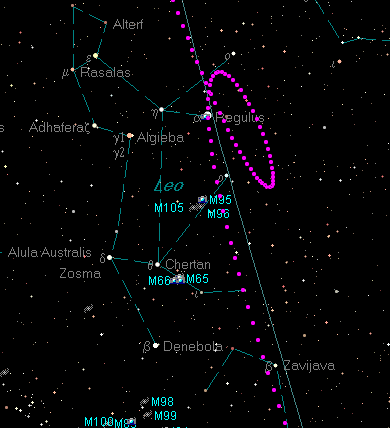
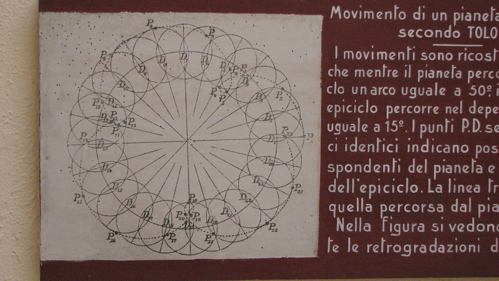
Why do planets appear to move forwards, stop, then move backwards, and then stop again, before they return to forward motion?
calendars | comets | planetary motions | precession | what the world may look like.
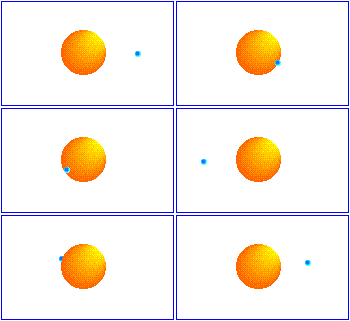
How Venus appears during the course of a year;
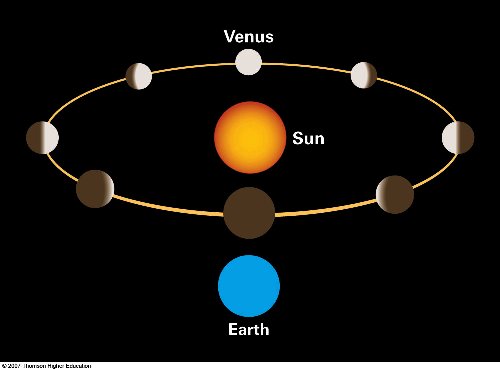
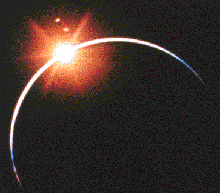
not to be confused with the transit of Venus across the Sun's face shown at the 6 o'clock position.
The animated cartoon of how the planets move in relation to the Earth and Sun.
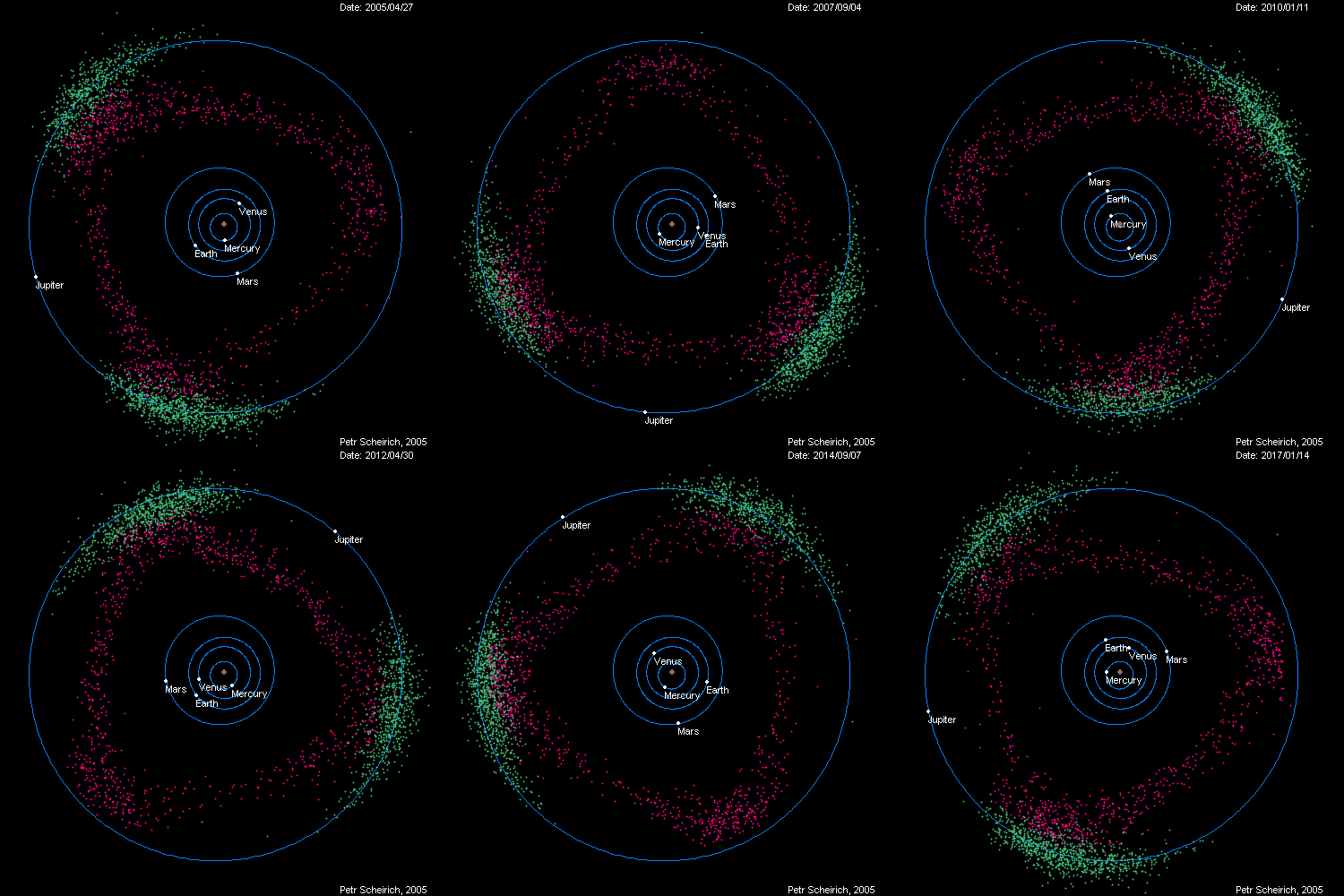
Petr Scheirich's 2005© drawing of how the inner planets move with respect to the earth and sun that explains the [above] observed movement of Mars and the phases of of Venus as its sequenced movements about the sun appear from Earth observatories.
calendars | comets | planetary motions | precession | what the world may look like.
Precession of the equinoxes
A scientific problem of complex movement
The slow westward movement of the equinoctial points along the plane of the ecliptic by a rate of 50.27 seconds of arc per year resulting from a slow westward shift of the Earth's axis of rotation.
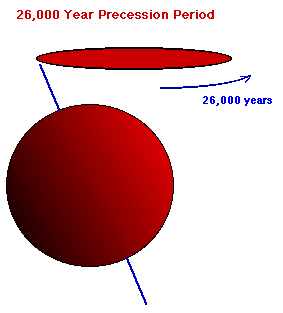
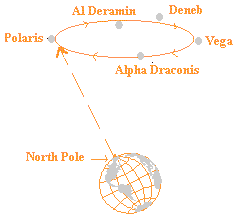
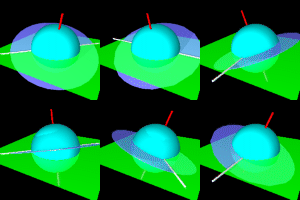
If the Sun is moving to the east, does that mean the moon moves to the west?
calendars | comets | planetary motions | precession | what the world may look like.

Galileo: The person & the myth
1300 - End of the Medieval and start of Spanish Renaissance
1633 - Galileo's Trial
1900 - The Church accepts a heliocentric universe just as that is about to change with Hubble's discovery of an expanding universe
a sense of identity, symbolism, measuring reality
"these are the days of miracle & wonder"
Middle Ages
A sense of place: personal, social, native, & cosmic
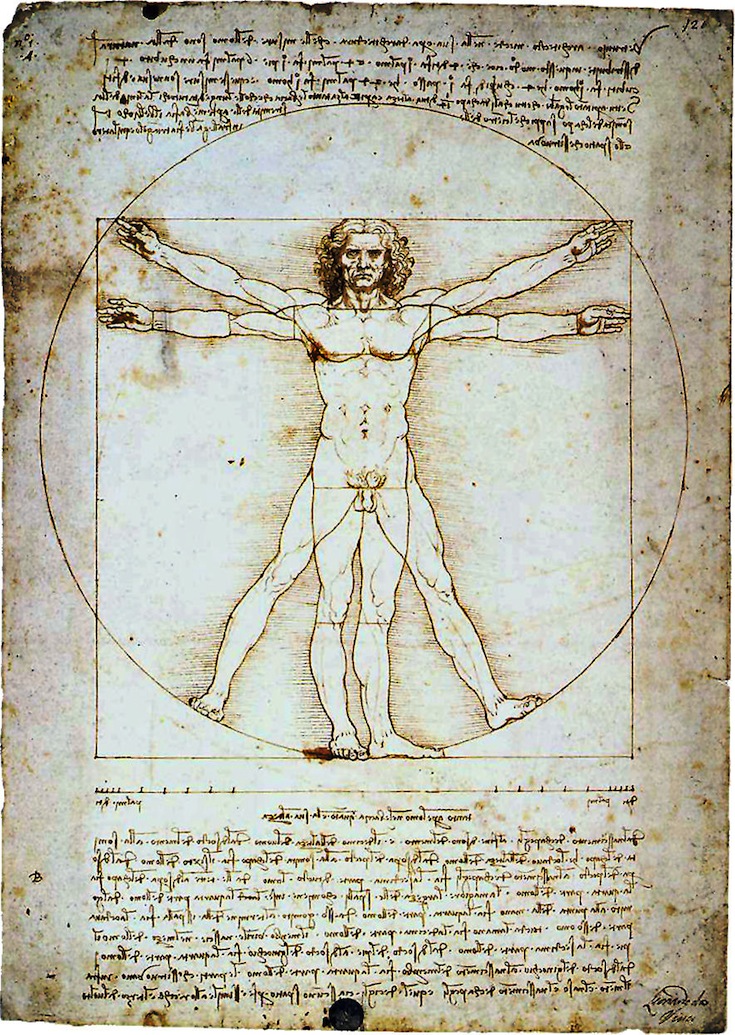
Holton's Three criteria for science
Analytical
History of ideas vs. Biography
Primary vs. Secondary sources
The rationalization of Humanism -- Science & Art
Foundations of Modernity:
Galileo - Descartes - Hobbes - Newton - Locke - Laplace
Newton referred to the world he created with calculus, gravity and telescopes as "modernity," because it replaced earlier alchemical, algebraic and Aristotelian worlds.
calendars | comets | planetary motions | precession | dates | what the world may look like.
Galileo's times:
zeitgeist.
Age of Discovery
from the Council of Trent, 1560s
to the
English Revolution, 1640s; there ensued a challenge to authority.
The personality of and influences on Galileo;
Father was a music teacher, 1 of 7 children
Conflicts sacred & secular; thinkers & doers
Writings:
- Sidereus Nuncius [Starry Messenger] (1610) &
- Dialogs (1630)
Trial by the Roman Inquisition & faithful Christian Doctrine
Legacy of Galileo -- Freedom of inquiry -- Kepler's Laws
Scientific Revolution -- mechanism, utility, efficiency, predictive behavior.
calendars | comets | planetary motions | precession | dates | what the world may look like.
Eventful moments in the Scientific Revolution
(internal history)
1477 earliest reprinting of Ptolemy's Geography
1492 First voyage of Columbus
1503 Vespids's Novas Mindy
1509 Erasmus, In Praise of Folly
1513 landing in Florida of Ponce de Leon
1517 Reformation
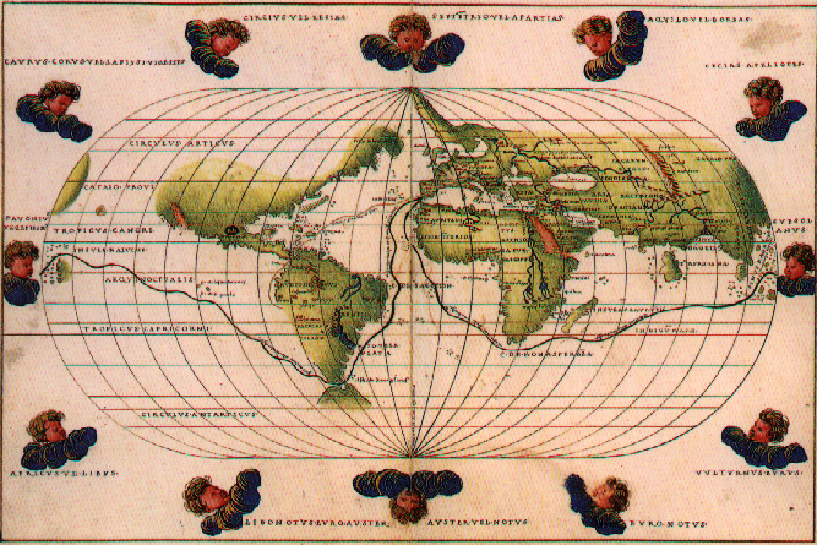 Map of Magellan's 1520-22 voyage.
1545-63 Council of Trent
1577 Tycho Brahe's discourse on comets
1590 microscope
1608 telescope
1609 Kepler's Astronomia Nova
1620 New Amsterdam founded; Bacon's, Novum Organum
1634 Thomas Hubs met Galileo Galilei
1649 Beheading of Charles I of Great Britain
1687 Isaac Newton's Principia Mathematica
International history
(external events)
1558 Fall of Calais from England to France
1560 Tycho Brahe begins observations of an eclipse
1561 Fallopius published his Observations on Anatomy
1562 Akbar the Mogul Emperor of India mentor to mathematics & astronomy
1563 Cathedral built in Mexico City
1566 Netherland's revolts against Spain & its Inquisition
1569 Mercator's Projection of the map of the world
1572 Catherine de' Medici assists in Protestant massacre
1578 Sir Francis Drake in California
1582 Hakluyt's Voyages published about the world
1587 Beheading of Mary, Queen of Scots
1593 Portuguese & Dutch colonize Africa
1602 Dutch East India Company established
1607 Jamestown, Virginia founded
1628 New Amsterdam (York) founded by the Dutch
1648 Treaty of Peace of Westphalia ends the 30 years war
1680s Locke assists in the founding of the Carolina colony
1688 "Glorious Revolution" William & Mary's reign
calendars | comets | planetary motions | precession | dates | what the world may look like.
Natural Philosophy was set against empirical philosophy
1500 - 1600
Aristotle "the Master of those who know" said Dante (8)
the most profound characteristic of nature is change (process)
Euclid's Elements, Book V theory of proportionality was the most
read book of the ancient world (Graeco-Roman period of 1st century through
the Medieval period of the 15th century).
|
1. |
techne | the Greek idiom for practical knowledge | experience |
|
2. |
episteme | the Greek idiom for scientific knowledge | reason |
Their sources & goals were very different; prediction of events vs.
fundamental causes of conditions in which events occurred.
During the 16-17-18 centuries -- Scientific Revolution -- the search for laws replaced the preoccupation with causes (11). Such was Galileo's law of falling bodies -- there is a sureness & a necessity in the displays of Nature
calendars | comets | planetary motions | precession | dates | what the world may look like.
Universities were conservative resisted the new knowledge from the field of mechanics, craftsmen, military -- civil & hydraulic engineers (16)
Even the church had asked Copernicus to solve a problem raised by the failure of existing calendars to accurately predict Easter!
Galileo was a craftsman, a measurer, and an experimenter who unlike Bacon & Descartes offered no overall philosophy of science. Instead he wedded theory & practice to predict the logical consequences of his observations. (2-20)
Galileo's fundamental difference from his detractors
was
"an epistemological conviction about reliable knowledge." (37)
"Measurement belongs to science; eternal truth belongs to faith, whether philosophical or theological."
actual measurements of the speed (velocity = v) of free fall confronted Galileo with problems that natural philosophers had avoided. "rigorous quantitative analysis of continuous change"
"God speaks in the language of mathematics." Galileo had said.
calendars | comets | planetary motions | precession | dates | what the world may look like.
Galileo's
Early influences, family:
Mother's work & piety {faith, practicality, devotion}
His Father's music {meter, measurement, order}
Galileo's intellectual antecedents:
Euclid's Elements most widely read book of antiquity
Archimedes -- measurement & predictable laws of behavior
Aristarchus -- measurement & heliocentric cosmos
Copernicus -- corrected the error in measurement - heliocentric
Kepler (1598 saw his work) combined observation & math.1583, Galileo -- outside of the University first read Elements
1586 he investigated hydrostatic balance based on Archimedes
great influence of a practical sort & mathematics in music from his father Vincenzio {mathematical law based on string length}1587 his notoriety led to a friendship with Christopher Clavius who taught astronomy in the Jesuit College in Rome, despite Clavius adherence to the Ptolemaic system.
1589 Chair of Mathematics at University of Pisa (3 year appointment)
1592 University of Padua (VENICE) Professor of Math.
tensions with Rome, expulsion of the Jesuits, & a new Pope, Clement VIII elected.
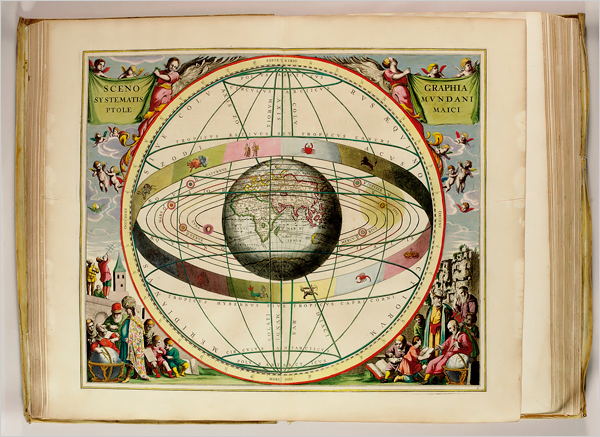
calendars | comets | planetary motions | precession | dates | what the world may look like.
1600 the burning of Giordano Bruno by the Inquisition
Galileo's academic experiences:
pendulum experiment 1602
craftsmanship -- ocular scope
experiment -- hydrostatics & motion
design for a harbor at Livorno
observation of the heavens: moon, Jupiter, Saturn, Venus."I have discovered four planets, neither known nor observed by any one of the astronomers before my time, which have orbits round a certain bright star, one of those previously known, like Venus & Mercury round the Sun, and are sometimes in front of it, sometimes behind it, though they never depart from it beyond certain limits."
The Galilean (Medicean) moons of Jupiter.
Fra Paolo Sarpi befriended Galileo - lifelong intellectual friendship Galileo wrote Sarpi initially about acceleration (1604) 1609 the telescope.
For Galileo, military necessity dictated many practical inquiries into surveying, fortifications, harbors, & mechanics!
1595 Galileo used Copernicus for the first time formally to describe his equations about the tides -- practical investigation
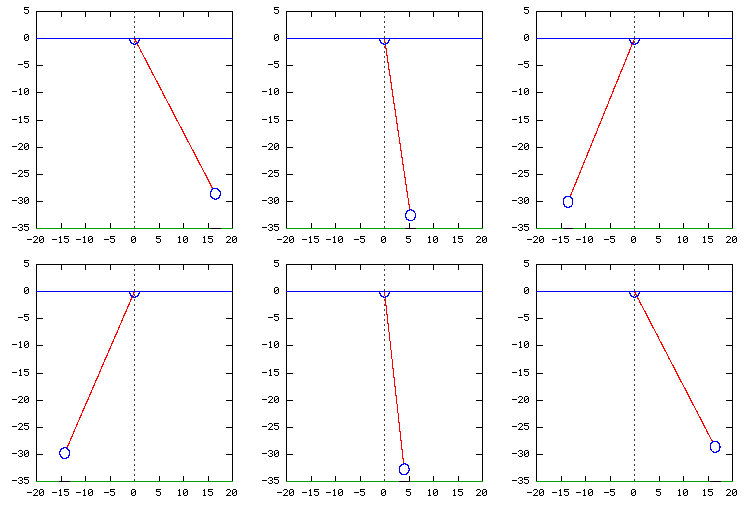
1602 pendulum experiment -- he became good at setting them up
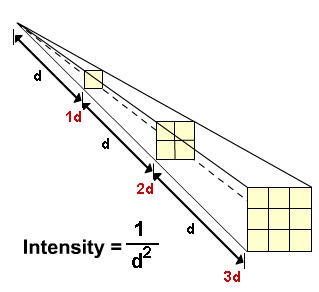
1603 motions & velocity of falling balls on an inclined plane.
"distances from the rest are as the squares of the elapsed times." (33) careful measurement -- frequent errors but a willingness to correct those errors.
calendars | comets | planetary motions | precession | dates | what the world may look like.
In rejecting the geocentric and geostatic or Ptolemaic model of the heavens, Galileo proposed that the Copernican model based on the heliocentric and geokinetic conception of the solar system as the only sensible way to predict the behavior of planets, moons, comets and the Earth's movement through space in the solar system.
"In 1609 he perfected the telescope to such as to make it an astronomically useful instrument that could not be duplicated by others for some time. By its means, he made several startling discoveries, which he published in the Sidereal Messenger (Sidereus Nuncius) Venice 1610."
Finocchiaro, p. 5.
Sidereus Nuncius, (1610) views of the Moon, sunspots, Jupiter's "Medicean Stars", the phases of Venus, experimental philosophy.
The appearance of a series of comets in the sky during caused a serious reconsideration of the Aristotelean description of heavenly objects.
In [1456] 1531, 1607, and again in 1682, what is later called Halley's Comet reappears and will later confirm the elliptical orbit of object about the Sun.
Sir Edmond (Edmund) Halley based on Isaac Newton's formula accurately predicted this comet's precise location & return in 1758.
In 1577 a very bright comet was studied carefully for some time and accurately tracked by Tycho Brahe [later Kepler's mentor].
"Again, it is a most beautiful and delightful sight to behold the body of the Moon . . ."
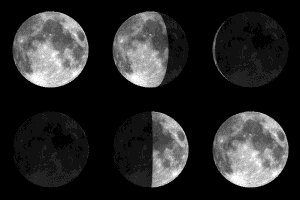
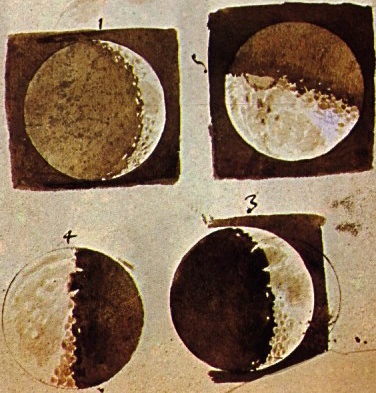
"just as the shadows in the hollows of the Earth diminish in size as the Sun rises higher, so also the spots on the Moon lose their blackness as the illuminated part grows larger and larger."
"The grandeur of such prominences and depressions in the Moon seems to surpass both in magnitude and extent the ruggedness of the Earth's surface. . . ."
What accounts for the phases of Venus?
The transit of Venus across the face of the sun [when the planet moves between the Earth's orbit and the Sun-shown above] was accurately measured by Sir Edmond Halley, in 1716, which enabled him to predict the Earth is approximately 93 million miles from the Sun.
"Now let me review the observations made by me . . . inviting the attention of all who are eager for true philosophy. . . ."
calendars | comets | planetary motions | precession | dates | what the world may look like.
Galileo's
Dialogue on Two Great World Systems
[1632]
"Several years ago there was published in Rome a salutary edict which, in order to obviate the dangerous tendencies of our present age, imposed a seasonable silence upon the Pythagorean opinion that the earth moves."
"its origin . . . in passion none too well informed."
"clip the wings of reflective intellects by means
of rash prohibitions." {p-1}
"a witness of the sober truth."
"I have taken the Copernican side in the discourse." {5}
"they are content to adore the shadows, philosophizing not with due circumspection but merely from having memorized a few ill-understood principles." {6}
Written to commemorate two Italian intellectuals:
Giovanni Sagredo Venetian
Filippo Salviati Florentine
"May it please those two great souls, ever venerable to my heart,
to accept this public monument of my undying love."
Ptolemy's account of the retrograde motion of planets in the heavens dominated the ancient world, except for some East Indian astronomers. El Dialogs
"The Second Day"
"The Third Day" stars as observable evidence for the earth's rotation Tides in the Adriatic & Atlantic require the motion of the earth, p. 416- calendars | comets | planetary motions | precession | dates | what the world may look like.
Trial of Galileo April 12, to June 21, 1633
Trial presided over by Ten judges; all Cardinals of the
Dominican Order

El Dialogo THREE PRINCIPLE HEADINGS: 1) experiments on earth are insufficient to conclusively prove the earth's motion or rest. 2) celestial phenomena will be examined, strengthening the Copernican hypothesis. 3) propose an ingenious speculation about the motion of the tides and the earth's diurnal rotation. calendars | comets | planetary motions | precession | dates | what the world may look like.
Bertolt Brecht's play: Galileo "Brecht was all wrong about the seventeenth century in general and about Galileo Galilei in particular." It is a paradox. The historical truth, rejected for its implausibility, has the air of an artifact, whereas the actual artifact, the play, has an air of truth." Another paradox: only when a figure has become legendary is he or she a good subject for a history play." Because the historical dramatist is concerned with the bits of history that have stuck in people's imagination, he may well find himself handling bits of pseudo-history that are the very products of people's imagination." "After all, very much of our 'knowledge' of the past is based on fiction." "So should we be prepared to see a modern, Marxist playwright distorting history in order to prepare young Communists for some future Battle of Russia? . . . even for spectators who know that a history play is bad history, such a play might still seem to have some sort of special relevancy, a more urgent truth." The present often intrudes upon the past: "There are two Galileo plays here, both exist in their entirety, the version of 1938, and the version of 1947." "He [Brecht] was a poet, but a poet in love with the idea of science, a poet who believed that his own philosophy was scientific:" Brecht's words: "In this respect, Galileo I is a 'liberal' defense of freedom against tyranny, while Galileo II is a Marxist defense of a social conception of science against the 'liberal' view that truth is an end in itself." {18-19} Is Galileo or "the people" the real hero? {33-34}
"The Science Fiction of Bertolt Brecht" by Eric Bentley, Drama critic, on Brecht's Galileo. Brecht's attributions to Galileo the legend -- universal qualities: 1 truth or many truths power or pluralism ethics or moral certainly special circumstances: calendars | comets | planetary motions | precession | dates | what the world may look like. Galileo's significance:
According to Gerald Holton an historian at Harvard any description in order to be scientific must be refutable and be consistent across three different perspectives or have integrity:
Ancient cosmology stressed: Cosmos was alive; made up of Four elements (earth, air, fire, water) ; earth was the center of the heavens and made of base matter; celestial realm was dwelling place of perfect forms, this world was a reflection of the celestial quintessence; humans were part of a "SCALA NATURA" (a chain of being) and were divinely made (as were all things) of four material humors and an immortal soul. Two oppositional forces called gravity and levity account for the movement of the heavens and the disc-like earth. A refutable theory
On the Julian calendar by 1425 the vernal equinox fell earlier and earlier than March 21 by 1570, the equinox was falling 10 days before 21 March. The October 1582 calendar was calculated on the basis of the Copernican model of the cosmos; to do so meant that the Church under Pope Gregory dropped eleven days from that month. in order to re-align the calendar with the apparent movement of the heavens. Protestant nations did not accept the change until 1752. Hipparchus in 127 BC recognized that the equinoxes move with respect to the fixed stars and this is called a: "precession of the equinoxes"
Return to top of the pagecalendars | comets | planetary motions | precession | dates | what the world may look like. |
|