 Intertidal Zones
Navigate the site:



Patterns of Shore Life
The tidewater region and tidelands are a test of conservation & development.
Opening | Carson says | Examples | Lesson of this story | tides | Overview | Seashore
“Nowhere on the shore is the relation of a creature to its surroundings a matter of single cause and effect; each living thing is bound to its world by many threads, weaving the intricate design in the fabric of life.”
Rachel Carson, The Edge of the Sea, p. 14.
The sea's margins:
The early history of life as it is written in the rocks is exceedingly dim and fragmentary, and so, it is not possible to say when living things first colonized the shore. . . . .in the rocks of the Cambrian period, which are about half a billion years old, all the major groups of invertebrate animals (including the principle inhabitants of the shore) suddenly appear, fully formed and flourishing.
There are sponges and jellyfish, worms of all sorts, a few simple snail-like mollusks, and arthropods. Algae also are abundant,. . . on good evidence that the strip between the tide lines 500 million years ago bore at least a general resemblance to the intertidal area of the present stage of earth history.
pp. 9-10.
"The towering physical realities of the sea itself, and the subtle life relationships that bind each living thing to its own community. The Patterns life as created and shaped by these realities intermingle and overlap so that the major design is exceedingly complex."
"the greatest tidal effect is exerted over a period of days immediately after the full and new moons, rather than at a time precisely coinciding with these lunar phases. During these periods the flood tides rise higher and the ebb tides fall lower than at any other time, The sea are called spring tides. . . . "
"In the quarter phases, the moon exerts its attraction at right angles to the pull of the sun so the two forces interfere with each other and the tidal movements are slack, Then the water neither rises as high, nor falls as low as on the spring tides. These sluggish tides are called 'neaps' . . . meaning 'hardly enough'."
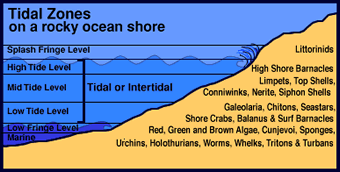
The consequence of these different forms of tidal scouring create intertidal zones along the shore. Other than currents, that create marine climates ( pp. 18-22.) the daily and monthly changes in the level of the water along the ocean shores is influenced by the position of the moon with respect to the sun and the earth generating rising and falling water as the most important of the recurrent inorganic forces that require adjustments of creatures to the changing nature of communities that cling to the tidal shorelines along the coast.
The characteristic creatures of the rock shoreline between the high and the low tides are best observed along the rock-bound coasts. Here the constant adjustment to changes in temperature, salinity, exposure to air and submergence, together conspire to select for organisms capable of thriving while withstanding these daily alterations of their conditions of existence.
Starfish (pisaster sp) and Anemones inhabit a rock bound tidal pool.
intertidal zones. important & signal indication of the inter-changeability of the sea and land, anomalous quality of creatures, and special case of property ownership,
p. 32.
For it is now clear that in the sea nothing lives to itself.... so [too] the present is linked with the past and future, and each living thing with all that surrounds it.
p. 37
Tidewater region, that area of the eastern Atlantic coast of the US from Maine to Texas where river's are affected by the movement of the sea's diurnal changes.
Tidelands those submerged areas of the shore stretching from the highest tide to the continental shelf, three, six, twelve or two hundred miles off shore.
tide a change or movement over time, specifically changes in the surface elevation of the sea (and land).
All tidal fluctuation is due to the movement of the Sun, the Earth and the Moon, and it was first predictably and formulaically understood by Sir Edmund Halley, in the Seventeenth Century, who was a colleague of Sir Isaac Newton.
Weaving the intricate design of the fabric of life.
At the sea's edge is always evident a palpable example of Newton's first law of motion; that "to every action there is an equal and opposite reaction." The water rises and falls as waves, is pulled under the gravitational influence of the sun and the moon generating the tides, falling in deceptively different patterns along the marginal boundaries where the winds, currents and tides ceaselessly sculpt the land at the very edge of the sea.
Carson notes:
"The Island of Monhegan on the coast of Maine lies unprotected in the path of such storms and receives their waves on its steep seaward facing cliffs. In a violent storm the spray from breaking waves is thrown over the crest of White Head, about 100 feet above the sea. In some storms the green water of actual waves sweeps over the lower cliff known as Gull Rock. It is 60 feet high."
The effect of waves is felt on the bottom a considerable distance offshore. Lobster traps set in water 200 feet deep often are shifted about or have stones carried into them. . . .Very few coasts have completely defeated the attempts of living things to gain a foothold."
p. 14.
Adaptation as a theme.
Does society alter its institutions in response to the tidal edges of the sea?
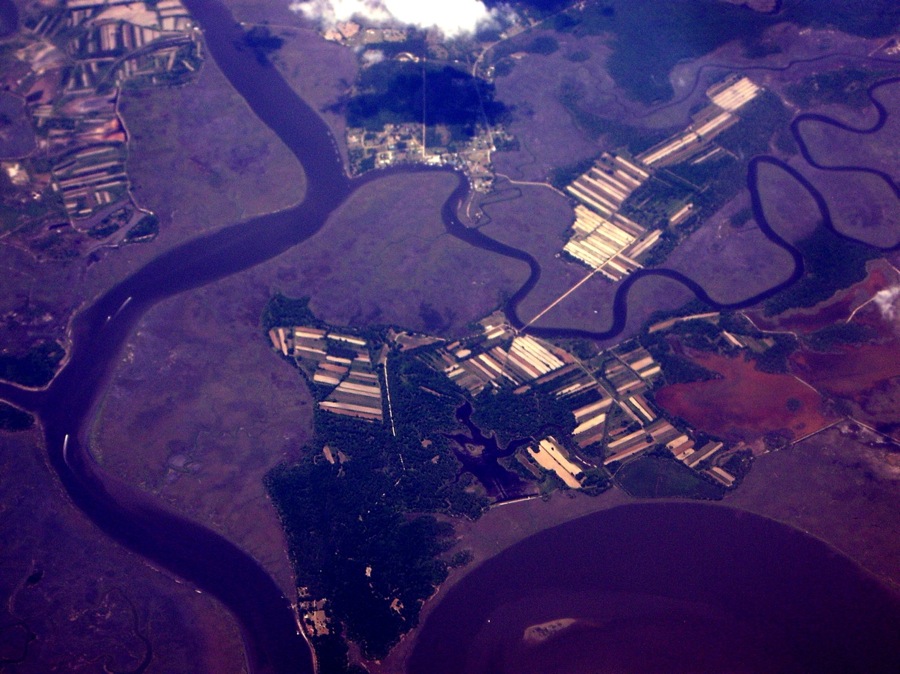
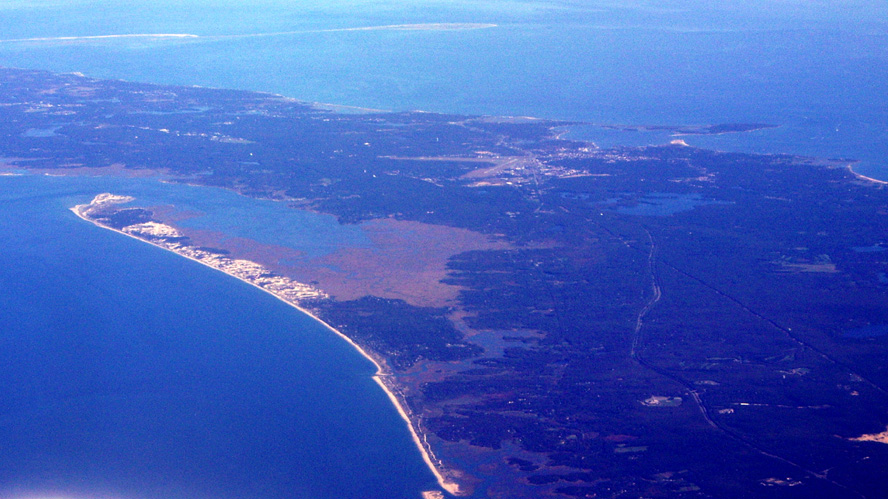
Nauset Marsh looking east on Cape Cod


Opening | Lesson's Content | Carson says | Examples | More | Lesson of this story
Society creates institutions to alter terrains to suit various human needs for water, shelter, fuel, sea defenses, or cultivation.
Those places in which a people finds necessities upon which to thrive will be altered so that these surroundings sustain populations from one generation to the next.
Farms were initially adjacent to tidal creeks from Plymouth in the north to Charleston in the south and often relied on the changing tides to power tidal gristmills. The tidal basin in Washington, D.C. is an example of an enclosed bay that filled with water on the incoming tide and then was dammed to allow the water to run through a mill sluice-way at low tide to generate a current to turn the millstone.

Chesapeake Bay farms set amidst salt marshes that line the tidal creeks nourished by the tides of the bay.
Only with the passage of much time and experience will some people and societies learn –after their use of resources is diminished or made more expensive – to restore resources. These expenses accumulate because of the many limitations imposed on any society by the physical and biological conditions which sustain fisheries, or forestry resources that serve as a source of wealth or necessary commodities.
The Coastal America Program was created by Congress to restore certain regional functions of coastlines damaged or altered by long-term occupation, exploitation, or reclamation.
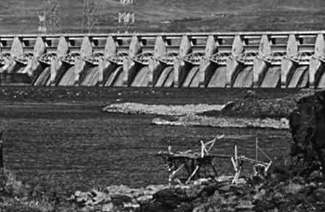
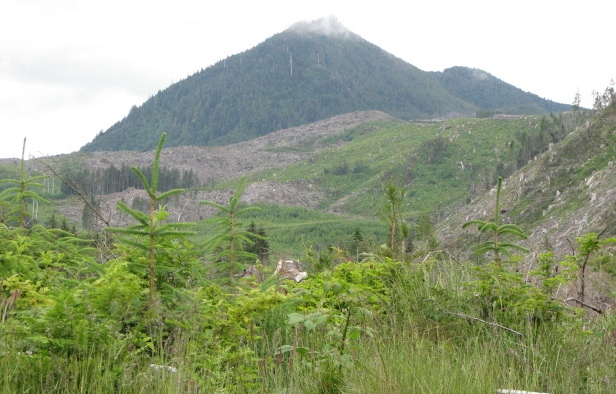
There are no better examples of this misunderstood relationship of humans to marine resources than the Grand Banks fisheries and their decline from over fishing, or the crash of Pacific Salmon numbers due to deforestation, dams for hydroelectricity, and overfishing.
The Dalles Dam on the Columbia River and logging along the Oregon coastal mountain ranges.
Concept, related ideas.
Essay about conserving biological wealth.
Trace elements can have more than trace effects!
Protection of the global commons.
Opening | Lesson's Content | Carson says | Examples | More | Last selection | story
Science Index | Site Analysis | Population Index | Global Warming Index | Nature Index