


Navigating the site:



 Richard
Lewontin, The Triple Helix: Gene, Organism, and Environment. (2000).
Richard
Lewontin, The Triple Helix: Gene, Organism, and Environment. (2000).
The discovery of DNA's structure in 1953 frequently called the double helix held promise briefly that a simple understanding of life's functions and evolution would develop. By reducing all of the complexity of life into proteins, amino acids, and nucleic acids with different base-pair sequences many hoped that genes possessed the secret of form and function in all living things. But Lewontin's book shows that there are added ingredients that complicate this picture of DNA as the "secret of life." Often the argument referred to as nature versus nurture obscures a reality that combines genetic and environmental influences by the way that proteins alert, silence or in some uncertain way permit inherited information to express or repress traits.
Through this third way called epigenetic, the complexity of inheritance of genes, mitochondrial DNA, and proteins has replaced the simplicity of deoxyribonucleic acid or DNA – as the double helix – at the root of life with a triple helix!
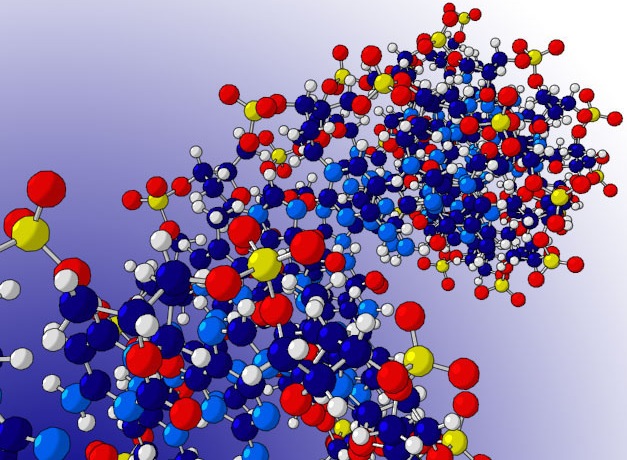
The artists's rendering of the biochemical elements as atomic contributors to the DNA molecule, or double helix.
III. Parts & Wholes, Causes & Effects
IV. Directions in the Study of Biology
1-38, Chapter I
39-68, Chapter II
69-106, Chapter III
107-129, Chapter IV
The first three chapters of this book were originally presented as lectures in the Lezioni Italiani in Milan.

 Pages
Pages

I
"It is not possible to work in science without using a language that is filled with metaphors. Virtually the entire body of modern science is an attempt to explain phenomena that cannot be experienced directly by human beings . . . ."
II
"The belief that organisms are remarkably well suited to the world in which they live predates scientific biology."
III
"The problem of how to parse the world into appropriate bits and pieces is a consequence of the analytic tradition that modern science has inherited from the seventeenth century."
IV
". . . explanations of the way in which a reductionist approach to the study of living organisms can lead us to formulate incomplete answers to questions about biology or to miss the essential features of biological processes, or to ask the wrong questions in the first place."
Conclusion
"It is useless to call . . . for some more synthetic approach or to say that . . . we need a new insight."
p. 109.
Progress in biology depends not on revolutionary new conceptualizations, but on the creation of new methodologies that make questions answerable in practice in a world of finite resources.
p. 129.
Richard Lewontin, The Triple Helix: Gene, Organism and Environment. (Cambridge, Mass.:Harvard University Press, 2000).
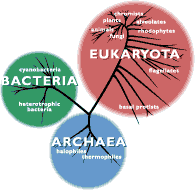
A taxonomy of three kingdoms of life all share some common genes.
Mayr | Thomas | Capra | Wilson | Hardin | Darwin | Margulis | Steingraber | Carr | Keller | Watson