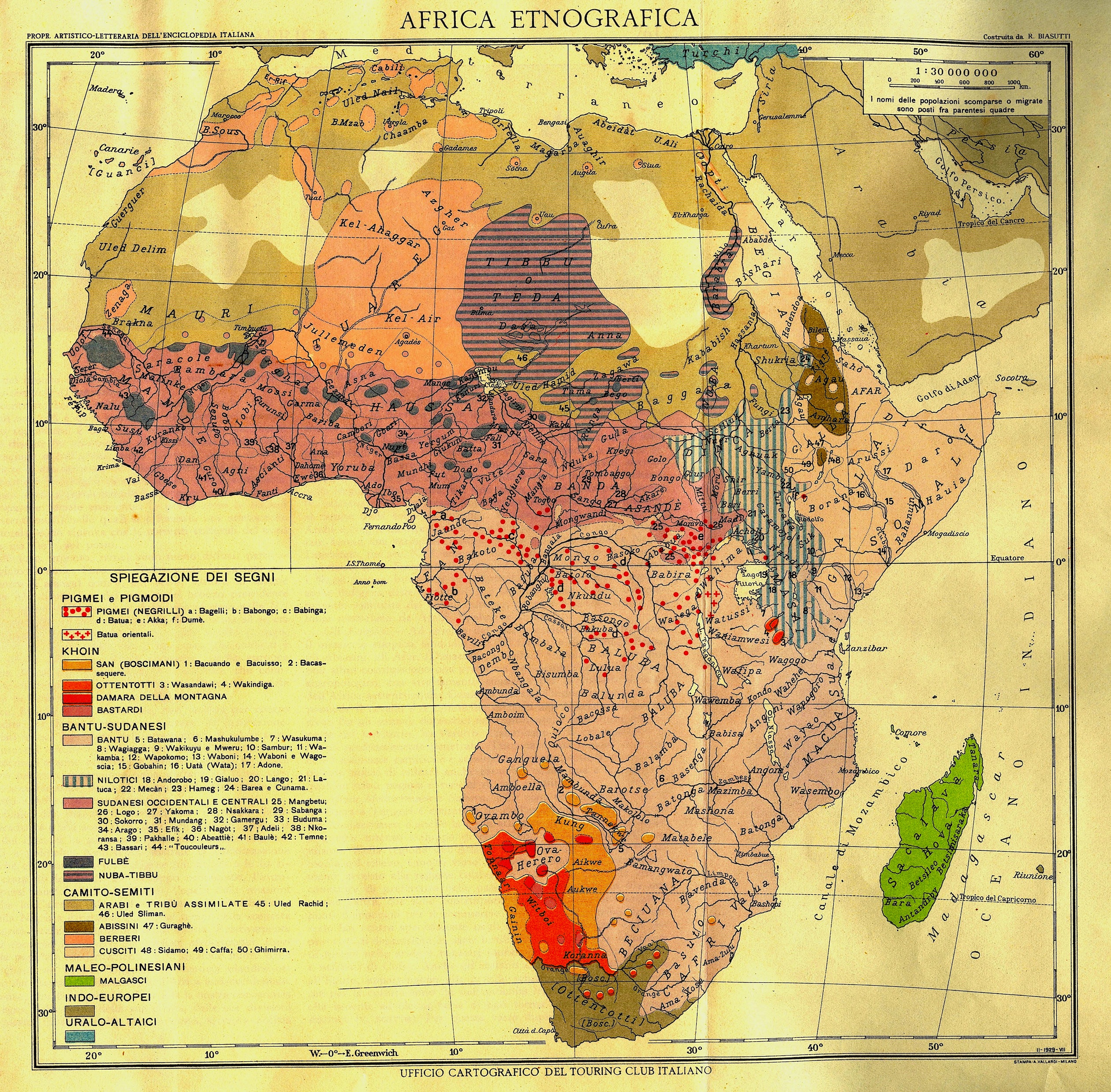
 The Negro

"In commerce it is the slave mart and the source of ivory, ebony, rubber, gold and diamonds."
"Africa is at once the most romantic and most tragic of continents. Its very names reveal its mystery and wide-reaching influence."
p. 9.
William E. B. Du Bois, The Negro, 1915.
See the text on-line The Negro (1915)
"Primarily Africa is the land of the Blacks."
p. 11.
Modern world | Where | Diversity | Culture | Slavery | When | laws | demographic data | Haiti | Slave Revolt | Sugar | Revolt | video-lecture
"The modern world , in contrast, knows the Negro chiefly as a bond slave in the West Indies and America.
Add to this the fact that the darker races of other parts of the world have, in the last four centuries, lagged behind the flying and even feverish footsteps of Europe, and we face today a widespread assumption throughout the dominant world that color is a mark of inferiority."
p. 12.
"The typical Negro is a rare variety even among Negroes."
"In fact it is generally recognized today that no scientific definition of race is possible."
p. 13.
Africa is a divided continent, it is the most varied of all -- that is more diversity of human groups live in Africa than in any other continent:
Khoi-San (bushman, Kalahari desert, light {yellow} complexion)
Pygmies (forest people, lighter complexion)
Berbers (desert non-black, animists converted to Islam)
Bantu (Niger River Valley, dark complexion, animists)
Ethiopian (plateau people, dark complexion, Christian & Jews)
Swahili (savanna, grazing people, dark complexion, Muslim)
Egyptian (Nilitic ancient civilization, mixed complexion)
"Today we realize that there are no hard and fast racial types among men (people). Race is a dynamic and not a static conception. . .
p. 16.
"Two physical facts that underlie all African history: the peculiar inaccessibility of the continent to peoples from without . . . .; and on the other hand, the absence of interior barriers. . . . with no [mountain range barriers] to hinder."
p. 18.
"The inhabitants of this land have had a sheer fight for physical survival comparable with that in no other great continent, and this must not be forgotten when considering their history."
p.19.
Modern world | Slavery | demographic evidence | Haiti | Slave Revolt | Sugar
Note:
Du Bois is in error in suggesting human origins from southern Asia, genetically it is shown today the the rift valley in South and central Africa and the Afar triangle in Ethiopia are resident hominid populations that are ancestral to modern homo sapiens. Among homo sapiens (the human race) a Niger River woman has been found to possess mitochondrial DNA with striking similarities to today's human mitochondrial DNA, suggesting a common ancestry.
Slavery
"The Portuguese began . . .sailing down the Atlantic coast and initiating the modern slave trade . . . but as traders in men rather than explorers."
p. 17.
"The organized slave trade of the Arabs penetrated the Congo valley in the sixteenth century (1500-1599) and soon was aiding all the forces of unrest and turmoil. Industry was deranged and many tribes forced to take refuge in caves and other hiding places."
"Here on the west coast, disintegration and retrogression followed, for as the American traffic lessened, the Arabian traffic increased."
p. 76.
African culture is plural.
"Charcoal is prepared by the smiths, iron is smelted and numerous implements are manufactured."
p. 110.
. . . consider the Negro as the originator of the art of smelting iron."
p. 113.
Iron smelting, mentioned by Franz Boas,
p. 114.
"The Negro is a born trader."
We "can learn much of the cunning and trade of the Negroes."
DuBois quotes Lenz,
"Long before cotton weaving was a British industry, West Africa and the Sudan were supplying a large part of the world with cotton cloth."
..."centers where cotton is spun and woven, . . ."
p. 116.
"For four hundred years, from 1450 until 1850, European civilization carried on a systematic trade in human beings of such tremendous proportions that the physical, economic, and moral effects are still plainly to be marked throughout the world"
p. 149.
Before Columbus came:
1400 Chinese on the East coast of Africa's Indian Ocean shores.
1441 Portuguese reach the Gold Coast of Africa and traded Moors for Negro ten slaves.
1474 slaves common in Spain but with privileges and self-governance.
1500 Slaves sent to Hispaniola
1510 "allowed to pass to the Indies"1595 The Dutch send the first slave ships to Africa
1672 The Royal African Company formed in the United Kingdom: Britain
1680-1688 "English Africa company alone . . . 249 ships . . . 46,396" survived
p. 155.
1698-1707 25,000 Negroes per year to English Colonies
1713 "This Asiento of 1713 was an agreement between England and Spain . . .granted . . a monopoly of the Spanish colonial slave trade.p. 152.
"When therefore, a demand for workmen arose in America, European exportation was limited by religious ties and economic stability. African exportation was encouraged not simply by the Christian attitude toward heathen, but also by the Moslem enmity toward the unconverted Negroes."
p. 144.
"Nevertheless, by 1501, we have the first incidental mention of Negroes going to America in a declaration that Negro slaves "born in the power of Christians were to be allowed to pass to the Indies, and the officers of the royal revenue were to receive the money to be paid for their permits."
pp. 146-147.

"Negro slaves . . sent to Hispaniola. . . fled amongst the Indians and taught them bad customs and never could be captured."
p. 147 .
"fifty to be sent out from Seville for the mines in 1510." to Diego Columbus on Hispaniola.
"The chief contract for trade in Negroes was the celebrated 'Asiento' or agreement of the King of Spain to the importation of slaves into Spanish domains."
1600 Portugal to 1640, Netherlands, 1701 France, 1713 United Kingdom
p. 152
Las Casas
" the injustice with which . . . [we] . . .take them"
"for he always held they had been made slaves unjustly and tyrannically."
p. 148.
Modern world | Slavery | demographic evidence | Haiti | Slave Revolt | Sugar
". . . when men realized that beyond the scowling waste of western waters were dreams come true."
"Poetry and romance
side by side
the filthiest institution in the modern world"
p. 160.
Slaves imported under the Asiento treaties went to all parts of the Americas
| 18th century | Island or nation | numbers |
|---|---|---|
| 1 | Santo Domingo | 10,000 |
| 2 | Cuba | 84,000 |
| 3 | Porto Rico | 50,000 |
| 4 | Central America | 60,000 |
| 5 | Louisiana & Florida | 60,000 |
total |
264,000 |
p. 162
The slave trade greatly increased in the latter part of the eighteenth century, and after the Revolution in Hayti large numbers of French emigrants from that island settled in Cuba."
p. 162
Before 1530 there were enough Negroes in Mexico to lead to an insurrection, where the Negroes fought desperately, but were overcome and their ringleaders executed."
p. 161
"The Brazillian lower class intermarries freely with the black people . . . ."
p. 165.
"the Dutch found better scope for slaves in Guiana, which they settled in 1616. Sugar cane became the staple crop, but the Negroes began to revolt and the Dutch brought in East Indians."
p. 167
Modern world | Slavery | demographic evidence | Haiti | Slave Revolt | Sugar
"It was in the island of Hayti, that French slavery centered." 1663 France seized the island from Spain.
By 1680 there were so many slaves and mulattoes that Louis the XIV issued his famous Code Noir, which was notable in requiring bachelor masters, the fathers of slave children, to marry their concubines.
...but families could not be separated by sale except in the case of grown children."
"Emancipation with full civil rights was made possible for any slave twenty years of age or more."
p. 168
Modern world | Slavery | demographic evidence | Haiti | Slave Revolt | Revolt
The consequences of the French Revolution: July, 1789.
In Haiti and the French West Indies "When the French Revolution broke out. . . . this led the French government to grant full civil rights to free Negroes."
"Immediately planters and free Negroes flew to arms against each other and then, suddenly, August 22, 1791, the black slaves, of whom there were four hundred and fifty two thousand, arose in revolt to help the free Negroes."
p. 169.
The Negro population of these lands (coastal South America) is everywhere in process of rapid amalgamation with whites and Amerindians."
p. 182.
William Edward Burghardt Dubois, The Negro. New York: Henry Holt, 1915.
Sydney Mintz, Sweetness and Power
Octavio Paz , The Labyrinth of Solitude. New York: Grove Press, 1961 (1950).
Keen and Haynes, The History of Latin America, Boston: Houghton Mifflin, 2005.

Modern world | Slavery | demographic evidence | Haiti | Slave Revolt | Sugar
William Edward Burghardt Du Bois, 1868 - 1968, Sociologist, co-founder of the Niagara Movement that was the origins of the NAACP or the National Association for the Advancement of Colored People.
The 1905 meeting at Niagara Falls was originally scheduled to take place on the United States side of the Falls, however when the group was denied accommodations by hotels because of racial prejudice, they moved to the Canada side. Approximately 60 prominent individuals were invited to the meeting but only about half showed up.
The National Association for the Advancement of Colored People (usually abbreviated as NAACP) is one of the oldest and most influential civil rights organizations in the United States.[1] The NAACP was founded on February 12, 1909 by a diverse group in Baltimore, Maryland.
Modern world | Slavery | demographic evidence | Haiti | Slave Revolt | Sugar
The Moral Problem of Slavery in Western Civilization.
Date: 1 April 2008, October 1, 2014.