 von Humboldt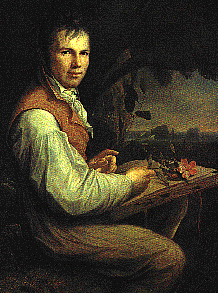


"My attention will be constantly directed towards the harmony that exists in the combination of all forces and the influence of non-living creations on the living plant and animal worlds!"
Alexander von Humboldt
Charles Darwin described von Humboldt as "the greatest scientific traveler who ever lived." He is widely respected as one of the founders of modern geography. Alexander von Humboldt's travels to the Caribbean, South and Central America,allowed him to conduct experiments, and measurements that added to a more reliable knowledge of nature, thereby having transformed western science in the nineteenth century.
Humboldt's conception of Nature
Map | historian's legacy | terms to know | Ethnicity | places | Humboldt's gift | his words | Kosmos | Crosby's quest
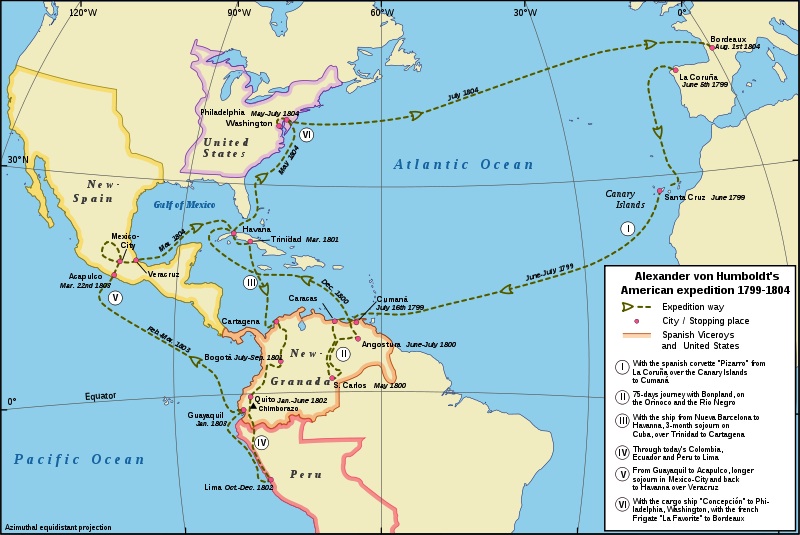
What makes society change and is history a clue to its causes?
historian's legacy | terms to know | Ethnicity | places | Humboldt's gift | his words | Kosmos | Crosby's quest
Von Humboldt, Herder and historicity as Herodotus’ gifts from the ancient texts to the Enlightenment: A focus on ethnic identity that is tied to particular characteristics of places,
- historicity, the use of facts, authenticity, he use of an understanding of history as a basis for trying to change it.
- historicism, the use of the past to understand nature and human purpose. Hegel's concept of the inevitable working forward to fruition of underlying ideas in history such as the dialectic. But the compelling notion that local conditions and peculiarities influence the results in a decisive way. These concepts influenced the economic analysis of Karl Marx and the anthropological work of Franz Boas in that peculiarity of cultures arise from the past conditions quite particular to local situations.
- Herder, Johann Gottfried von Herder (August 25, 1744 – December 18, 1803), German born thinker and prelate: Outline of a Philosophical History of Humanity which largely originated the school of historical thought and German romanticism. Herder's philosophy stressed the influence of physical and historical circumstance upon human development, arguing that "one must go into the age, into the region, into the whole history, and feel one's way into everything". The historian should be the "regenerated contemporary" of the past, and history a science as "instrument of the most genuine patriotic spirit". He and others conceived of the "Volk" as the embodiment of the national spirit tying blood and soil together in a sort of nationalistic esprit.
Not unlike Bartholomew de las Casas,two centuries earlier, Herder's empathy for the native Amerindian or indiginistas, fueled a rediscovery of cultural traditions that found merit in customs and folkways unique to the tribal peoples or "First Nations" of the Americas.
Herder replaced the traditional concept of a judicial-political state with that of the "folk-nation" or Volkstat as an organic entity with historical growth. He championed the volk as a promoter of democracy and free expression of the underlying "volksgeist" of spirit of the people in a sort of German variation on Rousseau's General Will.
Herodotus, a Greek writer from Ionia who lived in the 5th century BCE (circa 484 BCE– 425 BCE) whose extensive travels led to a series of inquiries and thus defined history as an inquiry into the character and ethos of a people distinguishing them from all others but particularly from adjacent peoples, of different ethnicity, such as the Greeks from the Persians, Hindus, or Babylonians, or Egyptians.
Herodotus reported that the Phoenicians had circumnavigated Africa and contended that the Nile flood was due the melting of snow in the southern mountains.
His travels inspired Renaissance Europeans to chart the earth and he is now recognized as a pioneer not only in history, but in ethnography and also anthropology.
By suggesting that ethnic identity differs due to the climate and geographical conditions of places, Herodotus established a method of relating the means of subsistence to explaining the differences among nationalities.
Herodotus and the Hippocratic corpus
How does ethnicity arise from one's conditions?
| Comparisons | |||
|---|---|---|---|
| historicity | historicism | ecology | |
| • decisive elements | the fact | the place | the interdependent milieu |
| • outcomes | people create events | settings compel change | multiple causes |
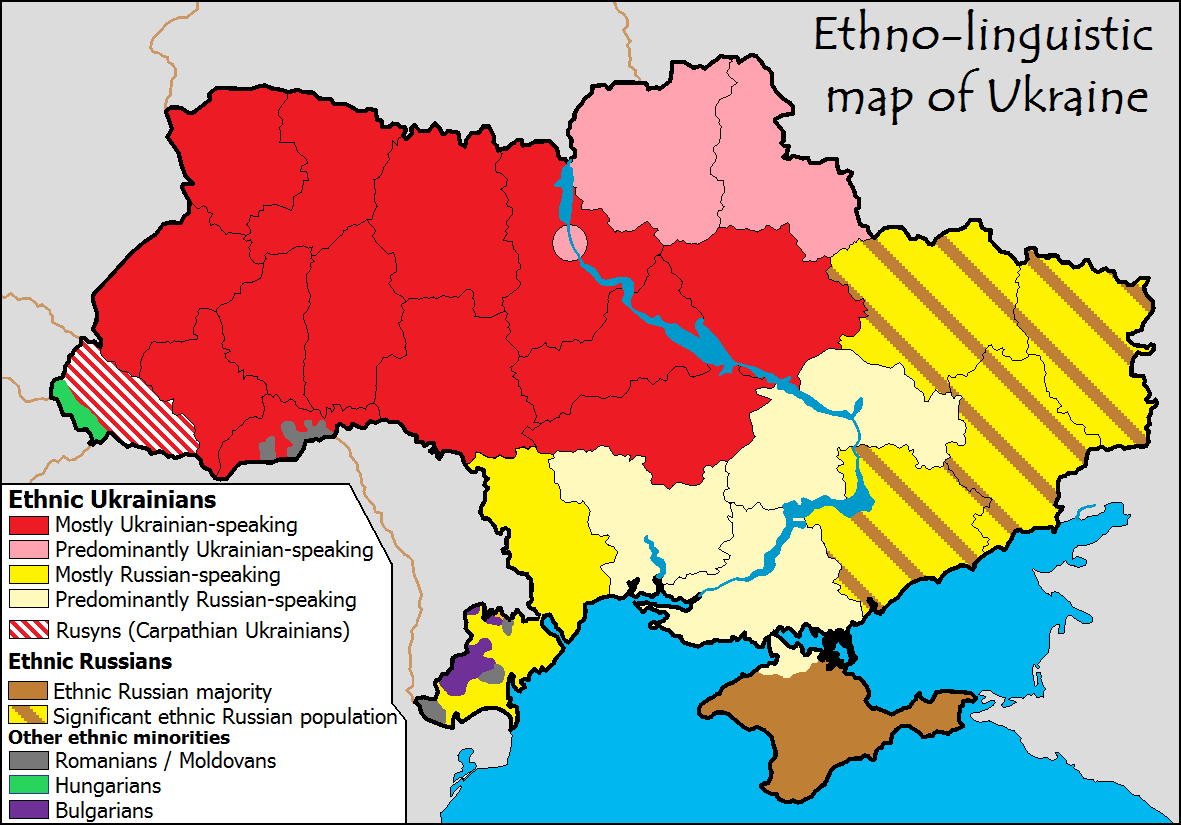
This map of the Ukraine on the Black Sea shows the divergent languages spoken and cultural divisions in the sub-regions of the country.
How do agricultural practices and agrarian patterns of settlements influence behavior as economic conditions change?
Ecological elements:
- climate,
- vegetation,
- domestic crops & animals,
- disease,
- settlements and
- place.
historian's legacy | terms to know | Ethnicity | places | Humboldt's gift | his words | Crosby's quest
Humboldt wished to study places and determine the underlying scientific universality often hidden by divergent appearances.
Alexander von Humboldt was born in Berlin, Germany in 1769. His father, who was an army officer, died when he was nine years old so he and his older brother Wilhelm were raised by their cold and distant mother. Tutors provided their early education which was grounded in languages and mathematics.
Once he was old enough, Alexander began to study at the Freiberg Academy of Mines under the famous geologist A. G. Werner. Von Humboldt met George Forester, Captain James Cook's scientific illustrator from his second voyage, and they hiked around Europe.
In 1792, at the age of 22, von Humboldt began a job as a government mines inspector in Franco, Prussia. In 1799 he was off to South America, the Caribbean and Mexico, and the discoveries of a lifetime.
historian's legacy | terms to know | Ethnicity | places | Humboldt's gift | his words | Crosby's quest
Places exhibit peculiarities of geography, climate, characteristic species and a "genii loci" according to the Romans. This South American bear is but one example of how the wildlife of a place is determined by its ancestry.
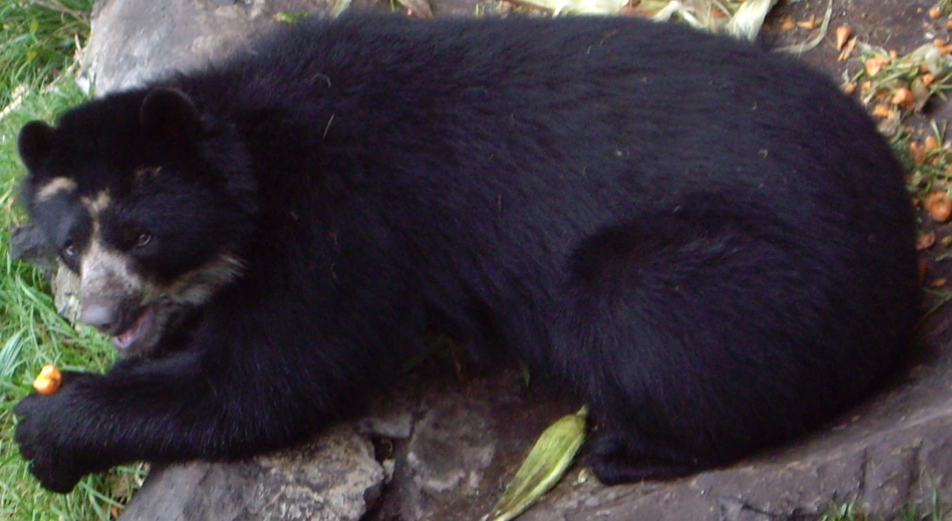
The South American bear in Ecuador, J. Siry , photograph 2007.
Photo Essay
“Discovery is a virtue”
by
Joseph Siry
On June 5, 1799, the 29-year-old Alexander von Humboldt embarked on a five-year research expedition to Spain’s South American colonial empire at that time, which now includes Venezuela, Cuba, Colombia, Ecuador, Peru and Mexico.
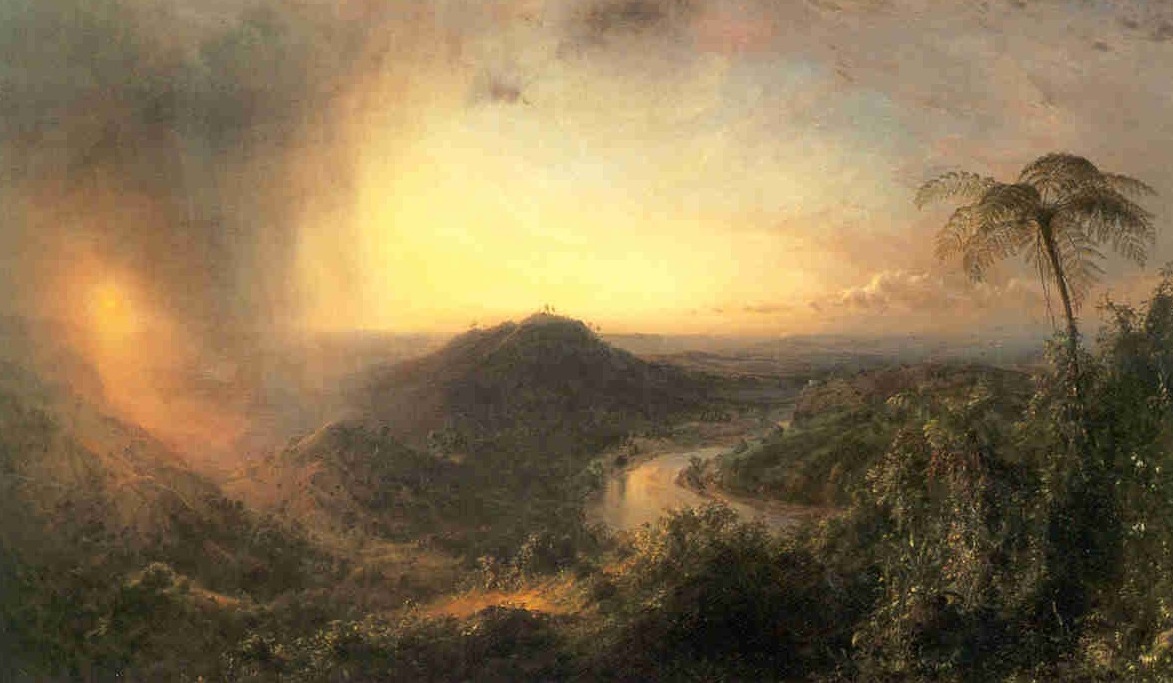
Never before was a research explorer away for so long at his own expense and without political backing. In the malaria-infested rain forest and in climbing active volcanoes, he placed himself in dangerous situations in order to arrive at new scientific findings.
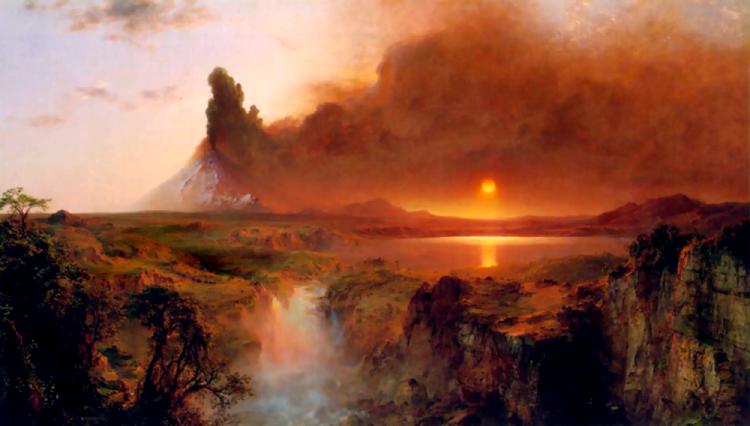
200 years after his departure on this journey, the mind of Alexander von Humboldt –who concerned himself throughout his life with topics we call today: ecology, human rights, the origin of rocks, and inquiries into the energy of life-- has shaped our minds because his five volume work, entitled Kosmos, was the most widely read scientific work in the 19th century consulted by Darwin, Marx, and Engels among others.
Because Humboldt's Kosmos was the most influential collection of ideas about the earth in the nineteenth century, he inspired generations of adventurous explorers to map the topographical and geographical features of of he world in a more coherent, systematic, and reliable way.
Alexander von Humboldt was a modern manager as well as a research explorer and innovative scientist. He provided fascinating insight into the structure of reality and provided those who did not perceive the world in the fractured specialties of individual sciences, a means to study and understand their surroundings as a fully integrated whole. By this fracturing of vision we mean that natural history was later (1880s) separated into distinctly separate studies of geology, botany, zoology, geophysics or geochemistry, and anthropology.
historian's legacy | terms to know | Ethnicity | places | Humboldt's gift | his words | Crosby's quest
Kosmos was published in 1845 and in that multi-volume work von Humboldt attempted to unify the various branches of scientific knowledge from astronomy to geology, geography, biology and anthropology in order to best describe the Earth in all its exquisitely diverse details.
He postponed until his seventy-sixth year, and then successfully executed, the crowning task of his life. Yet this was Humboldt's Cosmos, in five volumes.
The first two volumes of the Kosmos were published, and, in the main, composed, between the years 1845 and 1847. The idea of a work that should convey not only a graphic description, but an imaginative conception of the physical world. Humboldt was devoted to the continuation of his work, of which the third and fourth volumes were published in 1850-58, while a fragment of a fifth was to appear posthumously in 1862. In these volumes he sought to elaborate upon the individual branches of science broadly surveyed in the first volume.
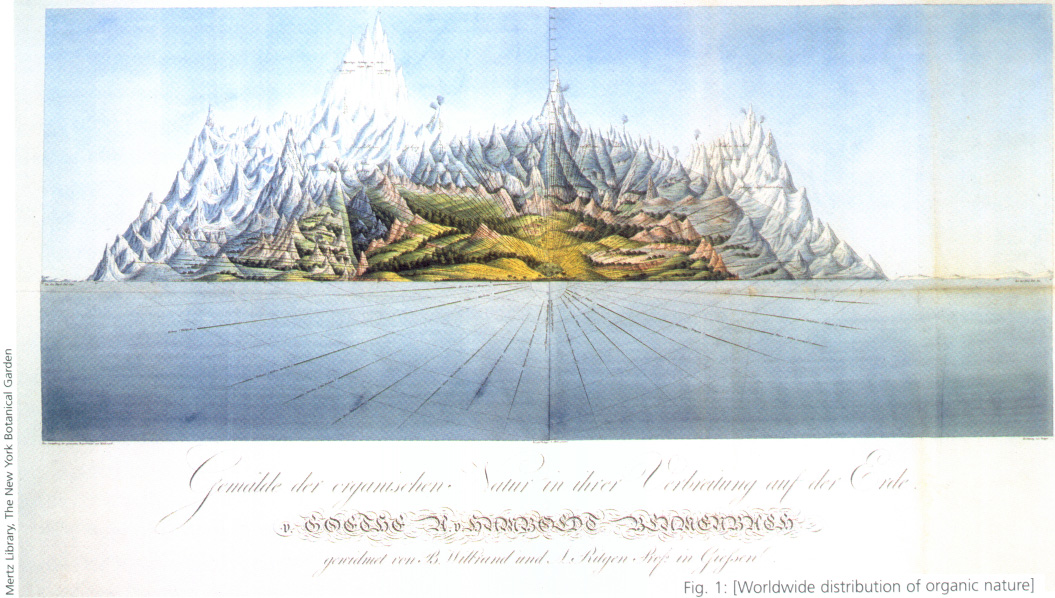
If all the features of the Earth were systematically drawn to their proportional expanse in relation to all other terrains, the world redrawn as a schematic graphic above would reveal the relative scale and size in terms of extent and preponderance of the terrains for each distinct plant and animal association with respect to their native geophysical conditions.
Note all of the high altitude life zones as opposed to more verdant lowlands and coastal regions.
Humboldt wrote:
"I will collect plants and fossils, be able to make astronomical observations with splendid instruments, and I will chemically dissect the air. But all of this is not the main purpose of my trip. My attention will be constantly directed towards the harmony that exists in the combination of all forces and the influence of non-living creations on the living plant and animal worlds!"
"Insight into the connection of phenomena as the aim of all natural investigation. Nature presents itself to meditative contemplation as a unity in diversity. Differences in the grades of enjoyment yielded by nature. Effect of contact with free nature; enjoyment derived from nature independently of a knowledge of the action of natural forces, or of the physiognomy and configuration of the surface, or of the character of vegetation. Reminiscences of the woody valleys of the Cordilleras and of the Peak of Teneriffe. Advantages of the mountainous region near the equator, where the multiplicity of natural impressions attains its maximum within the most circumscribed limits, and where it is permitted to man simultaneously to behold all the stars of the firmament and all the forms of vegetation."
Cosmos, I, p. 23-33.
Alexander von Humboldt
historian's legacy | terms to know | Ethnicity | places | Humboldt's gift | his words | Crosby's quest
Octavio Paz | Sydney Mintz | Alfred Crosby | Jamaica Kincaid
J. Siry,

Date: 9 February 2008