 Knowing
our nature
Knowing
our nature
Genome's Importance
Book | What's a genome? | significant aspects | components | Revolutionary | Misunderstood | Conclusion | Terminology

There exist 23 chromosomes in humans: 1, 2 , 3, 4, 5 ,6 , 7, 8, 9, 10, 11, 13, 14, 15, 17, 19, 21, 22, 23.
I. Size matters
BPS is base pair sequences there are 3 billion of them in the human genome containing 35,000 genes
DNA
is arranged in base pair sequences;
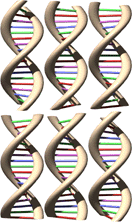
A cartoon of a strand of DNA.
Scientists publish maps of genomes, 2014.
A genome is a prime example of a word coined in the 1920s that has persisted as remarkable discoveries added to the complexity of the term which means the entire hereditary material on all the chromosomes of an organism where genes [that is coding sections of DNA] are found with non-coding strands of DNA.
Ridley's Preface is a primer where genes are defined as stories, exons, introns & junk DNA, RNA varieties, etc.
- Chromosomes are the places where genes reside.
- Genes are various lengths of base pair sequences
- Genes embody clues to our past.
- They comprise the inverse, interior universe.
- In every one of our cells except for red blood cells the ancestry of of life today is decipherable in a binary code.
- Genes are related to the revolutionary discovery of the structure and function of RNA and DNA
- Secret of Life, James Watson; the "double helix"
- A far more complicated picture emerges from understanding that genes are not what they appear to be:
- Lewontin, The Triple Helix
- Keller, The Century of the Gene
- Immunity and resistance to disease
- Margulis and the Origins of Eukaryotic cells
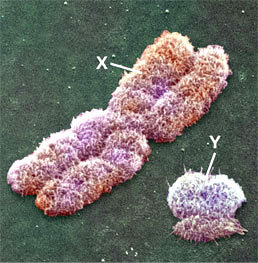
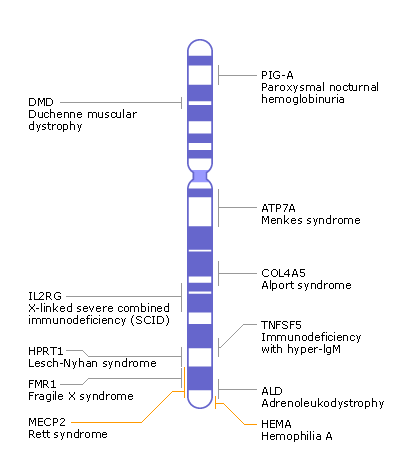
- The secrets of the X chromosome in humans
The genome as a book
of recipes for making and maintaining humans and even more!
Genome: The Autobiography of a Species in 23 Chapters
Chromosome & Chapter focus details Research
1 Life what is it? DNA, RNA information & Turing and code breaking, digital data, proteins.
A=T G=C (1-4, 3-2) digital code is two dimensionalUnity of life
Chromosome 1 is the largest human chromosome and comprises approximately 300Mb of DNA (approximately 10% of the human genome). Our aim, in close collaboration with the chromosome 1 community, is to construct a comprehensive map of human chromosome 1, including all genes and other biologically important sequences, up to the level of the DNA sequence itself.
http://www.sanger.ac.uk/HGP/Chr1/
2 Species what are they? 300,000 generations ago Humans split from ancestral line to apes, with whom we share 98% of our genes: 3 billion bps
3 History what is a gene?Mendel to Crick, Alkaptonuria, T-RNA, H-Dioxygenase VHL
0ne or two bps are different, either 690, or 901 sequence is altered! tumor suppresser1, 2 , 3, 4, 5 ,6 , 7, 8, 9, 10, 11, 13, 14, 15, 17, 19, 21, 23.
4 Fate 1 to 1 relation genotype, CAG repeat sequences & Huntington’s Chorea,
5 Environment asthma -- ADRB2; space #46 = bronchial constriction, pleiotrophy,
1239 bps long gene"indeterminacy" means we can not know with great certainty
p. 75.
1, 2 , 3, 4, 5 ,6 , 7, 8, 9, 10, 11, 13, 14, 15, 17, 19, 21, 23.
6 Intelligence IQ fallacies, IGF2R, Martin Gardner, & MHC gene, non determinative
analytic - creative - rational (Sternberg)Chromosome 6 is a submetacentric chromosome that constitutes about 6% of the human genome. The finished sequence comprises 166,880,988 base pairs, representing the largest chromosome sequenced so far.
The entire sequence has been subjected to high-quality manual annotation, resulting in the evidence-supported identification of 1,557 genes and 633 pseudogenes. The Nature paper reports that at least 96% of the protein-coding genes have been identified, as assessed by multi-species comparative sequence analysis, and provides evidence for the presence of further, otherwise unsupported exons/genes. Among these are genes directly implicated in cancer, schizophrenia, auto immunity and many other diseases. Chromosome 6 harbors the largest transfer RNA gene cluster in the genome; we have shown that this cluster co-localizes with a region of high transcriptional activity. Within the essential immune loci of the major histocompatibility complex, we found HLA-B to be the most polymorphic gene on chromosome 6 and in the human genome.
http://www.sanger.ac.uk/HGP/Chr6/
1, 2 , 3, 4, 5 ,6 , 7, 8, 9, 10, 11, 13, 14, 15, 17, 19, 21, 23.
7 Instinct how we survive, language predisposition, Chomsky,William's syndrome, caused by a change in a gene on Chromosome 11, children with it are loquacious, but not endowed with bright intelligence, they are addicted to spoken language, without reason.
SLI & fetal lesions Cystic Fibrosis
1,150 genesGenes certainly shape anatomy, but do they shape behavior?
p. 91.
"Instinctive tendency to acquire an art"
p. 93.
x & y sexual predation DAX & SRY combative,
Xq28 fallacy & birth order gene conversion
Conflict between male y and female x chromosomes
palindromes
The human X chromosome has a unique biology that was shaped by its evolution as the sex chromosome shared by males and females.
Together with colleagues in the USA and Germany, we have determined 99.3% of the euchromatic sequence of the X chromosome. Our analysis illustrates the autosomal origin of the mammalian sex chromosomes, the stepwise process that led to the progressive loss of recombination between X and Y, and the extent of subsequent degradation of the Y chromosome.
LINE1 repeat elements cover one-third of the X chromosome, with a distribution that is consistent with their proposed role as way stations in the process of X-chromosome inactivation. We found 1,098 genes in the sequence, of which 99 encode proteins expressed in testis and in various tumor types. A disproportionately high number of Mendelian diseases are documented for the X chromosome. Of this number, 168 have been explained by mutations in 113 X-linked genes, which in many cases were characterized with the aid of the DNA sequence. [17th March 2005]
http://www.nature.com/cgi-taf/DynaPage.taf?file=/nature/journal/v434/n7031/abs/nature03440_fs.html
1, 2 , 3, 4, 5 ,6 , 7, 8, 9, 10, 11, 13, 14, 15, 17, 19, 21, 23.
8 Self-Interest genes are far too complicated. retrovirus, ALU-280, Hervs, retinoblastomatransposons --jumping genes-- "first discovered in the 1940s, by the far-sighted and much neglected geneticist Barbara McKlintock"... who discovered jumping genes..."explained by mutations jumping into and out of pigment genes."
pp. 128-129.
1/700 human mutations is attributable to parasitic or jumping DNA
p. 129.
"The P element is a piece of selfish DNA that shows its presence by disrupting the genes into which it jumps."
p. 129.
jumping genes dampened by cytosine methylation (represses expression)
"hypervariable minisattelites" are "found on all chromosomes, it crops up at more than one thousand locations in the genome ....about twenty letters long, repeated over and over again many times.
p. 131.
Sperm competition distorts expectations.
"Cuckoldry and infidelity are much, much commoner than anybody expected."
p. 135.
1, 2 , 3, 4, 5 ,6 , 7, 8, 9, 10, 11, 13, 14, 15, 17, 19, 21, 23.
9 Disease genotype & phenotypic expression, junk DNA, blood groups, 1062 BPS
parasites cause changes in the genome, cycled cell anemia, choleraChromosome 9 is highly structurally polymorphic. It contains the largest autosomal block of heterochromatin, which is heteromorphic in 6-8% of humans, whereas pericentric inversions occur in more than 1% of the population.
The finished euchromatic sequence of chromosome 9 comprises 109,044,351 base pairs and represents >99.6% of the region. Analysis of the sequence reveals many intra- and interchromosomal duplications, including segmental duplications adjacent to both the centromere and the large heterochromatic block.
We have annotated 1,149 genes, including genes implicated in male-to-female sex reversal, cancer and neurodegenerative disease, and 426 pseudogenes. The chromosome contains the largest interferon gene cluster in the human genome. There is also a region of exceptionally high gene and G + C content including genes paralogous to those in the major histocompatibility complex. We have also detected recently duplicated genes that exhibit different rates of sequence divergence, presumably reflecting natural selection.
http://www.sanger.ac.uk/HGP/Chr9/
10 Stress triadic relation: mind- body-genes, past plagues, immune suppression--
CYP17 = protein changes cholesterol to cortisol, testosterone & estradiol.The finished sequence of human chromosome 10 comprises a total of 131,666,441 base pairs. It represents 99.4% of the euchromatic DNA and includes one megabase of heterochromatic sequence within the pericentromeric region of the short and long arm of the chromosome.
Sequence annotation revealed 1,357 genes, of which 816 are protein coding, and 430 are pseudogenes. We observed widespread occurrence of overlapping coding genes (either strand) and identified 67 antisense transcripts. Our analysis suggests that both inter- and intrachromosomal segmental duplications have impacted on the gene count on chromosome 10. Multispecies comparative analysis indicated that we can readily annotate the protein-coding genes with current resources. We estimate that over 95% of all coding exons were identified in this study. Assessment of single base changes between the human chromosome 10 and chimpanzee sequence revealed nonsense mutations in only 21 coding genes with respect to the human sequence.
http://www.sanger.ac.uk/HGP/Chr10/
1, 2 , 3, 4, 5 ,6 , 7, 8, 9, 10, 11, 13, 14, 15, 17, 19, 21, 23.
11 Personality phenotypic variety; D4DR gene =dopamine receptors, AT Gene
serotonin is a neurotransmitter and the key to nervous system response.D4DR "recipe for a protein called a dopamine receptor and it is switched on in cells of certain parts of the brain but not in others."
"Dopamine is a neurotransmitter released from the tips of other neurons by an electrical signal."
"A synapse in a brain is an electrical switch embedded in a chemical reactor of great sensitivity."
Dopamine
- controls blood flow to the brain
- motivates brain responsiveness to stimulus
p. 162.
Long D4DR suppress / Short D4DR activates dopa receptors.
- Long D4DR, low responsiveness to dopamine, so seek "kicks"
- Short D4DR, highly reactive, high responsiveness, seek simplicity.
p. 163.
"Quite the reverse: your brain chemistry is determined by the social signals to which you are exposed. Biology determines behavior, yet is determined by society."
p. 171.
1, 2 , 3, 4, 5 ,6 , 7, 8, 9, 10, 11, 13, 14, 15, 17, 19, 21, 23.
12 Self-Assembly -- development"Something somewhere must be imposing a pattern of increasing detail upon the egg as it grows and develops."
p.174.
homeotic genes control where in the body that cells end up
p. 175.
"The developmental genes seemed...to act hierarchically, parceling up the embryo into smaller and smaller sections to create ever more detail."
p. 176.
HOX sequence & homeotic genes are comprised of eight genes lying together on the same chromosome "genes which became known as Hox genes." "they were lined up in the same order as the part of the fly they affected."
Hox gene sequence on Chromosome 12:
- 1 = affected the mouth
- 2 = affected the face
- 3 = affected the top of the head
- 4 = affected the neck
- 5 = affected the thorax
- 6 = affected the front half of the abdomen
- 7 = affected the rear of the abdomen
- 8 = affected the other various abdominal parts
"they were all laid out in order along the chromosome -- without exception."
pp. 174-175.
how random the order of genes usually is
"A second surprise was in store. In 1983 a group of scientists ...discovered something common to all these homeotic genes. They all had the same 'paragraph' of text, 180 'letters' long within the gene -- known as the homeobox."
"the homeobox is the bit by which the protein made by the gene attaches to a strand of DNA to switch on or off another gene."
"All homeotic genes are genes for switching other genes on or off."
p. 177.
"At he level of embryology we are glorified flies."
Cluster C on Chromosome 12 in humans is identical to the Hox gene sequence on mice.
"The evolutionary implication is that we are descended from a common ancestor with flies which used the same way of defining the pattern of the embryo more than 530 million years ago, and that mechanism was so good that all this dead creatures dead descendants have hung on to it."
even sea urchins have Hox sequence genes.
p. 178.
timers
BMP4 -dorsalizes inverts but ventralizes vertebrates!
Chordin -gastrulation ventralizes inverts but dorsalizes vertebrates!1, 2 , 3, 4, 5 ,6 , 7, 8, 9, 10, 11, 13, 14, 15, 17, 19, 21, 23.
13 Pre-History human descent, migration race & Y chromosomal variation of traits
language groups & genes: Nostradic, NaDene, Basque-Tuscan, UralicChromosome 13 is the largest human acrocentric chromosome. The short arm of the chromosome is heterochromatic and is homologous to the short arms of chromosomes 14, 15, 21 and 22.
The sequence of the euchromatic, long arm of the chromosome was determined at the Sanger Institute and covers 95,567,076 base pairs. The analysis of the sequence, reported in Nature, identifies 633 gene structures and 296 pseudo genes, which means that chromosome 13 has the lowest gene density of the autosomes analyzed to date. The genes present include ones linked to various cancers (BRCA2, RB1) and to schizophrenia.
105 putative non-coding RNA genes have also been identified, including 9 microRNAs. Multi-species sequence comparison indicates that over 95% of protein coding genes on the chromosome have been identified. This analysis also reveals 112 non-exonic conserved regions, some of which could be regulatory or structural elements.
http://www.sanger.ac.uk/HGP/Chr13/
1, 2 , 3, 4, 5 ,6 , 7, 8, 9, 10, 11, 13, 14, 15, 17, 19, 21, 23.
14 Immortality why cells die -- telomerase, 7000 genes for aging, 10% genome
15 Sex combat & “y” chromatids; X feeds brain, Y’ makes placenta, 3 outcomes
16 Memory long Vs short, AMP, CREB, hippocampus, pyramidal bodies, a-integrins1, 2 , 3, 4, 5 ,6 , 7, 8, 9, 10, 11, 13, 14, 15, 17, 19, 21, 23.
17 Death cells commanded to die by gen-editors, TP-53 guardian gene, cancertelomeres, telomerase and the ever lengthening chromatids
18 Cures DCC gene suppresses Colon cancer, disease engendering genes1, 2 , 3, 4, 5 ,6 , 7, 8, 9, 10, 11, 13, 14, 15, 17, 19, 21, 23.
On chromosome 19 is the APOE gene and it is 897 Bases or base pair sequences [BPS] long. Because it is found in 3 kinds or variations of the genotype, it plays a role in making cholesterol, it can be used in testing, in addition to causing Alzheimer's syndrome because it is responsible for the formation of plaques or the prevention of plaque forming on the nerve's myelin sheaths.
20 Politics PRP & proteanase resistant protein = prions & folding mad cows, CJD.
Chromosome 20 is metacentric and has an estimated size of 63.7 Mb (NCBI build 34). We completed 99.4% of the sequence of the euchromatic part of the short (p) and long (q) arm of the chromosome in 6 contigs (59,187,298 bp). An additional 234,339 bp of sequence has been determined within the pericentromeric region of the long arm.
The finished sequence of human chromosome 20 comprises 59,187,298 base pairs (bp) and represents 99.4% of the euchromatic DNA.
A single contig of 26 megabases (Mb) spans the entire short arm, and five contigs separated by gaps totaling 320 kb span the long arm of this metacentric chromosome. An additional 234,339 bp of sequence has been determined within the pericentromeric region of the long arm. We annotated 727 genes and 168 pseudo genes in the sequence. About 64% of these genes have a 5' and a 3' untranslated region and a complete open reading frame. Comparative analysis of the sequence of chromosome 20 to whole-genome shotgun-sequence data of two other vertebrates, the mouse, Mus musculus, and the puffer fish Tetraodon nigroviridis, provides an independent measure of the efficiency of gene annotation, and indicates that this analysis may account for more than 95% of all coding exons and almost all genes.
Nature 414, pp. 865 - 871 (20 December 2001); doi:10.1038/414865a
21 Eugenics Galton & Haldane-Holmes & Churchill traditions,Questions with respect to the health of children. Who chooses the gender in transgender births, the attending physician, the obstetric MD, or the Mom, or parents if they are known?
22 Free Will individual capacity to compensate for phenotype, Hume’s fork, flexibility
larger font # sequenced alreadyChromosome 22 is the second smallest of the human autosomes. The short arm (22p) contains a series of tandem repeat structures including the array of genes that encode the structural RNAs of the ribosomes, and is highly similar to the short arms of chromosomes 13, 14, 15 and 21.
The long arm (22q) is the portion of human chromosome 22 that contains the protein coding genes and this is the region that has now been sequenced. The completed sequence consisted of 12 contiguous segments covering 33.4 million bps separated by 11 gaps of known size. One of these gaps has subsequently been closed by the Oklahoma group. The sequence is estimated to cover 97% of 22q, and is complete to the limits of currently available reagents and methodologies. The largest contiguous contig is >23 million bps, and at that time, this was the largest piece of continuous sequence determined.
Nature 402, 489 - 495 (02 December 1999); doi:10.1038/990031
23 Conflict the roles of X & Y Chromosomes
The X chromosome carries some genes for which the "Y" chromosome match in males lacks an allele or a means of suppression.
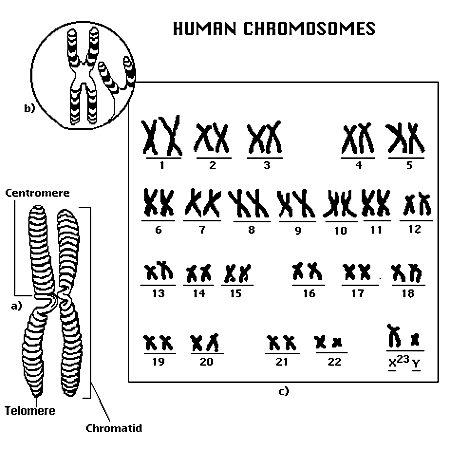
There exist 23 pairs of chromosomes in humans: 1, 2 , 3, 4, 5 ,6 , 7, 8, 9, 10, 11, 13, 14, 15, 17, 19, 21, 23.
Matt Ridley, Genome:Autobiography of a Species, (New York: Harper, 1999).
II. Revolutionizing our view of nature
DNA a double helix or a braided sequencing of base pairs molecules of instructions on how to live
base pair Adenine to Thymine Guanine to Cytosine 3 = Amino acid
codon a section of instructive base pair sequences instructing RNA to make a protein from amino acids
gene locus or loci of information (codons) along the helix recipes for proteins or RNA sequences traits
chromosome long dark staining bodies paired in cells that are double helixes polypeptide tightly wound up cords
III. So dangerously misunderstood
There is no one to one relation of genes to traits as there is with genes and some diseases.
genotype: is very implicated in evolution and disease
phenotype is so crucially implicated in Eugenics movements
triple helix is so important to understanding buffer's role in ecology
"The Unseen Genome: Beyond DNA," genetic vs. epigenetic considerations
Genes are a capability, they embody a potential, the both call forth a response and are responsive to the world the organisms encounter.
They are shaped by the conditions they experienced in the past and yet also shape the life they enable to adapt to changing conditions.
So that with respect to genetic engineering, the means to know nature's secrets, and what we do with this body of knowledge are changing the way we understand our place ion nature. Our discoveries will alter our identity, our social order, and our environment.
- Human Genome Project is the ongoing, two decade old effort to identify, map and describe the location of all the genes in the human cell nuclei.
So deoxyribonucleic acid is code (Phenotype) as:
DNA -it is an- inheritable molecule having four distinct nitrogen bases:

- A, is for Adenine
- T, is for Thymine
- C, is for Cytosine
- G, is for Guanine
Bases always pair:
Where "=" means or stand for: binds to, or links with.
A=T
C=G
In binary code, it is as if the A could be distinguished as 00, the C as 01 and the rule established that zeros, 0 matches to ones, 1 and thus:
00 = 11
01 = 10
1, 2 , 3, 4, 5 ,6 , 7, 8, 9, 10, 11, 13, 14, 15, 17, 19, 21, 22, 23.
In RNA, ribonucleic acid, U, is for Uracil and it replaces C.
RNA may be older in derivation than is DNA. RNA is both the editor, interpreter, repair mechanism and transfer agent of DNA from the cell nucleus to the cytoplasm where the hard work of life is performed.
RNA suggests that the genome is more a script, than it is a dictionary, or book.
Any genome is more than a mere script that tells life how to survive, find cover, seek nourishment, reproduce and otherwise exploit the available niche created by other organism's genomes. In some sense it is an archive of maps, clocks, switches and protein creating instructions that can be brought to bear under shifting circumstances and unforeseen conditions.
1, 2 , 3, 4, 5 ,6 , 7, 8, 9, 10, 11, 13, 14, 15, 17, 19, 21, 22, 23.
Book | What's a genome? | significant aspects | components | Revolutionary | Misunderstood | Conclusion | Terminology
Matt Ridley. Genome: The Autobiography of a Species in 23 Chapters. (New York: Harper-Collins1999).
Darwin | | Keller | | Lewontin | | Margulis | | Mayr | | Tattersall | | Thomas
Genetics Index | What makes genetics significant? | History of Genetics | DNA discovery | RNA | Resistance| Visual images
Genetics | Science Index | Sites & places | Analysis | Population Index | Global Warming Index | Nature Index | Brief