 Analysis
.gif)


Ernst Mayr
One Long Argument:
Charles Darwin and the Genesis of Modern Evolutionary Thought.
(1991) Cambridge: Harvard University Press.
"The worldview formed by any thinking person in the Western world after 1859, when the On the Origin of Species was published was by necessity quite different from a worldview formed prior to 1859."
1991, p. 1.
"Evolutionary theory" Mayr says, "is a fact so overwhelmingly established that it has become irrational to call it a theory."
Loading

Four reasons for Darwin's importance.
"the causes of evolution were a complete mystery to him."
These notes are a critical interpretation of Mayr's assessment of at Darwin & the book: On the Origin of Species, 1859.
Darwinism | tree metaphor | natural selection | modern synthesis | worldview | causes | terms | thesis | precursors

What he did do:
"The intellectual revolution generated by Darwin went far beyond the confines of biology, causing the overthrow of some of the most basic belief of his age."
p. 1.
"seriously undermined by Darwin's demonstration that evolution brings about change and adaptation, but it does not necessarily lead to progress, and it never leads to perfection."
p. 2.
What he did not know:
"Therefore, genetic recombination, rather than mutation was seen as the immediate source of the genetic variation available for selection. The way selection acts in a population was understood much better when it was connected with these improvements of understanding."
p. 133.
"Darwinism...
we mean evolution by (means of) natural selection."
He had studied barnacles, flowers, earthworms, corals, & animal behavior;
"In all these areas Darwin was a pioneer."
p. 2.
Mayr's Argument | five theories | Biological ideas | Aristotle | on causes | Term
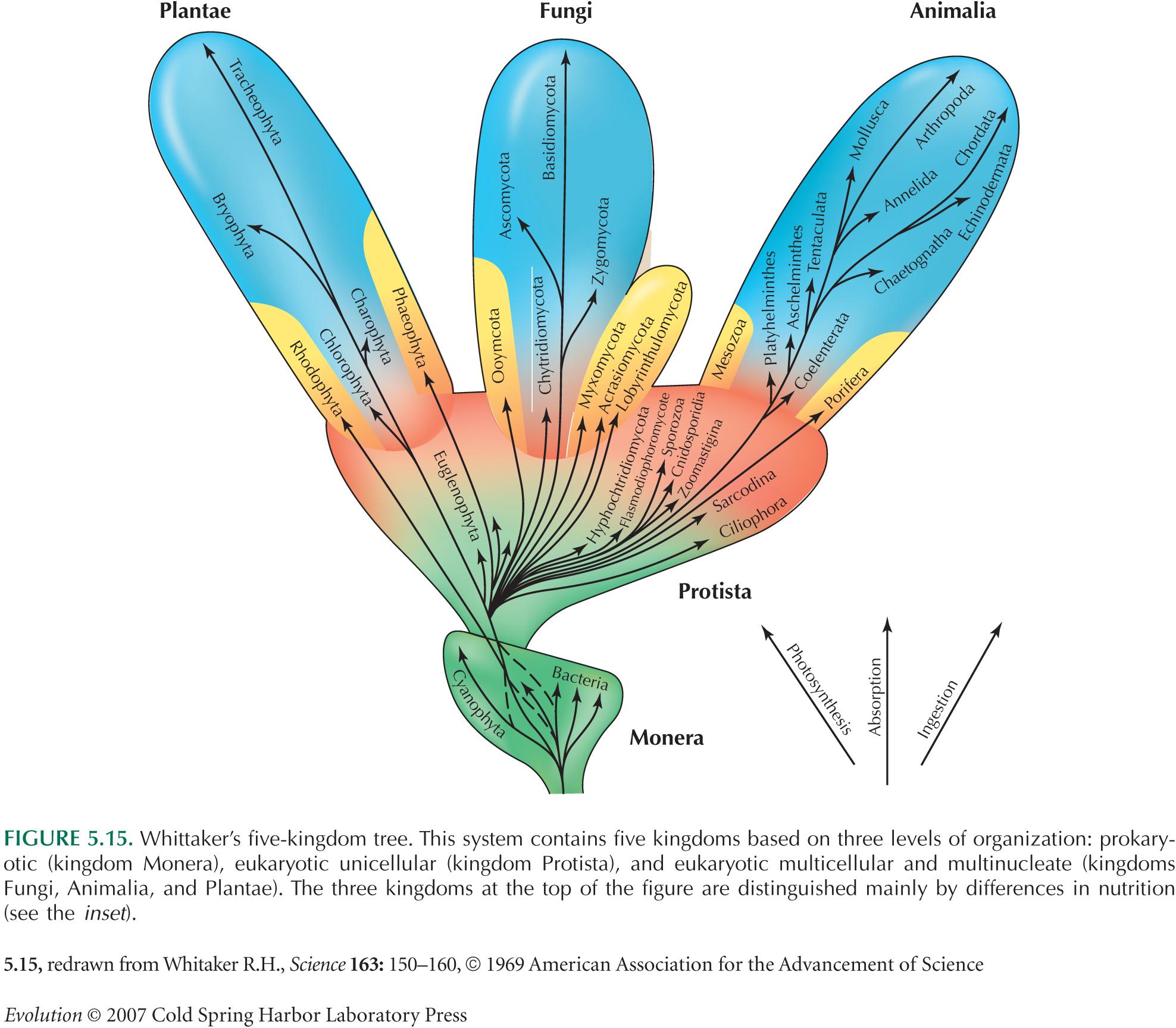
Darwin used the metaphor of the "tree of life".
He used the phrase to describe one way to visualize all living creatures today on earth as the descendents of an original pair of parents.
Survivors today or in the future are like new buds on the old branches of a tree, the trunk and limbs of which are hidden from our view. These limbs are hidden by time and our limited sensory experience. But we can imaginatively visualize how apes, primates, chimpanzees or elephants are all just different branches on the family tree of vertebrates. By extension plants, animals and fungus are all branches on the same family tree of bacteria, who first brought forth life on this planet and --due to their metabolism-- sustain life today.
On the Origin of Species, notes.
Mayr's Argument | five theories | Biological ideas | Aristotle | on causes | Term
Last of five theories put forth by Darwin is natural selection
One Long Argument, pp. 36-37.
1. a dynamic (not static or steady) world based on "evolution" and
2. common descent from the same ancestor
3. multiplication of species -- adaptive radiation (finches, tortoises,pines)
4. gradualism
5. natural selection -- abundant genetic variation every generation; limited survivalThat natural selection "it is actually itself a small package of theories."
- 5.1, perpetual existence of reproductive surplus
- 5.2, the continuing availability of great genetic variability
- 5.3, the heritability of individual differences
- 5.4, mere reproductive superiority is selected for (sexual selection)
p. 68.
"mechanism of adaptive change"
"harmony and adaptability of the organic world"Argument, page 68.
"no one clearly perceived the great check amongst men."
page 75.
"Darwin stressed that it was Malthus's demonstration of the exponential increase in populations that was so decisive in his discovery of the importance of natural selection."
page 75.
√ the unbelievable fertility of protozoans (small single-celled animals).
√ population thinking had begun to mature in Darwin's mind."
page 76.
Is evolution by means of natural selection "an essentially mechanical explanation." ?
One step vs. two-step process: first, all creatures have a rather huge to incredibly prolific reproductive capacities; this creates variability. Second, not all offspring can possibly thrive equally well, due to:
- rivals
- scarcity
- intelligence
- courtship rituals
- adaptive behavior
- competition from other species (inter specific)
- fortune
Darwinism | tree metaphor | natural selection | modern synthesis | worldview | causes | terms | thesis | precursors
Darwin's idea modern biological synthesis:
1) individuals convey variation +
2) reproductive success +
3) selection from among the survivors of an abundant number of different offspring.
Hence, not all variants are "hardy" in that they reproduce.page 69.
Darwin made an analogy from wild creatures to animal and plant breeders:
artificial selection to natural selection
What humans select to what humans do not select"breeding pairs" are selected vs. differential survival
There is no definitive answer to whether or not Darwin was externally influenced by his times (zeitgeist) and what he read, or was he influenced internally by his method of evaluating evidence he collected by contrasting and comparing his findings with practitioners and writers.
page 69.
Darwinism | tree metaphor | natural selection | modern synthesis | worldview | causes | terms | thesis | precursors
July, 1837, in Darwin's worldview nature and human order were altered:
Static forms become seen as dynamic processes
After 1833-36 voyage he was, with some help of ornithologist John Gould in 1837, a determined "evolutionist" . . . . What this meant was he had altered the status of human beings in the worldview of creation, natural history and biological thought.

- By this idea humans were correctly placed "into the stream of animal evolution." random (stochastic) variation replaced Newtonian formulas
- certainty was eclipsed by random chance: "law of the higgledy-piggledy"
"Yet, the causes of evolution were a complete mystery to him"
Mayr writes on page 70.
Darwinism | tree metaphor | natural selection | modern synthesis | worldview | causes | terms | thesis | precursors
Aristotle had argued there were four causes:
1. Material forces or a dialectic account for changes we see.
2. Proximate the immediate reason something happens
3. Underlying belief that surface features are misleading
4. Teleological theory of purposefulness or the idea of an end cause
For the sake of reason, rhetoric, argumentation and proof, Aristotle is largely correct as far as the western approach to cause and effect is concerned.
Consider how we today might re-define the four causes:
• material -- genes from 23 female and 23 male chromosomes combine to form a human embryo
• proximate -- fertilization occurs when an egg is "compromised" by a sperm cell: fertilization
• underlying -- there are more offspring than there are opportunities for their successful survival
All of the above steps are actually rational equivalent explanations from an Aristotelian view.
• teleology -- the end or purpose to events; is merely random survival.
Teleological makes for a far different story about nature's purposes.
1. Mayr argues that Darwin is not teleological, (doctrine of end causes), but is this what other's say?
2. Consider egg + sperm = fertilized cell or ZYGOTE, then blastula, gastrula, embryo, fetus, birth.
The zygote's end purpose is to create an adult organism.
Mayr's Argument | five theories | Biological ideas | Aristotle | his metaphor | Term
Garrett Hardin, Nature and Man's Fate
acquired traits -- characteristics that organisms learn from mimicry or culture that are hence "obtained" and are not genetically transferred.
asexual -- creatures (bacteria, yeast) that reproduce without resorting to fertilization.
chromosomes -- literally dark stained bodies -- places in cells where DNA is packed together.
genes -- metaphor -- stands for all the inherited material passed from parents to offspring
inheritance of acquired traits -- soft inheritance -- Lamarckism (coined the term "biosphere") believed in the ability of creatures to pass on traits.
micro-molecular -- compounds of atoms usually bound together by hydrogen, carbon and sulfur.
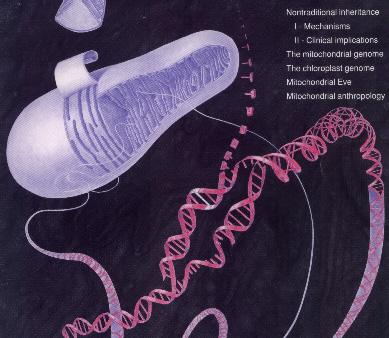
Mitochondria --organelles in eukaryotic cells that acquire their own DNA from female line -- power houses of the cell where ATP is burned to form ADP for energy.
natural selection -- the refutable law of variability and differential survival that has passed the test of experience over time and is hence irrefutable today concerning inheritable (hard inheritance) qualities in organisms that accounts for a differential rate of survival among offspring of the same generation who, for whatever reason, do not reproduce.
ribosomes -- organelles in eukaryotic cells where RNA and enzymes rearrange proteins.
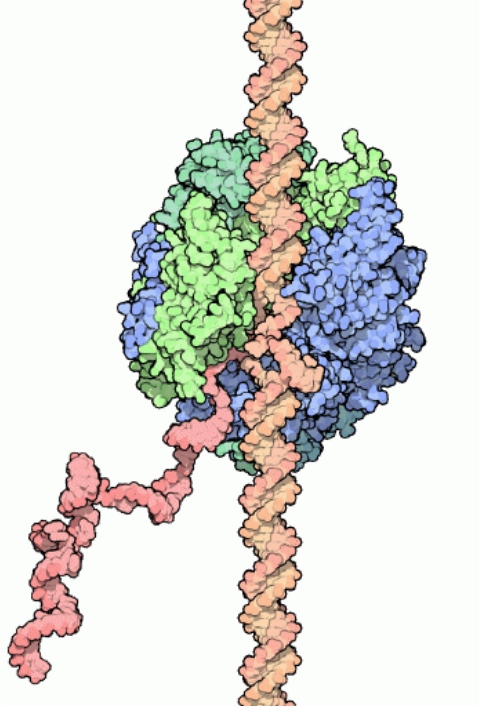
RNA - ribonucleic acid, plays many roles but one is to replicate the DNA code in cells.
sexual -- organisms that exchange genetic material by recombination to have offspring.
DNA - deoxyribonucleic acid, material of inheritance that has code to make proteins.
Literally the molecule that defines the genotype.
Darwinism | tree metaphor | natural selection | modern synthesis | worldview | causes | terms | thesis | precursors
Mayr's argument:
1. Darwin is inconsistent, largely because he had no awareness of Mendel's work on peas.2. The theory attributed to Darwin of evolution by means of natural selection was:
a. Neither the idea nor means were original with Darwin,
- b. Nor was this the whole interpretation of the story of nature, since there are five theoretical pieces to Darwin's conceptual contributions to biology.
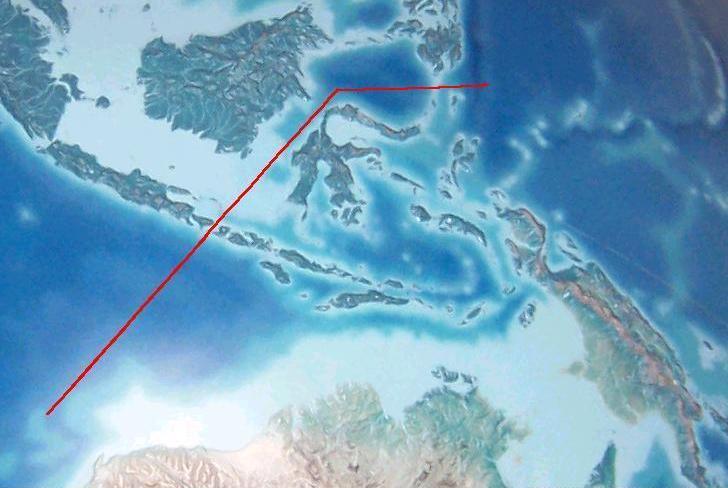
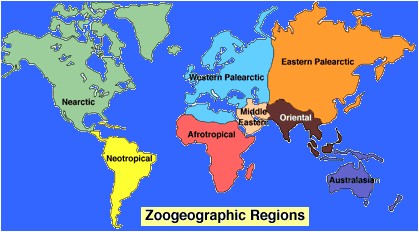
3. Darwin and Wallace saw in the diversity of life a common elemental unity at work, such as the separation of species along Wallace's line shown here:
Wallace's line in Indonesia separating two distinct populations of plants and animals from one another.
4. Darwin's power lies in not any one of the five insights, but in how he placed them together to powerfully reveal -- in a causal explanation -- the mechanism beneath life.
Mayr's Argument | five theories | Biological ideas | Aristotle | on causes | Term
Darwinism | tree metaphor | natural selection | modern synthesis | worldview | causes | terms | thesis | precursors
Homework:
List Mayr's five parts of Darwin's beliefs:
The five parts of Darwinian evolution.
| # | term; | meaning, | with an example: |
1. 2. 3. 4. 5. |
|||
| Summary |
Compare your response to two other peoples' when you come to class:
- Change partners and compare again looking for similar responses.
Your goal is to list all 5 without resorting to the book, you may use your notes!
What is meant by, and what is wrong with each set of concepts empirically speaking?
fixity of the species, or the unchanging quality of species (special creation)?
Balance of nature?Now look at Darwinism as a "worldview."
pp. 101-104.
Darwinism as the revolution in science Discuss the importance of Darwin's vision of life. Second half of Mayr's book: Darwinian Synthesis.
On the Origin of Species, "A Facsimile of the First Edition" with an introduction by Ernst Mayr. 1964.
What Evolution Is, by Ernst Mayr. 2002.
Population thinking explained by Mayr as a cause for variation seen in nature.
Darwinism | tree metaphor | natural selection | modern synthesis | worldview | causes | terms | thesis | precursors
Two less well known precursors of Darwin's On the Origin of Species.
1810-1859.
Patrick Matthew
1/1/1831
"There is a law universal in nature, tending to render every reproductive being the best possibly suited to its condition that it kind, or that organized matter, is susceptible of, which appears intended to model the physical and mental powers, to their highest perfection. . . ."Darwin acknowledges "he had anticipated by many years the explanation which I have offered of the origin of species, under the name of natural selection, . . ."
Edward Blyth
1810-1873
"May not, then, a large proportion of what are considered species have descended from a common parentage?"Blyth was a "stepping stone" since he thought natural selection would create a continuity or stasis of traits that otherwise conserve species not actually promoting a gradual change within the species.
Bases his conclusion on Loren Eisley*, who "has given Blyth greater credit for contributing to Darwin's views..." p. 131
"could natural law, which Darwin claimed natural selection to be, rest on variations that occurred by chance?"
Ronald W. Clark, The Survival of Charles Darwin, ( N. Y.: Random House, 1984 ), pp. 128-131.
* anthropologist and author of Charles Darwin & the Mysterious Mr. 'X'.
Ecology, & values of natural areas explained by Eugene Odum.
On the Origin of Species, notes on Charles Darwin's primary document.
What is a commensal comprehension of the biological world?
Lynn Margulis and the need to surpass our "trained incapacities."
What is symbiosis?
Darwinism | tree metaphor | natural selection | modern synthesis | worldview | causes | terms | thesis | precursors
Mayr | Thomas | Wilson | Hardin | Darwin | Margulis | Steingraber | Tattersall | Carr | Keller | Watson
Genetics Index | What makes genetics significant? | History of Genetics | DNA discovery | RNA | Resistance| Visual images

Genetics | Science Index | Social Analysis | Population Index | Global Warming Index | Nature Index | Brief